
A research team led by Professor Zhao Jiong from the Department of Applied Physics at The Hong Kong Polytechnic University has published groundbreaking work in Nature Materials, achieving simultaneous enhancement of strength and toughness in materials by twisting bilayer two-dimensional structures. This discovery offers a new approach for designing high-performance flexible electronic devices.
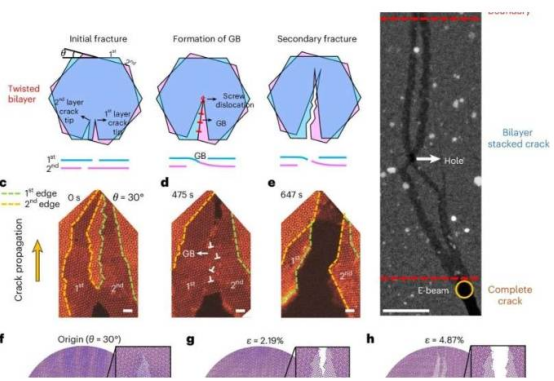
Using transition metal dichalcogenides such as molybdenum disulfide (MoS₂) and tungsten disulfide (WS₂) as model systems, the team found that when a specific twist angle exists between the two layers, crack propagation forms an interlocking pathway. Through in-situ transmission electron microscopy, they revealed for the first time a "crack self-healing" mechanism: after initial fracture, the crack edges in the upper and lower layers spontaneously form stable grain boundaries, effectively dispersing stress and preventing further crack growth. This process increases fracture energy dissipation by up to 300% without compromising the material's intrinsic electrical properties.
"This discovery breaks conventional fracture mechanics paradigms and provides a completely new framework for designing 2D materials that combine both high strength and toughness," said Professor Zhao Jiong. The study confirms that precise control of the twist angle (with 5°–15° identified as the optimal range) enables quantitative tuning of material toughness. This twist-engineering strategy avoids the electrical performance degradation typically caused by traditional defect-introduction methods, making it highly valuable for applications in flexible electronics and quantum devices.
The team is currently collaborating with industry to explore the technology's use in wearable devices and high-power electronics. The research also found that this self-healing mechanism is universal across multiple 2D material systems, paving the way for the development of next-generation smart materials.