
Researchers at the Niels Bohr Institute (NBI), University of Copenhagen, have developed a novel tunable quantum system that achieves sensing performance beyond the standard quantum limit by dynamically squeezing quantum noise. The breakthrough, published in Nature, provides a revolutionary tool for gravitational-wave detection, biomedical diagnostics, and quantum technology applications.
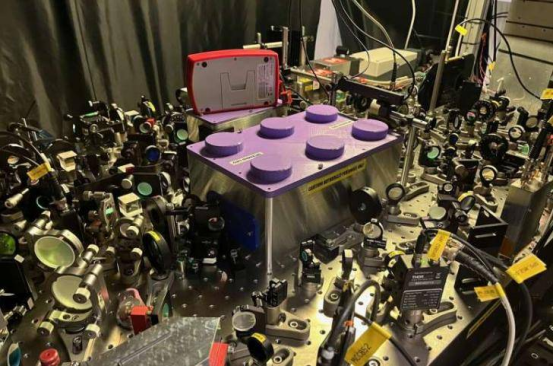
Conventional optical sensing is constrained by the standard quantum limit — the practical boundary imposed by measurement noise at the microscopic scale. The NBI team, for the first time, combined large-scale entanglement with multi-photon optical states and a macroscopic atomic spin ensemble to achieve frequency-dependent squeezing. This technique dynamically suppresses quantum noise across a broad bandwidth. The core innovation lies in using a "negative-mass" spin oscillator to flip the sign of the noise: when the sensor signal is combined with the spin-ensemble signal, back-action noise (interference from the measurement itself) and detection noise (uncertainty in reading the signal) are simultaneously suppressed. Project leader Professor Eugene Polzik explains: "The system interacts with both the sensor and the spin ensemble via two entangled light beams, merging the detection signals to achieve broadband sensitivity enhancement."
Compactness is a key advantage of the new system. Traditional gravitational-wave detectors rely on optical resonators hundreds of meters long to achieve noise squeezing, whereas the NBI approach delivers equivalent performance on a tabletop. For example, LIGO uses 300m cavities, and the planned European Einstein Telescope will extend to several kilometers, while this research opens the door to miniaturized devices. In biomedicine, the system can increase MRI resolution for earlier detection of neurological disorders or boost biosensor sensitivity to streamline diagnostic workflows. Its architecture also supports quantum repeaters and quantum memories, paving the way for secure long-distance communication and scalable quantum computing networks.
The achievement marks a major step from laboratory prototypes toward practical quantum sensing technology. The team is now investigating system stability under extreme conditions and plans to collaborate with European gravitational-wave projects to validate its potential for cosmological observations. Professor Polzik emphasized: "From sensing ripples in spacetime to decoding the signals of life, this technology is redefining the measurement frontier of the quantum era."