
Scientists at the Australian National University (ANU) have achieved a major breakthrough by developing a simple, cost-effective method that makes the extraction of valuable resources from brine deposits significantly more environmentally friendly. The findings have been published in Nature Water.
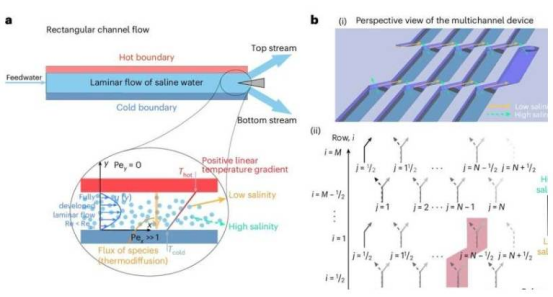
Brine mining is critical for lithium extraction, a key component in battery manufacturing, with a large share of global lithium production coming from continental brine deposits. In 2024, ANU researchers developed the world's first thermal desalination process that keeps water in the liquid phase throughout. Now, they have successfully applied the same principle to brine concentration.
This energy-saving technique is not driven by electricity but instead uses moderate heat generated directly by sunlight or waste heat from air conditioners and industrial processes. Associate Professor Juan Felipe Torres, a mechanical and environmental engineer and the lead researcher who first proposed the concept of thermal diffusion desalination, says the new study demonstrates that thermal diffusion technology has the potential to concentrate highly saline brines.
According to Assoc. Prof. Torres, while existing desalination and brine concentration technologies are mature, thermal diffusion offers a promising alternative. Current desalination methods rely on membrane filtration, which requires large amounts of electricity, expensive materials, and regular maintenance, whereas thermal diffusion has already proven successful in desalination while reducing energy costs and corrosion issues.
ANU researchers explain that all-liquid thermal diffusion brine concentration provides a new solution for material extraction across multiple industries, including brine mining. Assoc. Prof. Torres notes that the method can now control the salinity of concentrated brine solutions without evaporation, meaning valuable water is not wasted. "Our goal is to replace traditional evaporation ponds that have been used for thousands of years, reducing land and water use and minimizing environmental impact. For example, lithium can be extracted from brine for batteries, and in the future our method could enhance that process."
Dr. Shuqi Xu, an ANU researcher and co-author of the study, highlights the technology's key advantages: it requires no membranes and efficiently separates water from ions. Tests show the method can control brine concentration to produce salt without evaporation, and future improvements are expected to increase throughput and energy efficiency by at least 40 times.
ANU researchers are currently collaborating with the U.S.-based Wacomet Water Co. to commercialize the technology in Australia and overseas. Assoc. Prof. Torres and colleagues have co-founded the ANU spin-out company Soret Technologies. He says: "Our vision for Soret Technologies is to revolutionize brine concentration and desalination processes through innovative thermal diffusion technology, making them far more cost-effective."