
Researchers at the Australian National University (ANU) have developed a simple, cost-effective technology that could transform the way valuable resources like lithium are extracted from brine deposits. Details of the study were published in Nature Water.
Building on ANU's world-first thermal seawater desalination method introduced in 2024—which keeps water in liquid form throughout—the team discovered that using non-uniform heating and slowly varying salt concentrations increased collected liquid volume by nearly 40 times. Adding partial insulation significantly improved energy efficiency.
The researchers say the method offers a more environmentally friendly approach to brine mining, a critical process in global lithium production. Associate Professor and lead researcher Juan Felipe Torres stated: "Our thermal diffusion method has already been successfully used for seawater desalination while reducing energy costs and corrosion issues."
Seawater desalination is vital for addressing global freshwater shortages but faces challenges such as high energy consumption, environmental impact, and expensive materials. Traditional technologies fall into two categories: membrane-based systems like reverse osmosis (RO), which are efficient but costly to maintain and power-intensive, and energy-intensive thermal processes.
To overcome these issues, ANU researchers invented Thermal Diffusion Desalination (TDD), a revolutionary all-liquid, membrane-free method powered by mild heat. Compared to conventional techniques, TDD is easier to scale, prevents phase changes, and reduces corrosion.
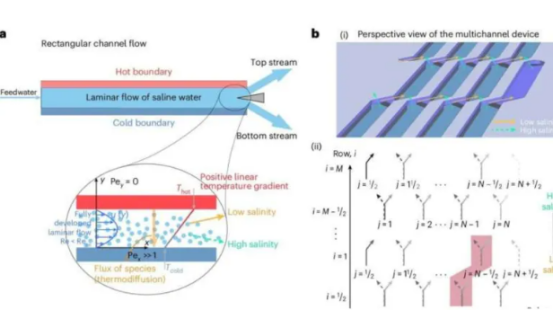
The new study demonstrates the potential of Liquid Buoyancy Cascades (LBC) to enhance TDD and Thermal Diffusion Salination (TDS) for both seawater desalination and brine concentration. The design integrates key elements such as flow-based partial separation, U-shaped conductive boundaries for optimized temperature distribution, target recovery rates, and insulation, dramatically improving performance.
The researchers believe the method can handle high-salinity brines common in seawater desalination and the oil & gas industry without membranes or hazardous chemicals. In this study, scientists tested LBC using real seawater from Australia's coast and found it significantly increased water recovery and successfully reduced salinity compared to previous single-channel devices, with results closely matching computer simulations.
The team experimented with multiple techniques to boost performance, including isolating system components, altering temperature distribution, adjusting flow conditions, and selecting optimal recovery rates. These modifications improved water yield and energy efficiency by approximately 40 times compared to the baseline design.
ANU researcher and co-author Dr. Shuqi Xu said: "Our study shows how the method can control brine concentration to produce salt without evaporation. Future improvements could increase flow rates and energy efficiency by at least 40 times."
Additionally, in January 2025, engineers from the University of Michigan and Rice University developed carbon cloth electrodes that effectively remove boron from seawater, providing a safer, non-corrosive solution for desalination.