
A commercial laser weeder is a large machine that travels between crop rows, takes photographs, uses a deep-learning computer program to analyze the images and precisely distinguish weeds from crops, and then fires lasers to kill the weeds. The machine's computer program can also help farmers prioritize which weeds to target—such as those close to crops or small plants that are hard to spot and remove—so the laser can hit them more accurately.
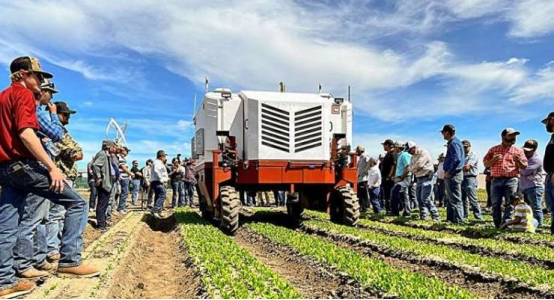
Previously, laser weeders were mainly used on the West Coast. Given differences in soil, crops, rainfall patterns, and weed populations on the East Coast, a new study tested their effectiveness there.
The results showed that in East Coast trials with peas, beets, and spinach, the laser weeder performed as well as common herbicides. Lynn Sosnoskie, assistant professor in the Horticulture Section of the School of Integrative Plant Science at Cornell University's College of Agriculture and Life Sciences and first author of the paper, said the study confirms laser weeders are equally effective on the East Coast. Co-author Thierry Besançon, plant biologist at Rutgers University, is the corresponding author. The research was published in Pest Management Science.
Carbon Robotics, based in Seattle, has sold around 100 laser weeders, each priced at up to $1.5 million, and their machines were used in this study. Sosnoskie noted that testing these machines is critical for growers, who bear the technological risk and significant investment—and the company could go out of business, so farmers need assurance. Currently, three onion farms in New York are using laser weeders.
Traditionally, farmers rely on expensive herbicides to control weeds, but these can damage crops and reduce yields. Both organic and conventional farmers may also hire workers for hand weeding, which is time-consuming and labor-intensive.
The study conducted three trials in New Jersey and New York on peas, spinach, and beets, with four treatments: control (weeds allowed to grow freely), application of common herbicides, laser weeding alone, and a combination of laser and herbicides. Researchers monitored crop emergence and development, as well as weed emergence, cover, density, and total biomass. During the study, laser weeding was performed two to three times, spaced about 10 days apart.
Results showed that laser weeding was as effective as or better than three common herbicides (metolachlor, bentazon, and phenmedipham) in controlling annual weeds. However, it worked well against weeds like lambsquarters and ragweed but was less effective on purslane and annual grasses because the laser targets plant growing points (meristems), and some weeds, like grasses, have underground growing points. The weeder was more effective on smaller weeds, requiring less energy.
The paper noted that compared to untreated controls, laser weeding reduced weed cover by 45%, weed density by 66%, and weed biomass by 97% by the end of the season. Additionally, the herbicides evaluated in the study delayed crop emergence or caused crop stunting, while laser weeding resulted in less than 1% crop stunting and a 30% increase in crop biomass.
Next steps include optimizing laser weeding for different environments and weed species and evaluating commercial units with improved lasers and faster processing speeds.