
Engineers at the University of Surrey have developed a new "cosmic veil" that protects perovskite solar cells in space, paving the way for lighter, cheaper, and more efficient solar power for satellites and spacecraft.
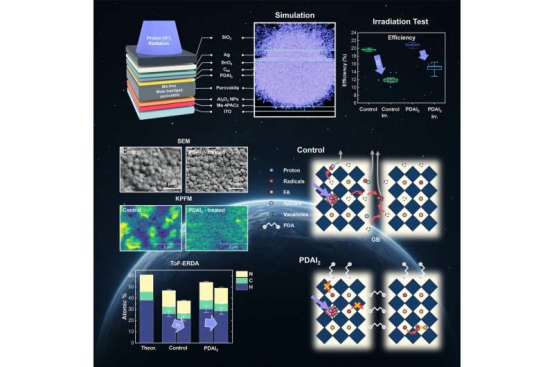
Perovskite solar cells are the next-generation lightweight, low-cost solar technology that is easier to manufacture and longer-lasting, but they are, however, easily damaged in the harsh space environment.
Researchers from the University of Surrey's Advanced Technology Institute collaborated with teams from the University of Oxford, UNSW Australia, Chungbuk National University, Gyeongsang National University, and the Korea Research Institute of Chemical Technology (KRICT) to create a thin protective coating using propane-1,3-diammonium iodide (PDAI₂). The results have been published in Joule.
Dr. Jae Sung Yun, Lecturer in Energy Technology at the University of Surrey and co-author of the study, said: "Perovskite solar cells hold tremendous promise for space applications, but the various radiation sources in our solar system – especially those that degrade the organic molecules needed for the cells to work – pose a major threat. This coating helps shield those fragile components from breaking down, allowing the cells to maintain efficiency over long periods."
To test the coating, the team exposed both coated and uncoated cells to high levels of proton radiation simulating more than 20 years in low Earth orbit. The coated cells performed significantly better, showing far less efficiency loss and fewer signs of internal damage because the protective layer prevented harmful chemical reactions before they could occur. PDAI₂ works by stabilizing unstable molecules and preventing them from reacting to form gases such as ammonia or hydrogen that would otherwise escape and degrade the cell.
Professor Ravi Silva, Director of the Advanced Technology Institute and Acting Director of the Surrey Institute for Sustainability at the University of Surrey, said: "This project is a perfect example of how cross-institutional collaboration can deliver real-world impact. By combining expertise from the Advanced Technology Institute, the Surrey Ion Beam Centre, and the Institute for Sustainability, we are tackling complex global challenges such as developing the next generation of clean energy technology for space."