
As the dairy industry increasingly adopts sensors and robotics for automation, researchers at Texas A&M College of Agriculture and Life Sciences are helping producers harness this evolving technology to optimize production and improve cow health and welfare.
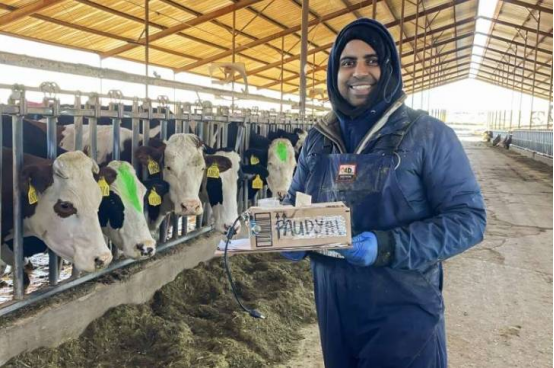
Dr. Sushil Paudyal, Assistant Professor of Dairy Science in the Department of Animal Science, is leading this effort. His lab applies artificial intelligence (AI) and machine learning to collect advanced real-time farm data, developing systems that enable earlier disease detection, informed decision-making, and cost-effective adoption of robotics.
"Sensor-based systems, AI, and real-time analytics are transforming day-to-day decision-making on dairies," Paudyal said. "But for these technologies to be effective, they must be adaptable, updatable, and tailored to each farm's needs."
Building a Data-driven Future for Dairy
Paudyal's lab focuses on practical, technology-driven research to help producers address evolving challenges, including intensifying heat stress and shifting labor dynamics. Technology-enabled models can detect diseases early, strengthen cow management, and increase dairy efficiency. He has successfully deployed models using advanced analytics trained on camera images and behavioral cues to detect lameness, mastitis, and heat stress in individual cows.
"We are currently developing machine-learning-based farm-efficiency models for robotic milking systems to identify idle time and milking failures," he said.
At the recent U.S. Precision Livestock Farming Conference in Lincoln, Nebraska, Paudyal and his team highlighted several findings:
Evaluating Heat Stress Impact on Robotic Milking Systems – Led by PhD student Rajesh Neupane, this study developed machine-learning and computer-vision models and found heat-stress management critical for robotic milking, as it significantly affects milk yield, robot utilization, intake, and milking performance. Cows performed markedly better in cooler conditions. Mitigation strategies such as improved cooling, ventilation, and adjusted feeding schedules are essential for maintaining productivity and animal welfare.
AI-Driven Quantification of Heat Stress and Mastitis in Dairy Cows – This study outlined an automated video-monitoring system using AI to assess heat stress and mastitis via behavioral cues, enabling real-time, scalable monitoring to improve animal welfare and farm efficiency.
Computer Vision for Detecting Different Types of Bovine Digital Dermatitis – This research explored recent advances in computer vision and machine learning for early detection and prediction of digital dermatitis in dairy cattle, emphasizing its potential in practical applications. Computer vision enables early, accurate, non-invasive detection, improving health monitoring and reducing reliance on subjective visual scoring.
Innovation Designed for Real-world Use
One of Paudyal's goals is to develop non-invasive, cost-effective diagnostic tools suitable for diverse production systems. For example, some systems rely on camera-based monitoring instead of physical sensors to track large herds, lowering startup costs and expanding reach.
"We are developing sensors in the lab that can help detect disease without collecting invasive blood or milk samples," Paudyal said. "They will monitor cow behavior and physiological variables to determine if the animal is sick."
His team is also building DairyBot, a generative AI virtual assistant that helps producers evaluate farm data and lab results, ask questions about feed decisions, and interpret herd data in real time using AI.
"They will have a real-time consultant with vast knowledge drawn from farm data and dairy-related literature," Paudyal said. "It won't replace veterinarians or nutritionists but will empower and support them in making informed decisions."
Paudyal presented early DairyBot results at the American Dairy Science Association meeting in Louisville, Kentucky, June 22–25. A working prototype of DairyBot is expected within six months.
The Right Technology for Every Dairy
While Paudyal says technology and real-time decision-making are the future of dairying, he stresses the importance of flexible, moderate solutions. Adoption rates remain uneven despite many farmers seeing ROI.
He believes camera-based systems that monitor larger herds can lower upfront costs and boost adoption, ultimately helping bridge the digital divide.
"I have always wanted to develop solutions that help farmers solve real-world problems," Paudyal said. "As a land-grant university with a mission to support Texas dairies, it's critical to develop research projects that deliver actionable, immediately applicable solutions. By giving farmers the tools and resources they need, we can more effectively help them tackle the real challenges they face on the farm."