
A new study from the University of St Andrews suggests that massive free-floating planets may have the ability to form their own miniature planetary systems without the involvement of a star. The research findings have been released on the arXiv preprint server, where researchers used observational data from the James Webb Space Telescope to deeply investigate young isolated objects with masses 5 to 10 times that of Jupiter. These objects share characteristics with giant planets but do not orbit a star, drifting freely through space.
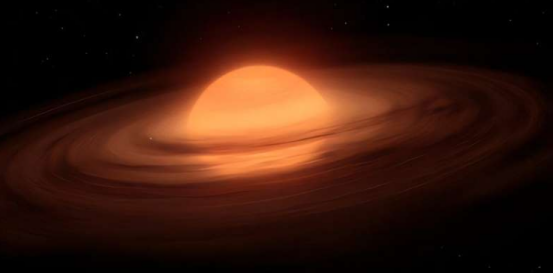
Free-floating planets are extremely faint and primarily emit infrared radiation, making them difficult to observe, yet they are crucial for answering key questions in astrophysics. The study indicates that these objects form from the collapse of massive gas clouds, similar to stars, but fail to accumulate enough mass to ignite core fusion reactions. To better understand the early stages of these objects, researchers from the School of Physics and Astronomy, in collaboration with international co-authors, used two sensitive infrared instruments on the James Webb Space Telescope to conduct detailed spectral observations of eight very young objects between August and October 2024.
The new study provides in-depth characterization of these objects, confirming their masses are comparable to Jupiter. Six of them emit excess infrared radiation due to nearby warm dust—a typical feature of protoplanetary disks, the cradles of planet formation. Observations also revealed radiation from silicate particles in the disks, along with signs of dust growth and crystallization, marking the initial stages of rocky planet formation. Previously, silicate emission had only been detected around stars and brown dwarfs; this is the first time it has been observed in planetary-mass objects. The study further shows that disk-like structures forming around free-floating planetary-mass objects can persist for millions of years, sufficient time for planets to form.
Project lead Dr. Alex Schulte stated: "These studies collectively indicate that objects with masses comparable to giant planets may be capable of forming their own miniature planetary systems; whether such systems truly exist remains to be verified." Lead author Dr. Belinda Damian remarked: "These findings suggest that planetary system formation is not limited to regions around stars."