
Physicists at the University of Copenhagen are utilizing the enormous magnetic fields of galaxy clusters to explore distant black holes in search of axions, this elusive particle that may be key to unlocking the mystery of dark matter. Axions, as a hypothetical elementary particle with extremely light mass—far smaller than the lightest atom—could be an important clue to understanding dark matter, which accounts for about 80% of the universe's mass. Although the existence of axions has not yet been confirmed, the research team at the University of Copenhagen, through innovative methods, may be closer than ever to discovering axions.
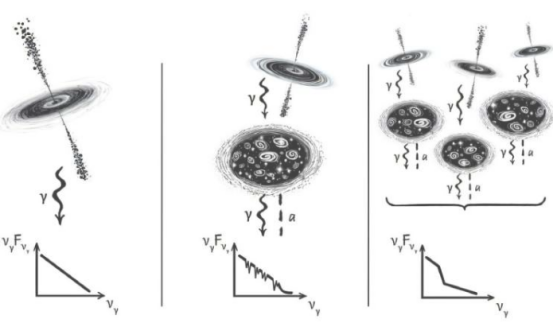
The researchers abandoned traditional Earth-based particle accelerators and instead treated the universe as a gigantic particle accelerator. They focused on electromagnetic radiation from the bright cores of distant galaxies, where supermassive black holes reside at the centers. Observations show that as the radiation passes through the enormous magnetic fields of galaxy clusters, some of it may convert into axions, leaving tiny random fluctuations in the data. However, individual signals are extremely weak and easily masked by cosmic background noise. To address this, the researchers proposed a new strategy: observing 32 supermassive black holes behind galaxy clusters and integrating the observational data.
Upon examining the data, they unexpectedly discovered a pattern resembling axion characteristics. Associate Professor Oleg Ruchayskiy from the Niels Bohr Institute at the University of Copenhagen explained: "Normally, signals from such particles are unpredictable and appear as random noise. But after integrating data from different sources, we were able to transform the noise into a clear, recognizable pattern." He described this discovery as "the whisper of the universe," faint yet loud enough.
Although the new pattern cannot conclusively prove the existence of axions, the study greatly enriches human understanding of axions. Researcher Lidiia Zadorozhna from the Niels Bohr Institute stated that this method can map out regions without axions, narrowing the search range. Although the experiment focused on gamma rays, it is equally applicable to other types of radiation such as X-rays. Zadorozhna said: "This is not a one-time advancement but opens a new pathway for studying elusive particles. We and other groups can replicate this technique over a wider range of masses and energies, adding more clues to explaining the dark matter puzzle."