
In a new study, researchers from Pennsylvania State University and NASA's Jet Propulsion Laboratory in Southern California analyzed the characteristics of human deep-space signal transmissions, proposing that searches for extraterrestrial intelligence can be optimized based on specific temporal and positional patterns. The study suggests that when planets like Earth and Mars align in a straight line from an exoplanetary observer's perspective, human deep-space radio signals are more likely to be detectable due to "leakage," and such planetary alignments could serve as key clues in searching for extraterrestrial communications.
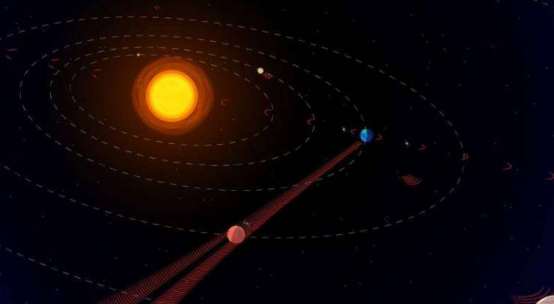
Lead author Pinchen Fan, a graduate student at Pennsylvania State University, explained: "Human deep-space communications are primarily directed toward spacecraft around planets like Mars. When these planets align with Earth, the probability of detection by an extraterrestrial spacecraft or planet along the communication path significantly increases. By analyzing 20 years of public logs from NASA's Deep Space Network (DSN), we found that if extraterrestrial intelligence is located in a position observable along the Earth-Mars line, the probability of being in the human transmission path reaches 77%, far higher than random chance." The team cross-referenced DSN logs with spacecraft position data, confirming that deep-space signals are mainly concentrated around Mars spacecraft and telescopes at Sun-Earth Lagrange points, with 75% of transmissions occurring within 5 degrees of the Earth's orbital plane.
The study also proposes that with the upcoming launch of NASA's Nancy Grace Roman Space Telescope, expected to discover hundreds of thousands of new exoplanets, the potential search area will expand dramatically. Researchers recommend future searches focus on star systems within 23 light-years where planetary alignments point toward Earth, and quantify the frequency of receiving Earth signals. Co-author Joseph Lazio emphasized: "The DSN transmission patterns are equally applicable to searching for laser signals from exoplanets; although laser leakage is weaker, extraterrestrial civilizations might prefer lasers for communication."
The calculations were performed using Pennsylvania State University's Roar supercomputer. The findings were published in The Astrophysical Journal Letters and presented at the 2025 Pennsylvania State University SETI Symposium. The researchers noted that as human exploration of the solar system deepens, deep-space communication volume will continue to increase, providing an important benchmark for optimizing searches for extraterrestrial intelligence.