
A new study finds that using cross-laminated timber (CLT) as a primary building material could deliver substantial environmental benefits in areas such as carbon storage, global reforestation, and increased forest cover.
CLT is manufactured by stacking and gluing multiple layers of lumber, resulting in strong, lightweight panels that can reach lengths of up to 60 feet (about 18 meters)—long enough to form entire walls or other structural elements. It also offers fire-resistant properties: when exposed to fire, the outer layer chars, forming a protective seal that prevents the inner wood from burning.
Given the promising outlook for CLT, researchers sought to quantify the broader impacts of its widespread adoption. To do so, they combined a life-cycle assessment (LCA) tool—which tracks the environmental impacts of a product across its entire life cycle—with the Global Timber Model (GTM), an economic model that examines how land use and policy affect the global timber market. The study, led by Kailan, an assistant professor in the College of Natural Resources at North Carolina State University, was published in the journal Nature Communications. Kailan explained: “LCA tracks a product’s environmental impacts from raw material extraction through transportation, manufacturing, use, and end-of-life disposal. We integrated the two tools because previous studies typically examined only certain stages of a product’s life cycle, rather than the full process.”
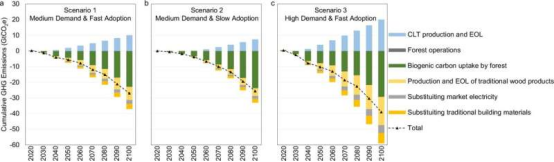
By merging data from both models, the researchers projected the economic and environmental consequences of widespread CLT adoption in the global construction industry. Their findings indicate that CLT use would increase global forest cover, as producing CLT requires larger and more intensively managed forests to supply timber. Although a small portion of natural forests would need to be converted, the expansion of managed and planted forests would result in a net gain of nearly 30 million hectares of global forest area by 2100. However, this growth would not be uniform: forest area would increase significantly in regions such as the United States and Western Europe, while tropical areas near the equator—particularly natural forests—would see a decline.
Economically, the GTM shows that increased demand for CLT would drive up timber prices. Even in the most aggressive adoption scenario, the overall increase in global timber supply from expanded forest cover would be only about 11%. Compared to a no-CLT scenario, by 2100 sawtimber prices are projected to rise 26.3%, and pulpwood prices 25.9%. Sawtimber is used for products like plywood and other traditional wood products, while pulpwood is used for paper and related products.
The increase in forest cover would deliver substantial carbon sequestration benefits, as both CLT itself and the expanded forests would store carbon. Depending on the pace of global market adoption, the researchers estimate that CLT demand could increase terrestrial carbon storage by 20.3 to 25.2 billion tonnes (CO₂ equivalent) by 2100. The rise in CLT use would also reduce demand for traditional building materials such as steel and concrete, further amplifying the carbon benefits. Kailan noted: “Increased CLT use reduces the need for conventional building materials, thereby lowering greenhouse gas emissions associated with their production. These effects accumulate across the entire life cycle of CLT, ultimately generating significant environmental benefits.”