
A world-first green manufacturing breakthrough has been achieved: rubber damping systems made from recycled tires have been proven to effectively protect railway tracks, reduce maintenance costs, and address the environmental challenge of waste tire disposal. The technology was jointly developed by the University of Technology Sydney (UTS), Sydney Trains, Transport for NSW, and industry partners EcoFlex and Bridgestone, and underwent two years of real-world validation on Sydney’s freight rail lines.
Technical Principle and Validation Results
The research team installed rubber pads made from recycled tires alongside conventional track sections. Over two years of monitoring, the track segments equipped with the rubber damping system exhibited reduced vibration, lower settlement, significantly less ballast degradation, and greatly improved stability compared to traditional tracks. The findings were published in the Canadian Geotechnical Journal under the title “Field Monitoring of Rubber-Mixed Ballast Response to Train Loading in Western Sydney.”
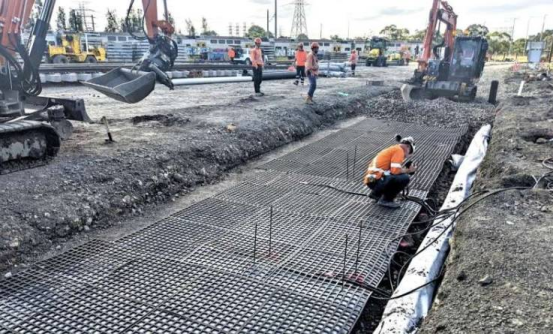
The core innovation lies in embedding recycled tire units in a specific layout within the track structure, filling them with waste ballast and coal washery rejects, and placing a recycled rubber geogrid (made from discarded mining conveyor belts) beneath the load-bearing layer of the rails. Professor Buddhima Indraratna, Director of the UTS Centre for Geomechanics and Railway Engineering, explained: “The rubber-based underlay prevents ballast particles from being crushed under train loads, thereby extending track lifespan. At the same time, the optimized substructure distributes train loads more evenly to the underlying soft soil, avoiding soil settlement and track weakening. This directly reduces maintenance costs, minimizes track closure times, and enhances network reliability.”
Economic and Environmental Benefits
Dr. Richard Kelly, Principal Geotechnical Engineer at SMEC Australia and project consultant, estimates that widespread adoption of this technology across Australia’s rail industry could save millions of dollars annually while reducing dependence on expensive and high-carbon natural rock ballast. Moreover, it provides a sustainable reuse pathway for the more than 50 million waste tires generated in Australia each year. Professor Cholachat Rujikiatkamjorn from UTS emphasized: “Transforming waste into high-value assets not only strengthens infrastructure resilience but also advances circular economy principles, aligning with national priority strategies.”
Future Outlook
Building on the current success, the research team plans to further test the technology in high-impact areas such as bridge approach zones and level crossings, where sudden changes in track stiffness often lead to rapid degradation. This innovation offers the global rail industry a low-cost, highly environmentally friendly solution for track maintenance, marking another significant breakthrough for green manufacturing in infrastructure applications.