
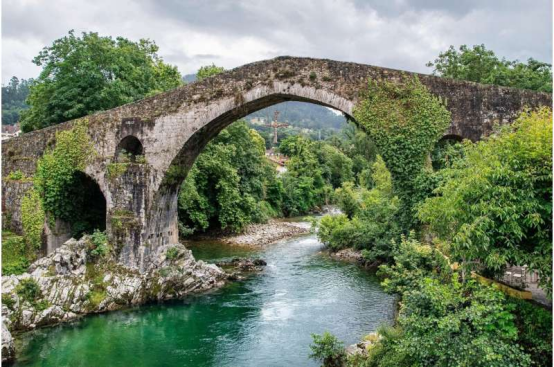
Roman concrete was used to build aqueducts, bridges, and buildings across the empire and has lasted more than two thousand years. In a study published in iScience, researchers investigate whether restoring the use of Roman concrete could improve the sustainability of modern concrete production.
Decarbonizing the construction industry is highly competitive, and producing more sustainable concrete remains a major challenge. Modern concrete production causes air pollution, accounting for about 8% of global anthropogenic carbon dioxide emissions and 3% of global total energy demand. Previous studies suggested Roman concrete may be more sustainable, prompting the researchers to test this hypothesis.
The key raw material for both ancient Roman and modern concrete is limestone, which, when heated, decomposes to produce carbon dioxide and calcium oxide that binds with other substances to form a paste that holds concrete together. The Romans added local rocks, volcanic ash, and recycled rubble to their concrete, while modern concrete is made by mixing cement with sand and gravel.
To compare sustainability, the researchers used models to estimate raw material usage as well as carbon dioxide and air pollutant production. Because Roman concrete production methods were not uniform, they compared multiple ancient recipes, as well as the sustainability of ancient versus modern production techniques and the use of different energy sources.
The results were surprising: producing Roman concrete per unit volume generates carbon dioxide emissions equivalent to modern concrete formulas, and in some cases even more. Daniela Martinez, engineer and author from Northern Columbia University, stated that using Roman formulas with current technology may not significantly reduce emissions or energy demand; using alternative fuels such as biomass for kilns might be more effective for decarbonizing modern cement production.
However, the researchers estimate that, regardless of fuel used, Roman concrete production can reduce emissions of harmful air pollutants to human health—such as nitrogen oxides and sulfur oxides—by 11% to 98%, with the greatest reductions from renewable energy sources.
In addition to being less harmful to human health, Roman concrete is considered more durable. For high-use applications such as roads, it may be a more sustainable choice. Saby Miller, engineer and author from the University of California, Davis, noted that more durable concrete, if it extends service life and reduces the need for new material production, could potentially lessen environmental impact.
However, such comparisons are difficult. Modern concrete has only been produced for 200 years, and ancient Roman buildings did not use rebar for reinforcement. Paul Monteiro, engineer and author from the University of California, Berkeley, cautioned that rebar corrosion is the primary cause of concrete deterioration and comparisons should be made with extreme care.
In the future, the researchers plan to conduct deeper analyses comparing the performance and lifespan of Roman and modern concrete under different conditions. Martinez stated that combining Roman strategies with modern innovative ideas could create a more sustainable built environment.