
Last month, the world's fourth-fastest supercomputer, JUPITER, made its debut at the Jülich Supercomputing Centre (JSC) in Germany. Georgia Tech played a key role in helping it climb the TOP500 list. In November 2024, JSC granted Assistant Professor Spencer Bryngelson exclusive testing access to the system through the JUPITER Research and Early Access Program (JUREAP). Through this program, the joint project obtained valuable simulation data on the impact of shock waves on medicine and transportation.
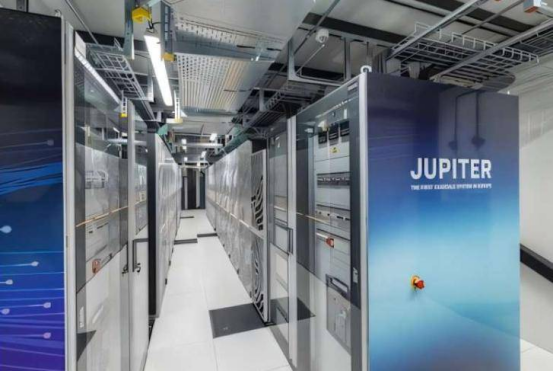
Bryngelson stated: “The shock-droplet problem has long been a flagship challenge in fluid dynamics. Understanding droplet behavior under extreme conditions is crucial for engineering applications.” Through JUREAP, JSC engineers tested Bryngelson’s multi-component flow code (MFC) on JUPITER, simulating droplet behavior under hypersonic shock waves. The results showed that droplets flatten into a pancake shape and eject vortex rings. This discovery provides critical data for aerospace engineers designing hypersonic vehicles, helping reduce risks and costs of physical testing. Additionally, the simulation technology advances innovations in medical shock wave therapy for kidney stones and inflammation treatment.
The versatility of MFC made it an ideal choice for JUPITER’s early testing, and the project successfully obtained JUREAP certification. Bryngelson noted: “Testing supercomputers with application codes is common practice, but deploying real workloads brings new challenges.” The joint project between JSC and Georgia Tech is named “ExaMFlow” (Exascale Multiphysics Flow), helping JUPITER become Europe’s first exascale supercomputer, capable of 1 exaFLOPS (10¹⁸ floating-point operations per second), and ranking first among the top five supercomputers in energy efficiency. ExaMFlow runs on JSC’s JUWELS Booster and JUPITER Early Transition Instrument (JETI), demonstrating near-ideal scaling behavior, with key support from optimized use of NVIDIA hardware.