
A recent study shows that a substance derived from camphor (a natural extract from camphor trees) can significantly improve the quality of perovskite thin films in solar cells. Its sublimation property (ability to transition directly from solid to gas without leaving residue) is used to enhance device performance and manufacturing efficiency.
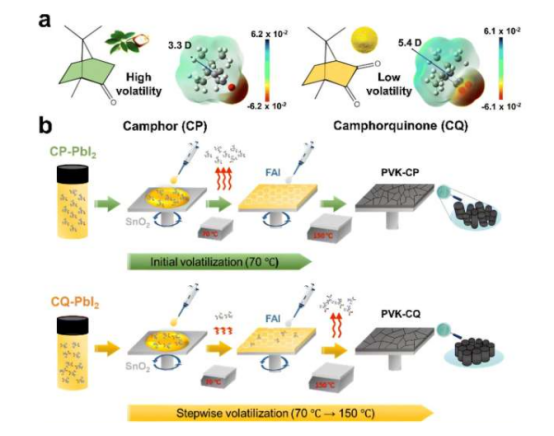
A research team led by Professor Yang Changde from the School of Energy and Chemical Engineering at Ulsan National Institute of Science and Technology (UNIST) successfully synthesized high-quality perovskite thin films by introducing camphor derivatives. Due to the absence of residual substances, these films are expected to extend the lifespan of solar cells, improve efficiency, simplify the manufacturing process, and reduce production costs. The related research results were published in the journal Energy & Environmental Science.
Perovskite thin films in solar cells consist of numerous crystal grains. Larger and more ordered grains facilitate smooth electron flow, enhance structural integrity, and thereby improve efficiency and durability. Additives are typically used during manufacturing to achieve high-quality structures, but residual additives can sometimes affect device performance.
To address this issue, the researchers used camphorquinone (CQ) as an additive. CQ is a derivative of camphor modified with oxidizing groups. Unlike camphor, which sublimes directly, CQ undergoes controlled stepwise sublimation—during the first heat treatment, it assists in uniform seed crystal formation, and during the second heating, it gradually sublimes completely. This controlled sublimation allows optimal growth of perovskite thin films without any residual contaminants.
First author and researcher Jeewon Park explained that CQ can precisely influence the crystal growth stages at specific times and leave no residue in the film, enabling the production of high-quality perovskite thin films.
Solar cells manufactured with CQ-enhanced thin films achieved a power conversion efficiency (PCE) of 25.2%, an improvement of approximately 9.6% over the 23.0% efficiency of control devices without additives. In maximum power point tracking (MPPT) tests simulating real-world operating conditions, these devices retained more than 90% of their initial efficiency after 1000 hours of operation, with a lifespan more than twice that of similar control devices. MPPT is a rigorous standard for evaluating the stability of solar cells under simulated sunlight.
Professor Yang stated that using environmentally friendly natural materials to solve the stability issues of perovskite solar cells not only advances sustainable energy technology but also paves the way for more durable and cost-effective solar solutions.