
An international team led by the Shanghai Astronomical Observatory of the Chinese Academy of Sciences has recently published research findings in the Monthly Notices of the Royal Astronomical Society, confirming that the pixelated strong lens model can significantly improve the measurement precision of the Hubble constant. Through the innovative application of the pixelated strong lens model, this study provides a new technical pathway for resolving the current "Hubble constant tension" in the field of cosmology.
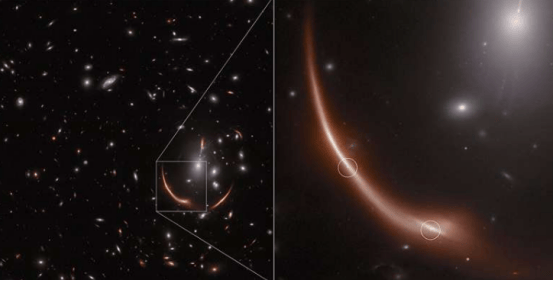
The Hubble constant, as a core parameter describing the expansion rate of the universe, shows a significant discrepancy between measurements from the early universe and the late universe. Based on the preliminary work of the CURLING project, the research team developed a new pixelated strong lens modeling framework. Through simulation analysis of the "Requiem" supernova system in the galaxy cluster MACS J0138.0-2155, the team compared the data differences between traditional point-source modeling and the pixelated method.
The research results show that using the pixelated strong lens model reduces the uncertainty in Hubble constant inference to ±0.8km/s/Mpc, achieving an order-of-magnitude improvement in precision. First author Dr. Yushan Xie stated: "Pixelated modeling allows us to utilize all the information encoded in the lensed arcs, rather than relying solely on the positions of multiple images. This is a key step toward precise cosmological studies using strong lensing on galaxy cluster scales."
The team further simulated the application prospects for future observational facilities. Under the observation conditions of the Multi-Channel Imager on the China Space Station Telescope, combining the pixelated strong lens model can control the Hubble constant measurement precision within 0.1km/s/Mpc. Corresponding author Professor Huanyuan Shan pointed out: "With the arrival of the James Webb Space Telescope, the Euclid Telescope, and the upcoming China Space Station Telescope, we are entering a golden age for strong gravitational lensing research."
This study confirms that lens model uncertainty is currently the main limiting factor in Hubble constant measurements. The combination of high-resolution observations and the pixelated strong lens model lays the foundation for achieving percent-level precision measurements.