
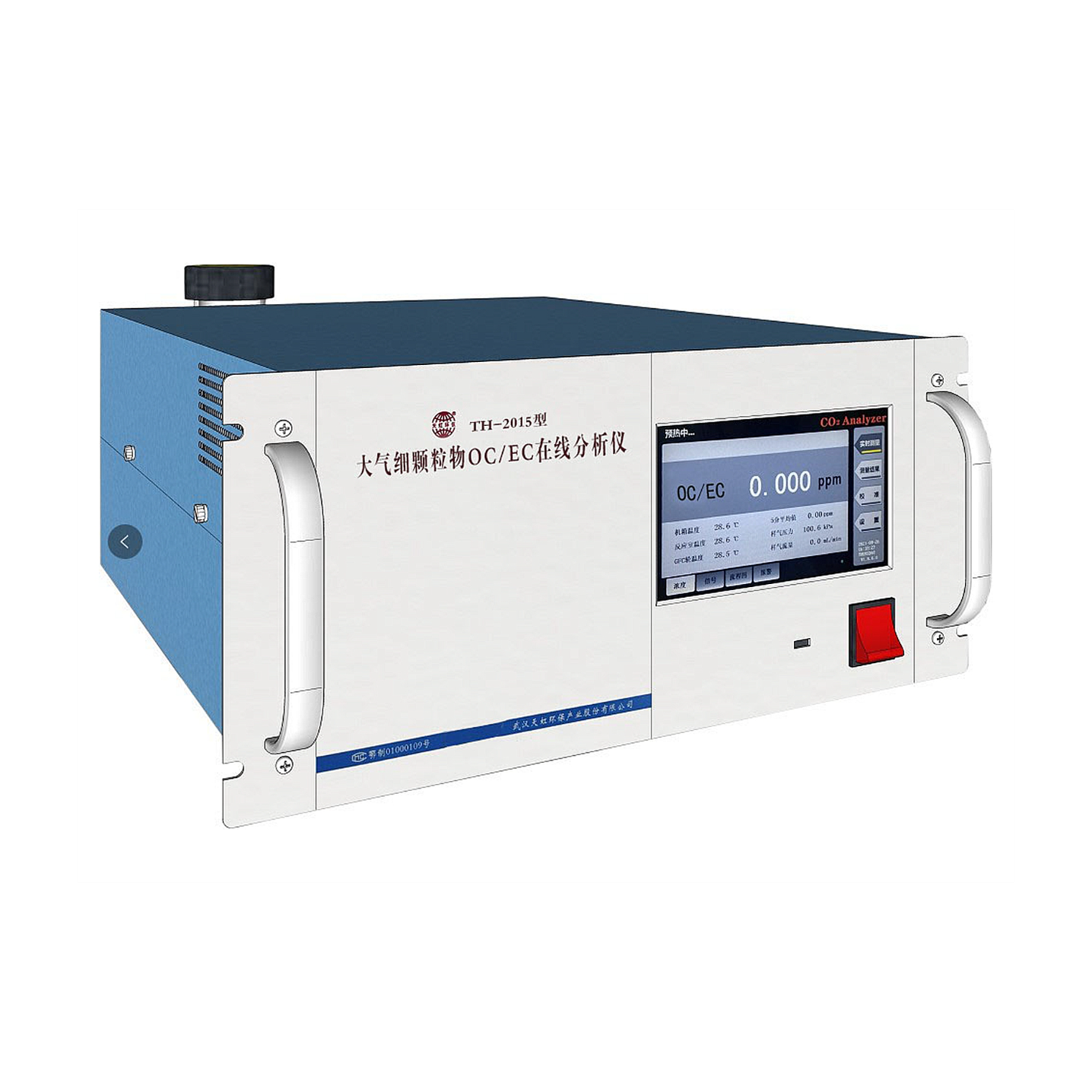


The product complies with GB 3095-2012 Ambient Air Quality Standard, HJ 93-2013 Technical Requirements and Detection Methods for Ambient Air Particulate Matter (PM₁₀ and PM₂.₅) Samplers, HJ 653-2013 Technical Requirements and Detection Methods for Continuous Automatic Monitoring Systems of Ambient Air Particulate Matter (PM₁₀ and PM₂.₅), Q/WTH 203-2023 TH-2015 Online Analyzer for OC/EC in Atmospheric Particulate Matter.
Instrument Introduction
Carbonaceous components in atmospheric aerosols mainly include organic carbon (OC) and elemental carbon (EC), which are important constituents of atmospheric fine particles and have significant impacts on the atmospheric environment and human health. Accurate determination of OC and EC concentrations is of great importance for evaluating the radiative forcing mechanism of carbonaceous aerosols, studying source apportionment of pollutants, and atmospheric chemical reactions. The TH-2015 online analyzer for OC/EC in atmospheric fine particulate matter adopts the thermal-optical method principle, utilizing modern ARM processor technology for signal detection, control, and data processing. It integrates optics, mechanics, electronics, chemistry, and modern sensing technologies to continuously monitor the concentrations of organic carbon and elemental carbon in ambient air aerosols. It is one of the high-tech series products for component network monitoring of ambient air quality.
Instrument Principle
The TH-2015 online analyzer for OC/EC in atmospheric fine particulate matter simultaneously uses TOT and TOR methods to separate OC and EC: First, the instrument collects atmospheric samples at a flow rate of 8L/min, depositing particulate matter samples onto quartz fiber filters with high thermal stability and low background. Helium gas is introduced into the system, and the quartz filter is heated stepwise in an oxygen-free environment to volatilize OC from the sample. After the OC stage, a He/O₂ mixed gas is introduced into the carrier gas, and heating of the quartz filter continues stepwise in an oxygen-containing environment, causing EC in the sample to oxidize and escape. Organic matter released from the filter during both OC and EC stages enters the oxidation furnace tube, where it is converted to CO₂ under the catalytic oxidation of MnO₂ and then detected by the NDIR detector.
Throughout the heating process, the laser emitter continuously emits a stable 660nm laser beam, which passes through the quartz filter and is received by the transmission and reflection laser receivers after transmission and reflection. The laser intensity received by the detectors first gradually decreases with the carbonization of OC, then begins to increase with the oxidation and escape of EC. When the transmission and reflection light intensities return to their initial values before heating, it is considered the OC/EC split point. All carbonaceous components thermally decomposed before this point are OC, and after this point are EC. After the heating program ends, a He/CH₄ mixed gas is introduced into the quantitative loop. Once the loop is filled, the mixed gas is injected into the system, converted to CO₂ in the oxidation furnace, and quantified by the NDIR detector. Since the quantitative loop volume is fixed, the methane content in the mixed gas injected into the system each time is constant. By comparing the CO₂ response integral areas corresponding to OC, EC, and He/CH₄ mixed gas, the OC and EC contents in the sample are obtained. The concentrations of OC and EC in the atmosphere can then be calculated based on sampling time and flow rate.
Instrument Features
• Automatic alarm prompts.
• Display of working status for valves and components, facilitating maintenance.
• Transmission and reflection dual detection system. The TH-2015H online analyzer for OC/EC in atmospheric fine particulate matter uses both transmission and reflection light to separate OC and EC, meeting comparison requirements between different methods.
• Flow controlled by digital mass flowmeter with high constant flow precision and accuracy.
• The instrument has parameter storage function for more than one year.
• The instrument has traceability function.
• Real-time curve display of key signals for easy analysis.
• All historical data can be exported via USB drive.
• Each actuator has independent testing function.
• Timely and convenient data acquisition. The instrument forms an automatic monitoring network with other analyzers through RS-232 and RS-485 serial communication ports. Collected data is transmitted to the sub-station via RS-232 or RS-485, and the central station remotely retrieves sub-station data through wired or wireless transmission to timely and effectively grasp the air pollution situation in a certain area, with good timeliness.
• Precise and error-free digital filtering. The analyzer adopts advanced digital filtering algorithm to optimally optimize response time and signal-to-noise ratio based on the minimum mean square estimation error criterion, thereby improving the system's signal-to-noise ratio.
