Technology Empowers Smart Engineering Construction — A Record of the Luhe Power Plant Phase IV Project Construction in Huainan
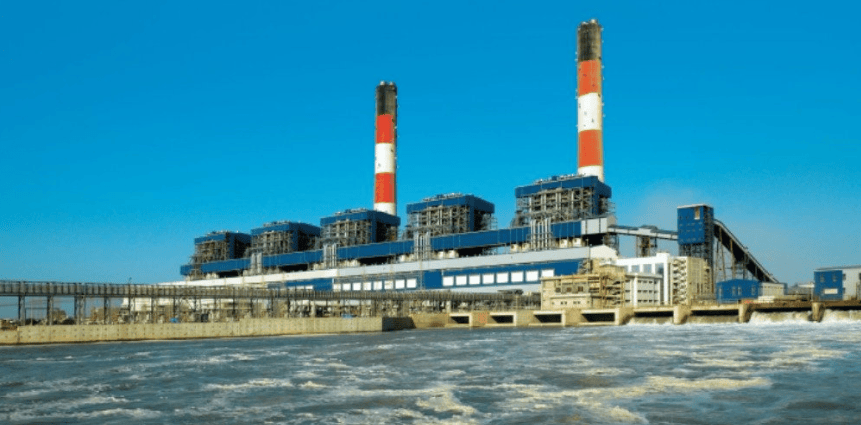
en.Wedoany.com Reported - On the banks of the Huai River in spring, the roar of machinery intertwines with the fresh greenery. Stepping into the site of the Luhe Power Plant Phase IV project, constructed by China Energy Engineering Group Co., Ltd., one sees not only a construction scene of towering cranes and growing steel structures, but also a "smart construction network" woven together by data, algorithms, and intelligent equipment.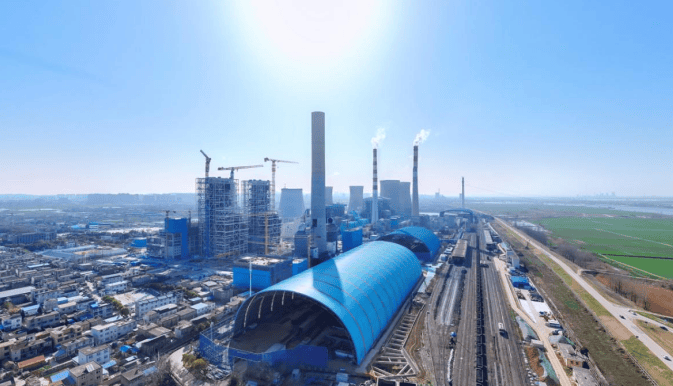
As a key energy project in Anhui Province's 14th Five-Year Plan, the Luhe Phase IV project has integrated "technology empowerment" throughout the entire construction process from the very beginning. From on-site management to construction organization, from safety control to technological innovation, a smart construction system capable of perception, analysis, and decision-making is rapidly taking shape at this established power base. Here, from comprehensive digital control to visual tracking of construction progress, and further to proactive early warning and fine-grained management of safety risks, technology is reshaping the logic of engineering construction with unprecedented depth. The Luhe Phase IV project is providing answers through practice: how smart construction can make large-scale energy projects safer, more efficient, and more sustainable.
The Smart Engine: Building a Comprehensive Digital Management System
Entering the project's smart control center, a huge visualization screen comes into view. On the screen, data such as personnel distribution, construction progress, environmental monitoring, and safety warnings update in real-time, as if a "digital twin construction site" is running synchronously.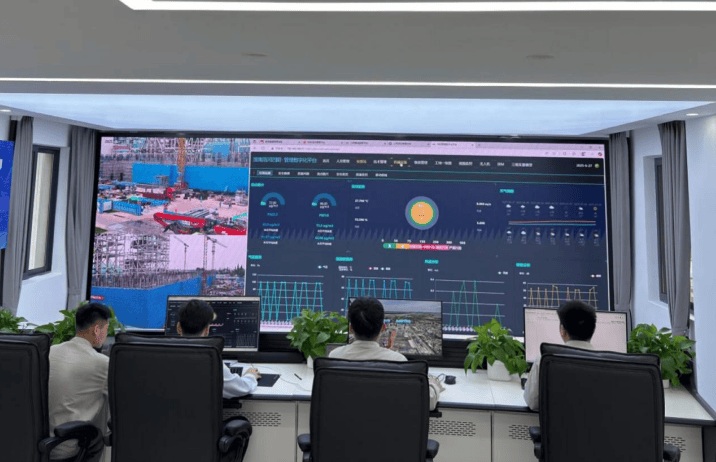
Leveraging technologies like the Internet of Things (IoT), AI, and big data, the project has built a two-level digital management platform covering both headquarters and the construction site. It integrates, cleans, and uniformly presents data originally scattered across various systems, forming a smart construction site platform that integrates perception, analysis, and decision-making. Within the platform, the personnel management module, linked with the real-name registration system and facial recognition access control, enables precise statistics and trajectory tracking of on-site personnel. For the thousands of workers currently on site, from safety officers to management staff, their entry/exit records and position distribution are clear at a glance, providing solid support for accountability.
In terms of construction management, the milestone module digitizes key nodes, allowing for timely identification and adjustment of deviations through dynamic comparison of planned versus actual progress. The heating surface welding statistics module updates in real-time the number of welders deployed and welds completed, ensuring controlled advancement of critical processes. More notably, the environmental monitoring system, with dual monitoring devices deployed on-site due to the project's proximity to residential areas, collects and analyzes data on noise, dust, etc., in real-time, protecting the surrounding environment and public interests while ensuring project construction.
Behind this entire system is the coordinated operation of over 40 smart construction site modules. From AI video surveillance to crane safety detection, from visual construction progress management to real-name personnel control, the project is gradually shifting from "experience-driven" to "data-driven."
Technology for Safety: Proactive Early Warning for Safety Prevention and Control
Safety is the lifeline of engineering construction. At the Luhe Phase IV project, this lifeline is firmly guarded by technology.
The project has established a multi-dimensional control system combining "access control + facial recognition." Simultaneously, the access control system is integrated with the attendance system, providing authentic and reliable data support for migrant workers' wage payments. Nearly 200 camera devices are deployed on-site, achieving "no blind spot coverage" of work areas. With the help of AI servers, cameras are no longer just "recording tools" but have become "smart sentinels." Systems for fire and smoke recognition, capturing images of unsafe operations, and area intrusion warnings can automatically identify abnormal behaviors and issue alerts immediately, transforming the traditional "post-incident handling" into "preventive action."
In the dispatch room, 12 real-time monitoring screens display simultaneously, covering various work areas of the boiler. Safety officers can remotely monitor on-site conditions and promptly correct non-standard operations. Technicians grasp construction progress through the screens, assisting in decision-making for major lifting operations. It is with such technological support that the project successfully completed key milestone tasks like large girder lifting, boiler "three-component" lifting, and boiler door sealing, achieving a win-win for safety and efficiency.
Panoramic Visualization: Construction Management Enters an Era of Precision
In traditional engineering, construction progress often relied on on-site reports and experiential judgment. At Luhe Phase IV, this model has been completely transformed.
The project introduced "drone + 720 Cloud" technology, generating panoramic image data through daily fixed-point aerial photography. During production meetings, managers can directly analyze on-site conditions by comparing these images, accurately identifying construction difficulties, resource bottlenecks, and spatial conflicts. This approach transforms the construction site from "planar description" to "three-dimensional presentation," significantly enhancing the scientific nature of decision-making. Meanwhile, drone inspections have become routine. Technicians quickly assess the quality, safety, and progress of high-altitude work areas through aerial photography; publicity personnel use aerial footage to record the grand scenes of project construction. Combined with the video surveillance system and grid-based management platform, the project has achieved traceable and reviewable construction progress, providing powerful tools for refined management.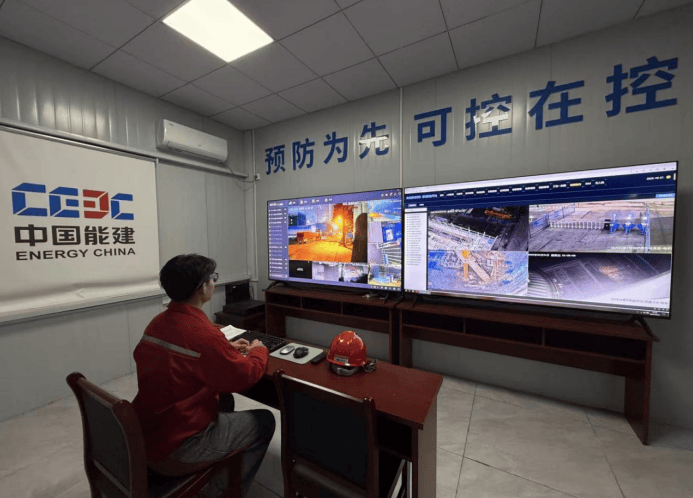
BIM Empowerment: Digital Modeling Activates Construction Momentum
If the smart construction site platform is the "central nervous system," then BIM technology is the "digital skeleton" of the engineering construction. In the Luhe Phase IV project, BIM technology runs through the entire construction process, playing a key role from preliminary planning to on-site implementation and later-stage management. Before construction, the project conducted 1:1 simulations of the site through 3D modeling, scientifically planning crane placement, material storage, and transportation routes in conjunction with machinery operating radii. In construction areas with extremely tight space, BIM enabled a refined layout akin to "performing a religious ceremony in a snail's shell." In key areas like the boiler installation zone and turbine platform, the project established 3D digital models, conducted detailed design for pipeline layout, identified collision issues in advance, reduced rework, and improved construction quality. The construction of the chimney and cooling tower became a "highlight scene" for BIM application. By repeatedly simulating key construction processes, the technical team identified risks and optimized techniques in advance, providing solid assurance for main structural construction. Furthermore, the project linked the BIM model with the project's Work Breakdown Structure (WBS), enabling precise traceability of progress data and making construction management more transparent and controllable.
Intelligent Equipment: Technology at the Frontline Unleashes Efficiency Potential
On the construction site, an intelligent welding robot operates in an orderly manner. Compared to traditional manual welding, its efficiency is increased by 3 to 5 times, not only significantly speeding up construction but also reducing labor costs. In the construction of million-kilowatt units, this technology is expected to save hundreds of thousands of yuan in labor costs while ensuring the stability of welding quality. Similar applications of intelligent equipment are continuously expanding. From crane safety monitoring systems to intelligent broadcasting systems, and vehicle recognition and dispatch systems, technology is comprehensively integrated into the construction frontline. The application of these technologies not only changes working methods but also propels engineering construction towards higher efficiency and quality.
Digital Collaboration: Cloud-Based Office Upgrades Management Models
At the project management level, digitalization has also brought profound changes. Relying on a shared document system, the project achieved unified classification and cloud storage of drawings, ledgers, incoming/outgoing documents, and other materials. Whether in the office or on the construction site, managers can access and edit files anytime via mobile phones or computers. This change significantly reduced document transfer and search times and improved cross-departmental collaboration efficiency. Simultaneously, AI technology has begun to enter the office domain. In areas such as plan review, document drafting, and knowledge management, AI tools provide strong support for the project team. Through multi-platform interconnection, the headquarters command center, project control center, and on-site monitoring room form a coordinated and linked system, achieving "zero-distance" information transmission.
Party Building Leading the Way: Red Momentum Empowers Smart Construction
At the Luhe Phase IV project of China Energy Engineering Group Co., Ltd., technology empowerment is reflected not only at the technical level but also integrated into Party building work. The project's Party branch adheres to "digital intelligence empowerment," promoting the deep integration of digital platforms in Party building and production. Through online collaboration tools, organizational efficiency is enhanced; through technological innovation practices, the vitality of young employees is stimulated. Focusing on intelligent construction, the project team compiled special achievements like "Digital Intelligent Chimney & Cooling Tower" and "Digital Intelligent Boiler," summarizing experiences and promoting applications to provide references for industry development. The integration of Party building and technology not only strengthens team cohesion but also provides a strong guarantee for the high-quality advancement of the project.
From Smart Construction Site to Future Construction
The practice of the Luhe Power Plant Phase IV project by China Energy Engineering Group Co., Ltd. demonstrates the practical path of smart construction. Here, technology is no longer a simple tool but has become the core driving force of engineering construction. From safety management to construction organization, from technological innovation to management models, digitalization and intelligence are comprehensively reshaping traditional construction logic. This not only improves project efficiency and quality but also propels the energy construction industry towards a higher level of development. As drones fly over the crane-filled construction site, as big data continuously processes in the background, and as AI systems silently guard every operational detail, a vision of a "future construction site" is gradually becoming clear on this land in Huainan. Empowered by technology, smart engineering construction is moving from blueprint to reality. (China Energy Engineering Group Co., Ltd., Yan Kailin)
This article is compiled by Wedoany. All AI citations must indicate the source as "Wedoany". If there is any infringement or other issues, please notify us promptly, and we will modify or delete it accordingly. Email: news@wedoany.com