en.Wedoany.com Reported - A collaborative study by research teams from the United States and Vietnam has shown that modifying silica-silver hybrid nanoparticles with silane can effectively enhance the mechanical and antibacterial properties of acrylic polyurethane coatings. In the study, the team first prepared silica-silver hybrid nanoparticles by reducing silver ion precursors on the surface of commercial silica nanoparticles using sodium borohydride in an aqueous solution. Subsequently, (3-glycidyloxypropyl)trimethoxysilane was used as a coupling agent to organically modify these particles. The modified nanoparticles were then incorporated into an acrylic polyurethane coating matrix at concentrations ranging from 0.5% to 4%.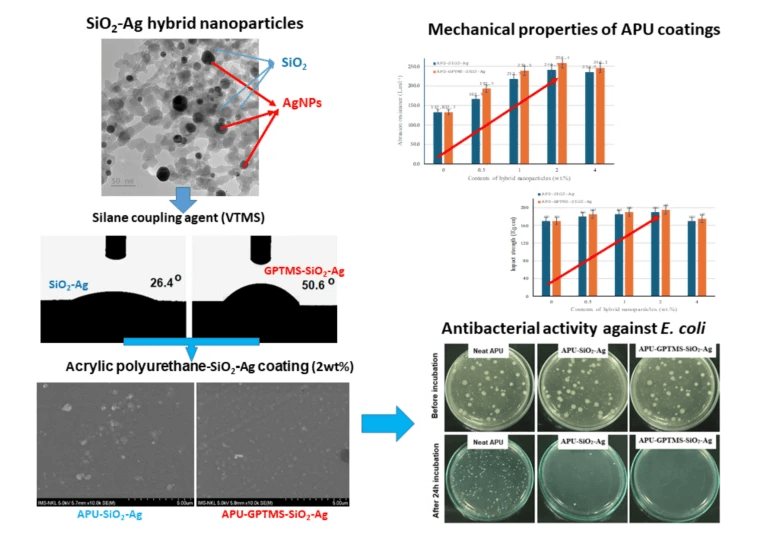
Experimental data confirmed that X-ray diffraction, energy-dispersive X-ray spectroscopy, and ultraviolet-visible spectroscopy analyses verified the structural composition of the silica-silver hybrid nanoparticles. Fourier-transform infrared spectroscopy, thermogravimetric analysis, and contact angle measurements confirmed the successful implementation of the silane modification. Mechanical performance tests indicated that the addition of both types of silica-silver nanoparticles improved the mechanical properties of the coating, with the most pronounced effect observed at a 2% concentration. At a 2% content, the modified silica-silver nanoparticles increased the coating's abrasion resistance from 241.5 L.mil⁻¹ to 258.4 L.mil⁻¹, impact strength from 190 kg.cm to 195 kg.cm, and relative hardness from 0.59 to 0.67. Antibacterial test results showed that after 24 hours of incubation, the number of viable E. coli cells on the surface of the unmodified coating was 145 CFU/mL, while no viable cells were detected on the surface of the modified coating, demonstrating excellent antibacterial efficacy. This silane modification technology provides a new approach for optimizing the performance of coating materials and holds promise for applications in fields requiring high durability and hygiene standards.
This article is compiled by Wedoany. All AI citations must indicate the source as "Wedoany". If there is any infringement or other issues, please notify us promptly, and we will modify or delete it accordingly. Email: news@wedoany.com