FCC Documents Reveal Amazon Leo Satellite Internet Wi-Fi Router, Equipped with Qualcomm Chips and Supporting Smart Home Protocols
en.Wedoany.com Reported - The U.S. Federal Communications Commission (FCC) officially made public the exterior and internal structure images of the Wi-Fi router accompanying Amazon's satellite internet service, Amazon Leo, on May 19 local time. This marks the first time the device has been disclosed to the public through regulatory channels.
According to the certification documents released by the FCC, this router model is L1LA10, with the product name labeled "E1." It features an overall minimalist square design with a white casing and rounded edges. The back of the device has three ports: one for power input and two Ethernet interfaces, one of which is specifically designated for connecting to the Leo satellite antenna. The user manual disclosed concurrently shows that the Leo antenna can connect to the router via a standard Ethernet cable. This wired connection method simplifies the installation process from the outdoor antenna to the indoor network equipment, lowering the deployment barrier for end users.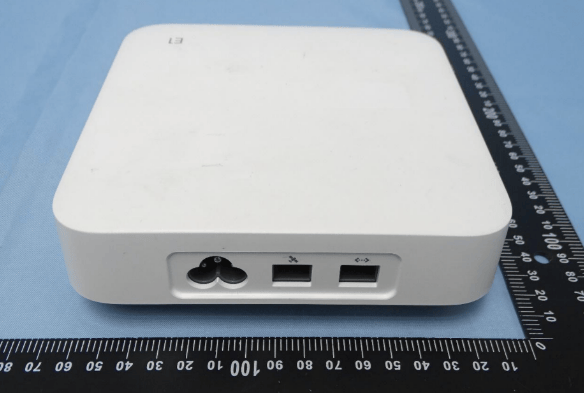
The router supports the Wi-Fi 6 standard and Mesh networking mode, allowing users to seamlessly expand coverage in larger homes by adding compatible nodes. The documents also show that the device integrates Bluetooth Low Energy and the ZigBee wireless protocol. The inclusion of the latter means this router not only functions as a satellite internet gateway but may also serve as a central hub for smart home devices, compatible with ZigBee ecosystem products like lights, door locks, and sensors.
Regarding the internal structure, test images released by the FCC show the router is equipped with a Qualcomm QCN6112, IPQ5018, and QCA8061 Wi-Fi chipset, along with 4GB of flash memory from SkyHigh. The internal power module is labeled "AC/DC adapter" and "Made in China." The router does not support the 6GHz band, and therefore cannot provide Wi-Fi 6E connectivity.
The timing of the FCC's image release stems from regulatory confidentiality procedures. Amazon obtained FCC sales authorization for the device as early as 2025 and requested confidentiality for the submitted test photos, user manual, and internal structure images. The FCC granted this request, setting a confidentiality period of 180 days, after which the commission promptly made the aforementioned documents public.
Amazon is making final preparations for the launch of the Leo service this summer. The company has successfully launched over 300 Leo low-Earth orbit satellites and initiated an enterprise preview version for business, telecom, and government customers in April. Amazon CEO Andy Jassy previously stated clearly in his 2025 annual letter to shareholders that the Leo service would officially launch in mid-2026. The Leo service will cover multiple terminals: the portable Leo Nano, the standard Leo Pro, and the Leo Ultra, designed for enterprise-level scenarios and capable of delivering gigabit speeds. The E1 router revealed this time is expected to be bundled with the Leo Pro terminal, with pricing yet to be announced.
Unlike existing satellite internet services on the market, Amazon Leo is deeply integrated with AWS cloud infrastructure. Jassy emphasized that enterprise and government customers can transfer data bidirectionally between satellite links and AWS for storage, analysis, and AI inference. Furthermore, the Leo router has previously received a conditional exemption from the FCC's ban on foreign-manufactured Wi-Fi routers, valid until October 31, 2027, ensuring the device can enter the U.S. market as planned.
This article is compiled by Wedoany. All AI citations must indicate the source as "Wedoany". If there is any infringement or other issues, please notify us promptly, and we will modify or delete it accordingly. Email: news@wedoany.com
Related Products


Hot Selling 10 Inch Intel N5100 I5 I7 FHD 8 +128GB 16+256GB Win10 Pro Win11 Pro 4G 5G Rugged Tablet PC Pad with NFC Barcode
Highton Electronics Co., Ltd.
Flat Portable Satellite Terminal 0.35m Aperture Manual Portable Terminal
China Starwin Science & Technology Co., Ltd.



MUX Series Communication Interface Device for Security and Stability Control System
Nanjing NR Electric Co., Ltd.
Mine Explosion-proof and Intrinsically Safe Industrial Ethernet Ring Network (10 Gigabit/Gigabit)
Chongqing Mas Sci&Tech Co., Ltd.

G.652.D Wavelength-extended Non-dispersion Shifted Single-mode Optical Fiber
HONGAN GROUP CO., LTD.


Multi-function Marine Monitoring Low-altitude Detection Radar Sea-air Boundary Ocean Dynamic Environment Measurement
Chengdu Dixin Technology Co., Ltd.