China's National Development and Reform Commission Deploys Embodied Intelligence Training Facilities, Connecting Large and Small Brain Model Training with Application Pilot Bases
en.Wedoany.com Reported - China's National Development and Reform Commission (NDRC) has identified the construction of key infrastructure for embodied intelligence as the focal point for advancing the industry in the next phase. On May 22, Li Chao, Deputy Director of the NDRC's Policy Research Office, stated at a press conference that the construction of embodied intelligence training infrastructure will be accelerated to better support embodied data collection and the training of "large and small brain" models.
This statement points to the infrastructure gap in the transition of embodied intelligence from demonstration and validation to real-world scenario applications. Unlike software models that only process text, images, or code, embodied intelligence requires robots to perceive the environment, understand tasks, plan actions, and execute them in the physical world. The "large brain" model typically handles semantic understanding, task planning, and scene reasoning, while the "small brain" model is closer to motion control, posture coordination, trajectory execution, and real-time feedback. Training such systems cannot rely solely on internet text data; it also requires high-quality embodied data, simulation environments, real-machine data collection, motion evaluation, computing power scheduling, and safety testing platforms. The NDRC's proposal to accelerate the construction of training infrastructure has the core goal of enhancing the general capabilities of embodied intelligence in different scenarios, enabling robots to move from competitions, exhibitions, and closed testing environments to more complex operational settings like factories, shopping malls, and homes.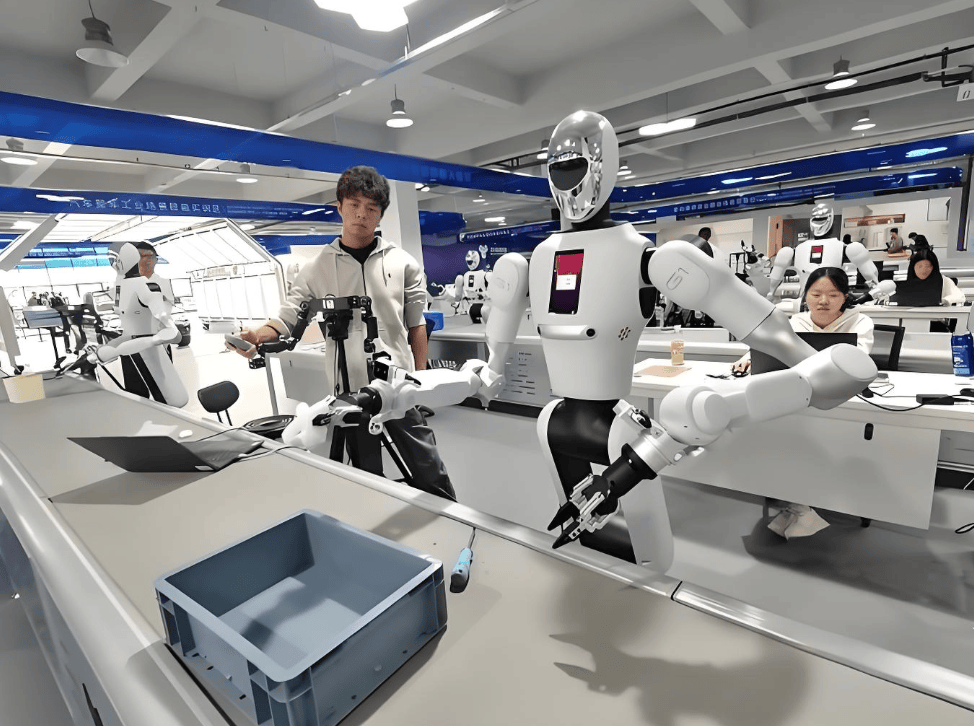
The "15th Five-Year Plan" outline has already included embodied intelligence as a future industry direction. The planning document proposes promoting quantum technology, biomanufacturing, hydrogen energy and nuclear fusion, brain-computer interfaces, embodied intelligence, and sixth-generation mobile communications as new economic growth points, and requires the construction of a full-chain cultivation system for future industries. This means that embodied intelligence is not just a single-point upgrade for the robotics industry, but a new type of industrial foundation connected to scenarios such as future manufacturing, intelligent services, public safety, elderly care, commercial services, and home terminals.
Application pilot bases represent another critical pathway. Li Chao stated that the NDRC will accelerate the construction of application pilot bases in the direction of embodied intelligence, improve the software and hardware ecosystem for embodied intelligence, strengthen coordination and linkage with training infrastructure, and accelerate technological innovation geared towards application implementation. The role of a pilot base is to verify algorithms, robot bodies, sensors, actuators, control systems, industry scenarios, and testing standards within the same environment, preventing technology from remaining at the laboratory prototype or short-term demonstration stage. The State Council's "Opinions on Deeply Implementing the 'Artificial Intelligence+' Action" has already proposed the layout and construction of a batch of national AI application pilot bases and the establishment of common platforms for industry applications; the "Implementation Opinions on the 'AI + Manufacturing' Special Action" by eight departments including the Ministry of Industry and Information Technology also proposes promoting innovation in embodied intelligent products, constructing humanoid robot pilot bases and training grounds, creating benchmark humanoid robot production lines, and applying them first in typical manufacturing scenarios.
The current difficulties in the embodied intelligence industry are concentrated in four areas: data, models, hardware, and scenarios. For robots to enter factories, they need to adapt to assembly line rhythms, tooling fixtures, material placement, personnel collaboration, and safety boundaries; entering shopping malls requires handling open spaces, crowd avoidance, guided tours, shelf recognition, and multi-turn interactions; entering homes means facing non-standard objects, spatial changes, the safety of the elderly and children, and long-term companionship needs. Training infrastructure can provide data collection, simulation evaluation, and model iteration conditions for these scenarios, while pilot bases undertake the tasks of joint software and hardware verification, application trial-and-error, and engineering screening before large-scale promotion. The NDRC previously mentioned in press conferences that it will focus on technical challenges such as the collaboration of "large and small brain" models, the adaptation of cloud-side and device-side computing power, and the fusion of simulation and real-machine data, and promote the construction of infrastructure such as training and pilot platforms.
This deployment by China's NDRC sends a clear signal: the competition in embodied intelligence is shifting from a contest of individual robot capabilities to the systematic construction of training facilities, data systems, software and hardware ecosystems, and application pilot platforms. Only by forming a closed loop of "large and small brain" model training, robot body iteration, and real-world scenario validation can embodied intelligence be more likely to move from competitions and prototypes to industrial, commercial, and home scenarios, becoming an important entry point for artificial intelligence to integrate into the physical industry.
This article is compiled by Wedoany. All AI citations must indicate the source as "Wedoany". If there is any infringement or other issues, please notify us promptly, and we will modify or delete it accordingly. Email: news@wedoany.com
Related Products