en.Wedoany.com Reported - Luxshare Precision successfully listed on the Hong Kong Stock Exchange, with an opening price of HK$63.25 per share, giving it a total market capitalization of HK$487.1 billion (approximately RMB 422.9 billion). The company holds an 11.2% market share in the global consumer electronics components and modules PIMS sector, ranking second globally and first in mainland China.
Through this IPO, Luxshare Precision expects net proceeds of approximately HK$24 billion. The fund allocation plan shows that 35% will be used to expand production capacity and upgrade existing manufacturing bases, 30% will be invested in technology R&D and smart manufacturing system upgrades, 15% will be used to invest in high-quality targets in upstream and downstream industries or related sectors, 10% will be used to repay certain existing interest-bearing bank borrowings for working capital purposes to optimize the capital structure and reduce financial expenses, and the remaining 10% will be used as working capital and for other general corporate purposes. This arrangement reflects the company's strategic focus on extending into high-value-added segments while consolidating its manufacturing scale.

Based on 2025 revenue, Luxshare Precision is the largest precision intelligent manufacturing solutions (PIMS) provider in mainland China and the fifth largest globally. In the consumer electronics components and modules PIMS market, the company ranks second globally and first in mainland China, with a global market share of 11.2%.
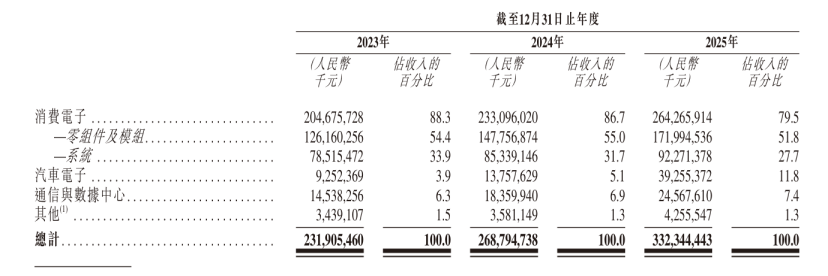
Over the past three years, Luxshare Precision's revenue has grown from RMB 231.9 billion to RMB 268.8 billion, and further to RMB 332.3 billion, with its scale continuously expanding. Behind this revenue growth is a deep adjustment in the company's business structure. By business segment, the share of consumer electronics revenue decreased from 88.3% in 2023 to 79.5% in 2025, while the automotive electronics business jumped from 3.9% to 11.8% over the same period, achieving a three-year compound annual growth rate of 106%. The communications and data center business also maintained an annual compound growth rate of approximately 30%.
Changes in the customer structure are equally noteworthy. As the well-known "King of the Apple Supply Chain," Apple contributed RMB 174.5 billion, RMB 190.1 billion, and RMB 188.4 billion in revenue over the past three years, with its share of total company revenue declining from 75.2% to 56.7%. Apple remains Luxshare Precision's largest customer, but its revenue share continues to decrease, reflecting the company's strategic intent to actively reduce dependence on a single major customer and promote customer diversification.
Overall, Luxshare Precision is transforming from an "Apple supply chain leader" into a multi-industry collaborative technology manufacturing platform, with automotive and communications businesses becoming new growth drivers.
Over the past three years, Luxshare Precision's revenue structure has undergone significant changes, with the automotive electronics business's revenue share exceeding 10% to reach 11.8%, regarded by the market as the company's second growth curve. This growth is primarily attributed to the acquisition of Germany's Leoni Group. Leoni has traditional advantages in the global automotive wiring harness field, and its integration has raised Luxshare's global market share in automotive wiring harnesses to 12.2%, placing it in the global first tier. This acquisition also helped Luxshare establish direct channels to European and American luxury brands such as BMW and Mercedes-Benz, as well as mainstream Japanese and Korean automakers. Currently, Luxshare's automotive business has formed a full-chain layout covering wiring harnesses, high-voltage connectors, intelligent cockpits, and domain controllers, with customers including leading new energy vehicle makers like BYD, NIO, and Li Auto, as well as traditional automakers.
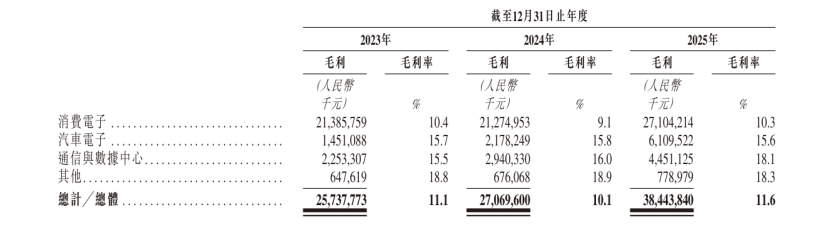
From a gross margin perspective, the communications and data center business performs more prominently, with profitability levels higher than those of consumer electronics and automotive electronics. Against the backdrop of growing AI computing power demand, the data center business, centered on optical modules, copper connections, and optical connections, has become a key focus for Luxshare Precision. The company achieved mass production of 400G optical modules in 2023 and simultaneously launched 800G products, with 800G optical modules now entering small-batch shipment stages. In terms of technology roadmap, the company adopts a "parallel development of optics and copper" strategy, with investments in both CPO and NPO directions. In May of this year, Luxshare signed a strategic cooperation memorandum with Marvell, covering high-end optical modules, high-speed copper interconnects, and joint pre-research on cutting-edge technologies. Additionally, Luxshare provides high-speed copper cables for Nvidia's GB200/GB300 servers and is one of the core suppliers.
Luxshare Precision is building a dual-engine growth pattern, with automotive electronics as the growth engine and the data center business as the profit high ground.
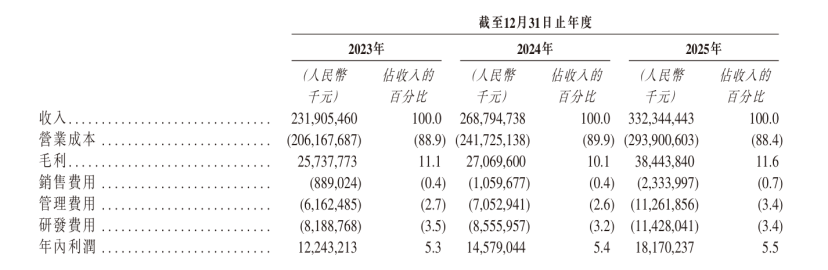
Luxshare Precision's net profit has continued to grow, with net profit attributable to the parent company reaching RMB 12.2 billion, RMB 14.6 billion, and RMB 18.2 billion over the past three years. This is driven by strong natural growth, including an expanding global customer base, rising order volumes, and industry trend growth. At the same time, the company has further diversified its customer base and driven sales volume increases through acquisitions, thereby boosting revenue and gross profit.
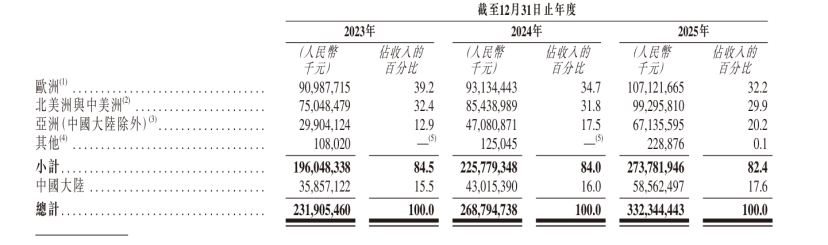
The majority of Luxshare Precision's revenue comes from regions outside mainland China. In 2023, 2024, and 2025, this portion of revenue was RMB 196 billion, RMB 225.8 billion, and RMB 273.8 billion, respectively, accounting for 84.5%, 84.0%, and 82.4% of total revenue in the respective periods. Among this, sales revenue from U.S. customers was RMB 74.5 billion, RMB 85 billion, and RMB 97.8 billion, respectively, representing 32.1%, 31.6%, and 29.4% of total revenue in the respective periods.