The maiden flight of the Long March 12B carrier rocket was a complete success, marking the entry of China Commercial Rocket's first self-developed rocket into service.
en.Wedoany.com Reported - At 16:40 on June 1, 2026, the Long March 12B carrier rocket (Y1) ignited and lifted off from the China Commercial Rocket research, test, and launch pad at the Dongfeng Commercial Aerospace Innovation Experimental Zone, successfully deploying the tenth batch of Qianfan Constellation networking satellites into the predetermined orbit. The maiden flight mission achieved complete success.
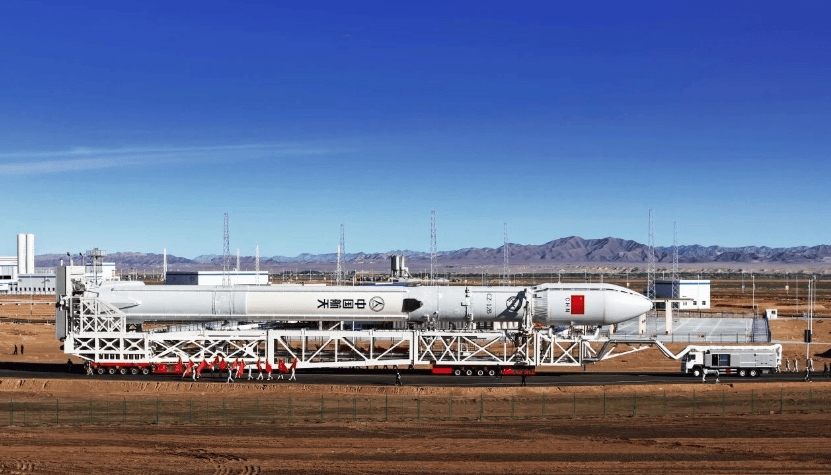
The Long March 12B carrier rocket is the first type of rocket developed under the overall leadership of China Aerospace Science and Technology Corporation Commercial Rocket Co., Ltd. (hereinafter referred to as "China Commercial Rocket"). It is a new-generation single-core, four-meter-class reusable carrier rocket designed to meet commercial launch demands such as China's large-scale internet constellation networking. The rocket adopts a two-stage configuration and a full liquid oxygen/kerosene propulsion scheme, with a total height of approximately 72 meters, a diameter of 4.37 meters, a low Earth orbit payload capacity of no less than 20 tons, and multi-orbit mission adaptability.
As a high-capacity main commercial rocket developed by China Aerospace Science and Technology Corporation (hereinafter referred to as "the Group"), the Long March 12B completed its maiden flight from a self-developed launch pad, achieving a closed-loop "rocket-launch site" industrial chain.
The maiden flight comprehensively validated the rocket's technical scheme and overall engineering reliability, achieving significant progress in demand adaptation, technology iteration, rocket-launch site coordination, and industrial implementation, injecting strong momentum into the high-quality, large-scale development of China's commercial aerospace sector.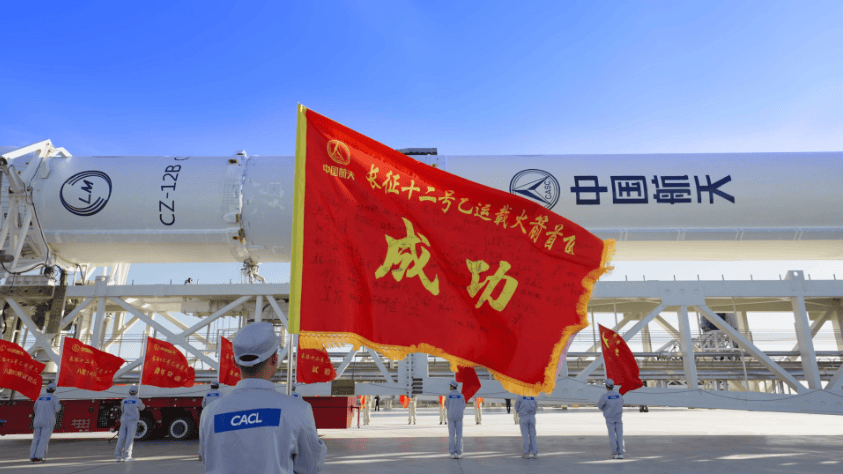
"Three Highs and One Low" Concept
Defining New Value Coordinates for Commercial Rockets
The development team built upon traditional rocket systems while innovating, establishing the product philosophy of "High Performance, High Safety, High Efficiency, and Low Cost," striving to create commercial rockets that can withstand market scrutiny.
High Performance: Creating a "Payload Powerhouse" for Large-Scale Internet Constellation Networking.
As the single-core rocket with the highest payload capacity in China currently, this model's first stage is equipped with nine 100-ton-class liquid oxygen/kerosene engines. Through innovative designs such as high-thrust pintle injector thrust chambers, lightweight turbopumps, and large-area-ratio high-altitude nozzles, it achieves performance leaps with a highly integrated propulsion system. Additionally, the rocket achieves systematic "weight reduction and slimming" of the airframe structure through optimized overall layout, and further enhances flight efficiency with innovative designs such as efficient propellant management, integrated tail section design, large-diameter common bulkhead tanks, and interstage aerodynamic separation technology, ultimately building a 20-ton-class commercial rocket high-payload platform.
High Safety: Building "Multiple Safeguards" for Intelligent Flight.
This model is equipped with flight control software featuring fault diagnosis and reconfiguration functions, capable of autonomously handling abnormal conditions during flight, significantly improving mission reliability and making the rocket truly "robust and durable." Meanwhile, the innovative application of gas-injection accumulator technology greatly simplifies the valve and pipeline systems for suppressing POGO vibrations, enhancing reliability at the system level and adding multiple layers of safety for flight.
High Efficiency: Streamlining the Entire Development and Launch Chain with "Commercial Rocket Speed."
The development team completed the entire process from blueprint design to model maiden flight in just 21 months, significantly shortening the assembly and testing cycle through digital collaborative design, achieving acceleration in commercial rocket development. At the launch end, the self-built research, test, and launch pad in Jiuquan achieves close coordination with multi-propellant compatibility and rapid recovery capabilities, significantly compressing the launch cycle and providing strong support for the mission.
Low Cost: Exploring Diverse Paths for Large-Scale, Low-Cost Solutions.
Through industrial support and technological innovation, the team seeks a balance between technology and economy, systematically advancing cost reduction in development. In terms of industrialization support, against the backdrop of large-scale development, it explores changes in the supply chain system, absorbing superior industrial resources with an open attitude to drive the upgrade of traditional systems. In terms of technological innovation, it innovatively conducts flight verification of flexible cables and TSN high-speed bus technology, introduces mature industrial products such as automotive-grade components, and compresses product manufacturing costs from the design source. Through a series of innovative practices, the cost per unit mass of orbital insertion has significantly decreased, achieving an organic unity of high reliability and low cost.
Multi-Dimensional Efforts
Boosting the Large-Scale Development of Commercial Aerospace
The successful entry of the Long March 12B carrier rocket into the launch service market marks a new stage in the engineering practice of China Commercial Rocket's rocket economic design philosophy. Targeting large-scale internet constellation networking, it will provide highly competitive launch options, driving the allocation of aerospace resources from "capability availability" to "optimal efficiency."
Precise Demand Adaptation, Accelerating the Commercial Closed-Loop Construction of LEO Constellations.
This mission accelerates the deployment of China's large-scale internet constellation networking. With its 20-ton-class high payload capacity and high-density, routine launch capability, the Long March 12B precisely matches the large-scale networking needs of internet constellations, effectively breaking payload bottlenecks and significantly reducing orbital insertion costs. It provides a high-quality launch solution for commercial satellite operators to build sustainable business models and achieve a virtuous industrial cycle, propelling the satellite internet industry from basic capability construction towards a new stage of large-scale, commercial closed-loop development.
Anchoring National Strategy, Building a New Paradigm for Commercial Rocket Industrialization.
The complete success of this mission is a landmark achievement of the Group in implementing the national commercial aerospace development strategy. As the main entity for the Group's commercial rocket development and China's commercial launch service operations, China Commercial Rocket, leveraging this model's development task, explores and forms a new market-oriented R&D and operation model of "demand-driven, technology-empowered, commercial closed-loop." The Long March 12B completed its development and maiden flight in just 21 months, fully demonstrating the comprehensive advantages of "short-cycle development, high-efficiency contract fulfillment, and full-process service," continuously improving the "one-stop" launch service system, opening new space for batch production, routine launches, and market expansion of the model.
Deepening Rocket-Launch Site Integration, Building an Efficient and Low-Cost Launch Operation System.
This maiden flight is the first comprehensive practical verification of China Commercial Rocket's implementation of the "rocket-launch site integration" innovation model. The Dongfeng Innovation Experimental Zone China Commercial Rocket research, test, and launch pad used for the mission is the Group's first self-built pad, invested in, constructed, and operated by China Commercial Rocket. This pad possesses the capability to support launches of liquid oxygen/kerosene and liquid oxygen/methane rockets and rapid recovery, achieving standardized rocket-ground interface matching, seamless testing and launch process integration, and significantly shortened mission cycles, providing efficient support for increasing launch frequency and supporting large-scale internet constellation networking in the future.
Adhering to Iterative Evolution, Empowering Leapfrog Development of Reusable Technology.
The success of the maiden flight is not an end, but a new starting point for technological iteration and capability upgrade. The model adheres to the development approach of "step-by-step verification, continuous iteration." The flight data collected throughout the maiden flight will provide valuable practical basis for subsequent research on key technologies for reuse and state optimization. Through the deep integration of flight verification and technological iteration, the model will accelerate its evolution towards a new generation of reusable, cost-effective, and highly adaptable commercial launch vehicles, continuously reducing the cost of round trips between Earth and space and improving space transportation efficiency.
Currently, the Long March 12B carrier rocket focuses on rapidly enhancing China's space access capability through high-density launches, supporting large-scale internet constellation networking. In the future, with the large-scale production of this model, launch services will become more efficient, economical, and flexible, allowing more satellites to enter orbit faster and at lower cost.
This launch is the 647th launch of the Long March series carrier rockets.
This article is compiled by Wedoany. All AI citations must indicate the source as "Wedoany". If there is any infringement or other issues, please notify us promptly, and we will modify or delete it accordingly. Email: news@wedoany.com
Related Products

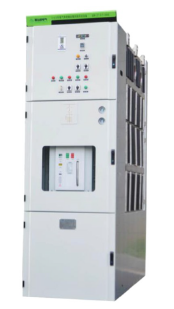
GSR6-27.5kV SF6 Free Gas-insulated Metal-enclosed Switchgear
Zhejiang Juhonkia Intelligent Electric Co., Ltd.

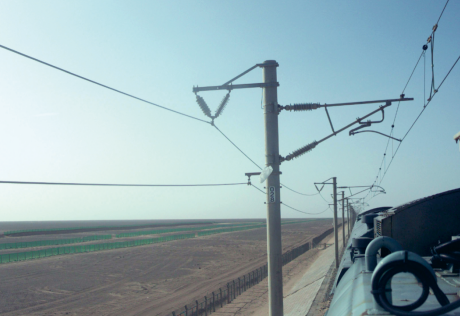
Pantograph-Catenary Comprehensive Detection Device (1C)
CHENGDU TANGYUAN ELECTRIC CO., LTD.


ERW Welded Pipe (Black Pipe and Hot-dip Galvanized Steel Pipe)
Handan Zhengda Steel Pipe Co., Ltd.