Siemens Launches Simcenter PhysicsAI, Engineering Simulation Enters AI-Powered Rapid Design Variant Screening Phase
en.Wedoany.com Reported - Recently, Germany's Siemens announced the launch of Simcenter PhysicsAI software, a new extension module for Simcenter STAR-CCM+ designed for AI-driven computational fluid dynamics design exploration. This tool enables engineers to quickly evaluate thousands of design variants within minutes and validate them through high-fidelity CFD simulation results.
Simcenter PhysicsAI targets early-stage design screening scenarios in automotive, aerospace, electronics, mechanical equipment, energy devices, and industrial product development. Traditional engineering simulation typically requires engineers to repeatedly model, mesh, solve, and post-process different geometries, with a single design exploration potentially lasting days or even weeks. With Siemens' introduction of PhysicsAI, geometric deep learning technology is embedded into the Simcenter STAR-CCM+ workflow. Engineers can train and validate AI reduced-order models using existing CFD simulation results, then perform near-real-time performance predictions for new geometric configurations. This allows design teams to conduct large-scale screening with AI in the early stages, reserving high-fidelity solving resources for more promising candidates, thereby reducing repetitive simulations and computational resource consumption.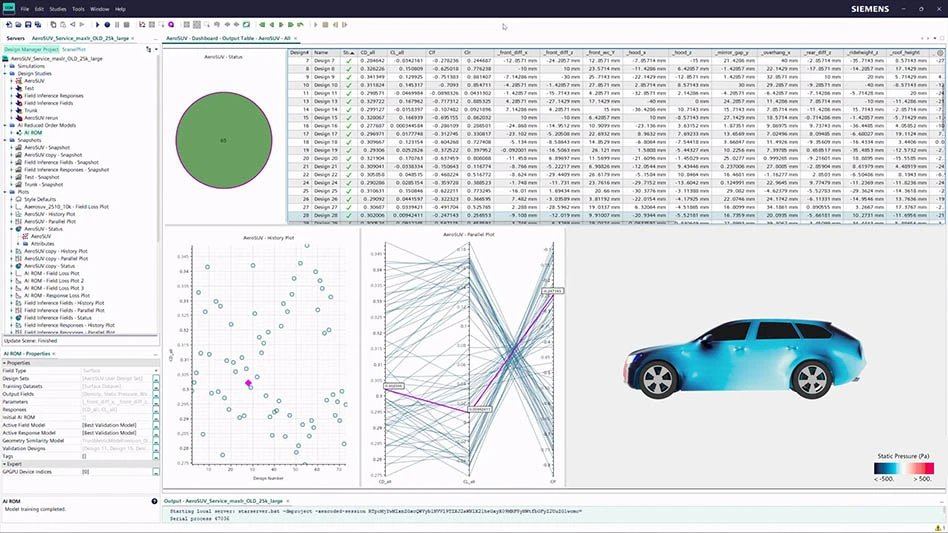
The core capabilities of this software include broader design space exploration, reuse of historical simulation data, rapid iteration, built-in error assessment, and GPU acceleration. Siemens states that Simcenter PhysicsAI can train predictive models based on a Transformer neural network architecture optimized for geometric data, evaluating thousands of design variants in minutes. It can also leverage historical data, newly generated results, and previous design experiment data to reduce the number of rerun CFD simulations. In optimization studies, the AI reduced-order model shifts early screening from solver execution to AI inference, enabling engineering teams to explore hundreds of design options within hours instead of waiting weeks.
The validation mechanism is critical for such industrial AI tools to be integrated into engineering workflows. Simcenter PhysicsAI retains high-fidelity CFD simulations as validation references and provides error metrics and validation tools to assess whether the AI model accurately captures performance trends. For engineering teams, AI prediction results must serve design decisions, not merely offer faster but uninterpretable numerical outputs. Built-in validation capabilities help engineers determine which options are suitable for further high-fidelity simulation, bench testing, or prototype validation, while also reducing the risk of AI model misjudgment in complex flows, thermal management, drag optimization, and structural shape variations.
This release is also tied to Siemens' expansion of its industrial software and AI simulation ecosystem. Simcenter PhysicsAI is now available as an extension module for Simcenter STAR-CCM+, and both new and existing customers will benefit from the ongoing capability expansion resulting from the integration of Siemens and Altair product ecosystems. As industrial enterprises pursue shorter cycles, lower costs, and higher performance in product development, AI simulation tools are moving from auxiliary analysis to the forefront of engineering processes. Designers can more quickly compare shapes, flow paths, cooling schemes, and aerodynamic parameters during the concept phase, while manufacturers have the opportunity to transform historical simulation assets into reusable engineering knowledge.
For industrial R&D systems, the change represented by Simcenter PhysicsAI is not merely about increasing solving speed, but about transforming the organization of design exploration. In the past, engineering teams were often limited by computing power, time, and manpower, selecting only a few options for in-depth simulation. With the intervention of AI reduced-order models, more design variants can be included in the screening scope at an early stage, with engineers then validating, selecting, and optimizing around the results. As digital twins, simulation software, GPU computing, and engineering AI further converge, industrial product development will increasingly emphasize "simulation data assetization" and "AI-assisted decision-making." Competition among engineering software vendors will also extend to model credibility, workflow integration, and enterprise-level data reuse capabilities.
This article is compiled by Wedoany. All AI citations must indicate the source as "Wedoany". If there is any infringement or other issues, please notify us promptly, and we will modify or delete it accordingly. Email: news@wedoany.com
Related Products


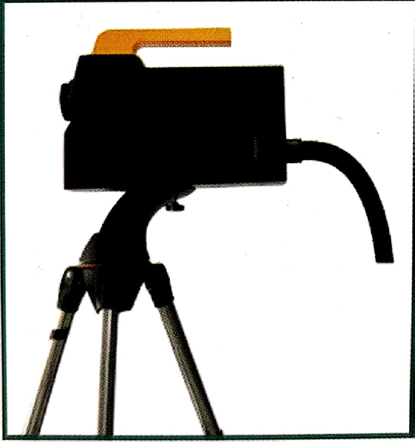
Automatic Aiming Laser Remote Obstacle Removal Robot
Pinggao Group Weihai High-Voltage Apparatus Co., Ltd.


TWP16 P-Band Tropospheric Wind Profile Radar
China Huayun Meteorological Technology Group Co., Ltd.

Mine Explosion-proof and Intrinsically Safe Industrial Ethernet Ring Network (10 Gigabit/Gigabit)
Chongqing Mas Sci&Tech Co., Ltd.

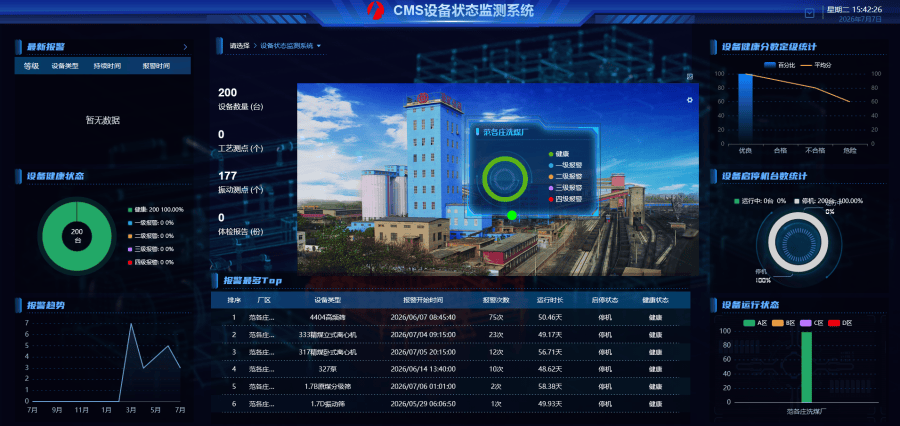
Comprehensive Mining Automation Control System
Beijing Tianma Intelligent Control Technology Co., Ltd.