UK Ofcom Reviews Openreach FTTP and Ethernet Pricing, Proposed Implementation in October 2026
en.Wedoany.com Reported - The UK communications regulator, Ofcom, has formally reviewed Openreach's new wholesale pricing proposals for full-fibre broadband (FTTP) and Ethernet connectivity services. These proposed changes are scheduled to take effect on 1 October 2026, and are subject to regulatory scrutiny due to Openreach's significant market power (SMP) in the UK fixed broadband infrastructure market.
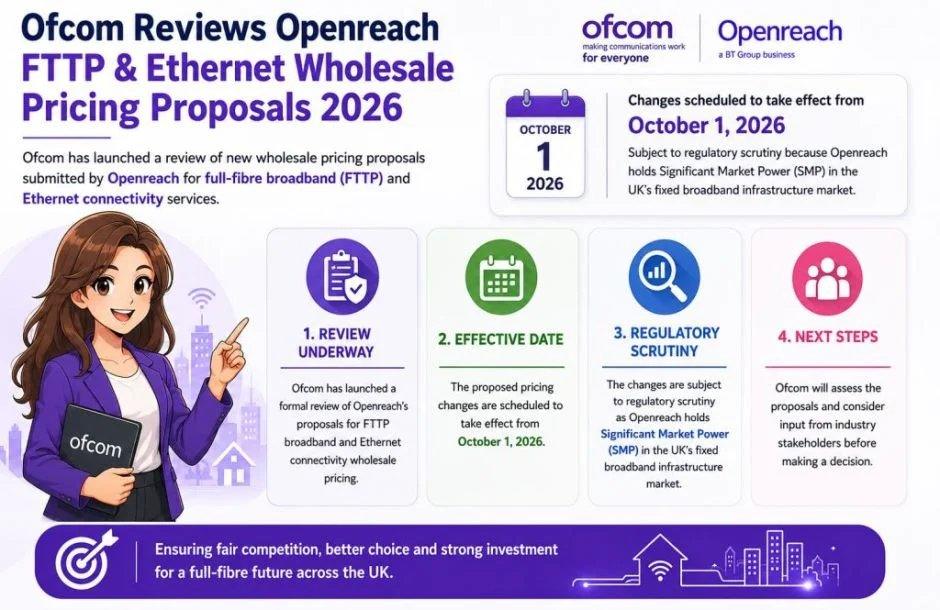
Under current regulations, Openreach must provide at least 120 days' notice before implementing major wholesale pricing changes. Ofcom has launched a Call for Inputs on this notification, inviting internet service providers (ISPs), telecom operators, and infrastructure companies to submit feedback by 19 June 2026. Openreach's revised FTTP wholesale pricing structure covers multiple broadband speed tiers, with proposed monthly rental fees including: £17.83 for 40 Mbps FTTP, £17.18 for 55/80 Mbps FTTP, £17.50 for 115 Mbps FTTP, £17.94 for 160 Mbps FTTP, £18.97 for 220 Mbps FTTP, £19.53 for 330 Mbps FTTP, £19.69 for 550 Mbps FTTP, £20.77 for 1.0-1.2 Gbps FTTP, and £21.30 for 1.8 Gbps FTTP. Among these, the pricing tiers for 550 Mbps, 1.0-1.2 Gbps, and 1.8 Gbps will continue to be adjusted in line with the Consumer Price Index (CPI). This pricing framework aims to support ongoing fibre network investment while maintaining affordability for wholesale broadband providers. Openreach emphasises that FTTP 80/20 broadband pricing is approximately £17.17 per month, equivalent to around £213.99 per year, helping to position fibre services as a cost-effective alternative to traditional copper broadband.
One key element under review is the £18.77 average revenue per user (ARPU) threshold mechanism. Under this arrangement, if retail broadband ARPU exceeds £18.77 per month, any additional revenue generated will be split equally between Openreach and retail service providers through a 50:50 revenue-sharing model. This mechanism allows Openreach to participate in broadband market growth while retaining wholesale pricing controls designed to protect competition.
Openreach has also proposed updated FTTP installation charges. For standard residential deployments, these include £32.07 for a new FTTP connection, £31.02 for an FTTP migration, and £64.15 for a complex installation. For rural and remote areas, a new connection costs £127.26, with migration fees ranging from £86.45 to £127.26. Business connection installation pricing is set at £127.26 for a standard business installation, £158.34 for a premium installation, and £308.56 for an advanced installation. These charges remain subject to Ofcom oversight to ensure fair market access and prevent excessive barriers to fibre adoption.
The scope of the review extends beyond residential broadband to include Openreach's Ethernet Access Direct (EAD) and leased line connectivity services used by businesses, mobile operators, cloud service providers, and data centre operators. Proposals include incentives to encourage customers to migrate from legacy Ethernet platforms such as WES, WEES, and BES to modern EAD services, offering migration discounts of 25% to 50% in specific scenarios, alongside pricing controls to support business network modernisation.
Openreach's notification also outlines revised exchange infrastructure and Cablelink pricing. Key charges include £2,373.50 for an external fibre connection (24-core), £2,793.30 for an external fibre connection (48-core), £1,100.30 for an internal room-to-room connection, £1,320.90 for a room-to-ODF connection, £1,757.80 for a room-to-splice connection, and an annual rental of £24.60 for a backhaul link. These services support fibre interconnection and deployment within Openreach's exchange facilities.
Other operational charges proposed by Openreach include £429.90 for external order cancellations and £238.80 for internal order cancellations. The company will continue to apply excess construction charges (ECC) on a 100% cost recovery basis for projects requiring additional civil engineering work. A primary objective of the pricing plan is to accelerate the migration from legacy copper and Ethernet infrastructure to a full-fibre network. The framework includes at least 90 days' notice for wholesale changes, 60 days' notice in specific approval cases, Ethernet migration discounts of 25% to 50%, waiving certain termination fees during the migration period, and incentives to encourage customers to migrate from FTTC to FTTP.
Ofcom will assess the proposal's impact on broadband wholesale competition, alternative network providers (altnets), FTTP market development, and Ethernet connectivity services. The regulator may approve the pricing framework, require modifications, or intervene before the proposed October 2026 implementation date. The outcome of this review will play a significant role in shaping wholesale broadband pricing, fibre investment strategies, gigabit broadband expansion, and the competitive landscape of the UK telecom market.
This article is compiled by Wedoany. All AI citations must indicate the source as "Wedoany". If there is any infringement or other issues, please notify us promptly, and we will modify or delete it accordingly. Email: news@wedoany.com
Related Products


MUX Series Communication Interface Device for Security and Stability Control System
Nanjing NR Electric Co., Ltd.
Multi-function Marine Monitoring Low-altitude Detection Radar Sea-air Boundary Ocean Dynamic Environment Measurement
Chengdu Dixin Technology Co., Ltd.




20 Inch 1600*900 Full HD 60Hz TFT LED Monitor with VGA and DP Interfaces for Desktop Computers-Business Use
Guangzhou Zanying Optoelectronics Technology Co., Ltd.

Flat Portable Satellite Terminal 0.35m Aperture Manual Portable Terminal
China Starwin Science & Technology Co., Ltd.
GYTA Type Non-Self-Supporting Aerial/Duct Optical Cable
TONGDING INTERCONNECTION INFORMATION CO., LTD.

Comprehensive Mining Automation Control System
Beijing Tianma Intelligent Control Technology Co., Ltd.