Starlink publicly acknowledges user session limit of 1,200
en.Wedoany.com Reported - SpaceX has publicly acknowledged that users of its Starlink Residential and Roam plans may experience performance degradation if they have too many active sessions on their connection.
A Starlink support page warns that the Residential and Roam plans use Carrier Grade Network Address Translation (CGNAT) and limit concurrent sessions to 1,200. Sessions are connections using UDP or TCP. When the 1,200 session limit is reached, new sessions automatically cause the oldest sessions to be dropped. The page further notes that disruptions may occur when "using many simultaneous applications," such as VoIP calls, video conferencing, online gaming, and VPNs. Many modern applications, especially real-time communication tools, require a large number of active sessions, and when the limit is exceeded, important connections may be terminated unexpectedly.
Starlink's use of CGNAT is not new, and some users have been informed of this limit in the past, but this is the first time the company has publicly acknowledged the issue. CGNAT is a workaround created to address the shortage of IPv4 addresses, allowing Internet Service Providers (ISPs) to share a single IPv4 address among multiple users. Starlink also supports the newer IPv6 protocol, but IPv6 is not backward compatible with IPv4. Many websites, such as GitHub, still lack IPv6 support. The Starlink support page also states that users on the Residential and Roam plans will use the 100.64.0.0/100 prefix as their default IPv4 configuration.
The CGNAT standard document encourages ISPs to limit active sessions to prevent users from monopolizing network resources, leading Starlink to set the 1,200 active session limit. Network expert Daryll Swer noted that CGNAT is "necessary to extend the limited v4 address space resources to serve millions of customers on large ISP networks," for example, a small ISP might have only a few hundred IPv4 addresses to allocate to 50,000 users. Swer estimates that the average Starlink user routes about 80% of their internet traffic via the newer IPv6 protocol, as most global traffic flows through content delivery networks that natively support IPv6, such as Cloudflare, Amazon Web Services, and Google Cloud. Netflix has built its own content delivery network for video streaming, while HBO Max uses a multi-CDN approach. This means about 20% of traffic is IPv4, and for an average household, having 1,200 TCP/UDP sessions active 24/7 per minute is extremely rare, even with over 40 devices on the local network. However, reaching 1,200 active sessions is still "very feasible," as a single application can open multiple internet connections.
A year ago, one Starlink user reported hitting the 1,200 limit while running about 35 devices in their house, from cameras to smart devices, desktops, phones, a NAS running Docker, and a Fedora machine running Nagios. After terminating some connections, all applications resumed normal operation. Data from Cloudflare Radars shows that about 48% of traffic from North American Starlink users accessing the web via browsers goes to IPv4 websites, with the rest going to IPv6; in Asia, Starlink IPv4 traffic is higher, reaching 80%, indicating far fewer websites in the region support IPv6. As for the reason, Swer suspects some Starlink users may be using their own older Wi-Fi routers that lack IPv6 support, adding: "I've deployed Starlink globally for 'residential-like' use cases, and we often see about 80% (IPv6) as the norm."
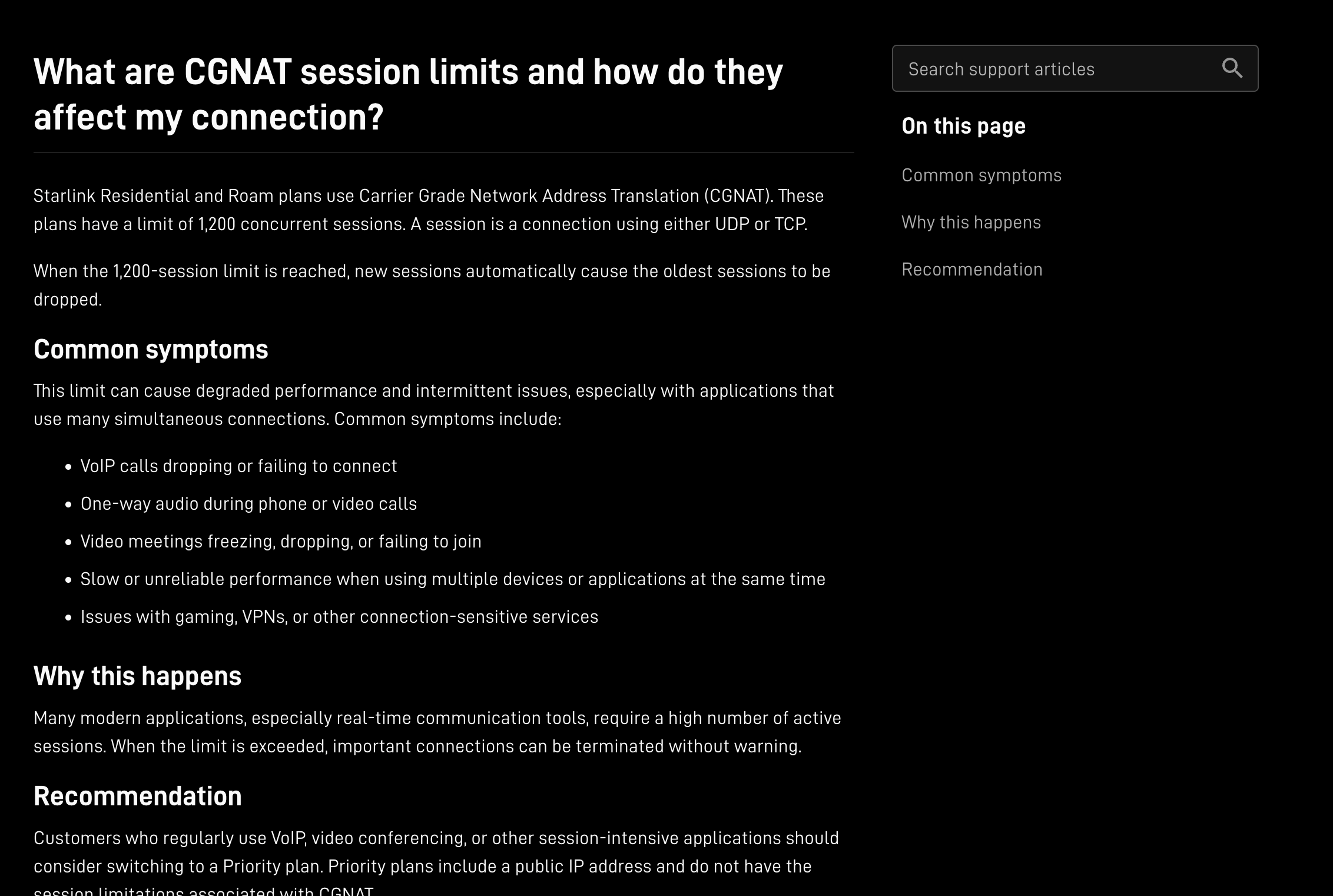
Another issue with Starlink's use of CGNAT is that it does not support port forwarding required for public-facing servers, as users are not assigned public IP addresses. User Robert Hawkins stated that he had difficulty streaming movies from his home network, "making hosting difficult due to CGNAT," and added: "Port forwarding doesn't work on my server because Starlink doesn't provide a publicly routable IP address." ISP use of CGNAT is often cited as a reason for hosting complaints. The Starlink support page notes that users who subscribe to the more expensive, business-oriented Priority plan can obtain a public IP address. This plan has a cap on high-speed data but includes a public IP address and has no CGNAT-related session limits. SpaceX has also established a "Fair Use Policy" for Starlink, allowing the company to take other measures to curb excessive usage.
This article is compiled by Wedoany. All AI citations must indicate the source as "Wedoany". If there is any infringement or other issues, please notify us promptly, and we will modify or delete it accordingly. Email: news@wedoany.com
Related Products



Mine Explosion-proof and Intrinsically Safe Industrial Ethernet Ring Network (10 Gigabit/Gigabit)
Chongqing Mas Sci&Tech Co., Ltd.

MUX Series Communication Interface Device for Security and Stability Control System
Nanjing NR Electric Co., Ltd.

Conveyor Belt Intelligent Monitoring System
LUO YANG WIRE ROPE INSPECTION TECHNOLOGY CO., LTD.
G.652.D Wavelength-extended Non-dispersion Shifted Single-mode Optical Fiber
HONGAN GROUP CO., LTD.
20 Inch 1600*900 Full HD 60Hz TFT LED Monitor with VGA and DP Interfaces for Desktop Computers-Business Use
Guangzhou Zanying Optoelectronics Technology Co., Ltd.