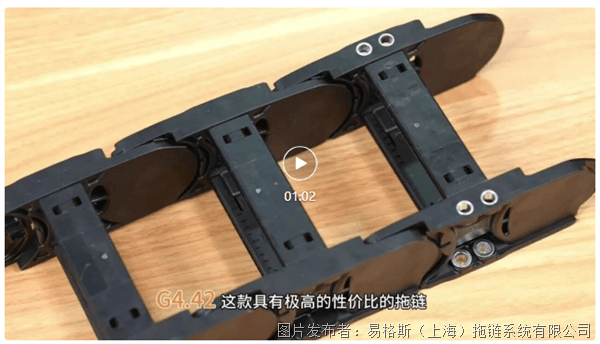
en.Wedoany.com Reported - igus has launched the G4.42 series energy chain for the indoor crane industry. This product is specifically designed for light-load, short-travel sliding applications on trolley structures, maintaining core performance while controlling procurement costs.
Compared to the standard E4.42 series, the G4.42 achieves a weight reduction of approximately 19% to 25%. However, its mechanical structure has been redesigned, for example, changing the tongue-and-groove structure to an internal and external snap-fit method. This concentrates material on key stress-bearing areas, achieving nearly the same load strength as the E4.42. Test data shows that under conditions of a 2.5 kg/m load, a 30-meter travel, and a speed of 2 m/s, the G4.42 has completed over 100,000 double cycles without stoppage. This series has a pitch of 100 mm, longer than the E4.42's 67 mm, requiring only 10 links per meter. This design reduces friction points and potential wear points, as well as the variety of installation parts and failure rates. Additionally, the side plates of the G4.42 feature wide sliding surfaces with a contact area nearly double that of the E4.42, effectively reducing unit pressure, extending sliding life, and mitigating jamming and breakage issues caused by misalignment.
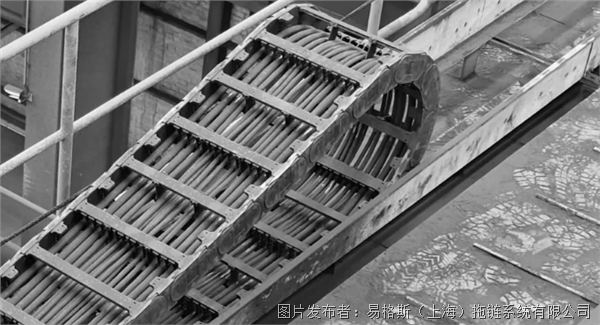
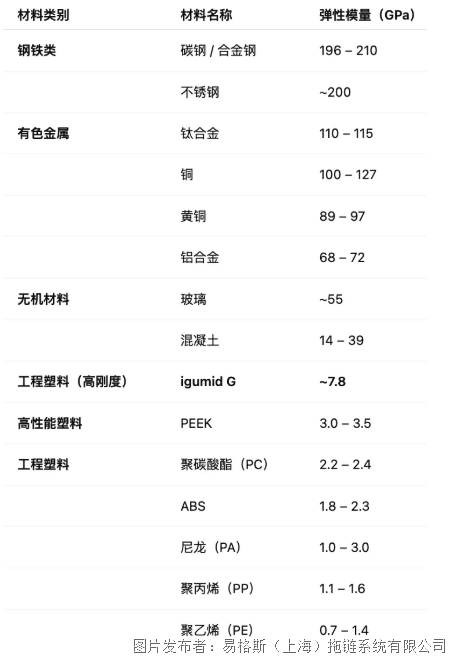
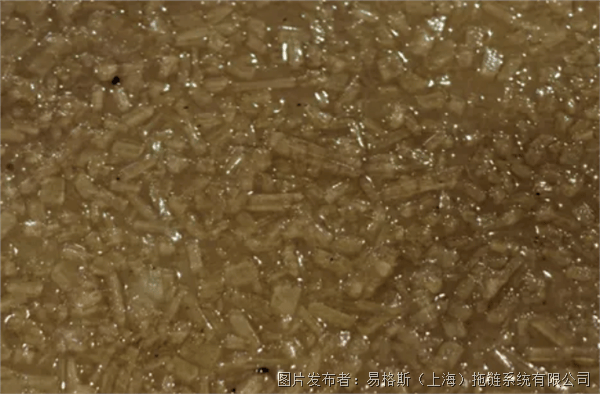
For harsh operating conditions such as high dust levels, igus manufactures energy chain links using igumid G material. This material has micro solid lubricants uniformly embedded within it, which are released during operation to reduce the coefficient of friction, creating a synergistic effect with the inherent lubricity of graphite dust. igumid G has a Shore hardness of 79D (per DIN 53505 standard) and an elastic modulus of approximately 7800 MPa (per DIN 53457 standard), effectively preventing hard particles from embedding into the material matrix. Combined with the tongue-and-groove odd-even link structure of the E4.1 series, the internal contact surfaces of the energy chain are smooth with rounded chamfers, reducing damage to cable outer sheaths from "mud cakes" formed by the combination of cement dust and moisture. In environments with both high temperature and high dust, such as electrolytic aluminum cranes, this solution can reduce equipment maintenance frequency.
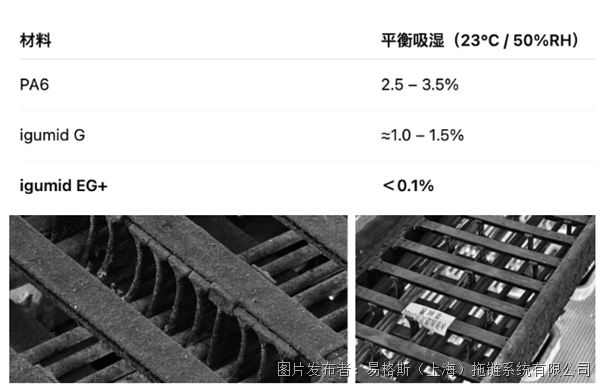
In highly corrosive environments such as electrolytic zinc plants, igus recommends using energy chains made of modified igumid EG+ material. This material has an extremely low water absorption rate, preventing corrosive media like acid mist and salt spray from penetrating the material matrix. This avoids issues common in standard PA-based materials, which are hydrophilic and susceptible to acidic solutions, leading to a 30% to 50% decrease in elastic modulus, softening, and deformation. In applications like electrolytic zinc cranes, using EG+ material energy chains can effectively reduce maintenance rates, minimizing downtime frequency and duration.
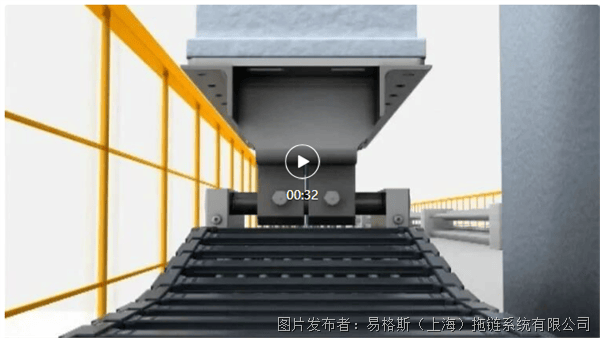
In high-frequency, high-speed, and long-travel operating conditions, igus ensures straightness through mold precision control, an odd-even link structure, and a floating head design. The odd-even links adopt an "inner-outer-inner-outer" alternating structure, which constrains the minute deflection forces generated by individual links, preventing non-linear error growth. This provides strong lateral rigidity, counteracting offsets caused by track precision errors. The floating head compensates for straightness errors due to objective factors such as installation, civil works, main beam deflection, and equipment aging, reducing wear and the likelihood of fastener loosening.
In terms of intelligence, igus has launched the iSense intelligent plastic system, which includes multiple types of sensor modules. The EC.P (Push-Pull Force Detection System) continuously monitors the actual push-pull force values during energy chain operation by installing a pair of tension sensors at the connection points. Once the value exceeds a preset threshold, it sends a stop signal to the crane PLC, typically with a response time in seconds. The EC.B (Energy Chain Breakage Detection System) arranges a polymer wire inside the energy chain, connected end-to-end. When a link mechanically breaks or separates, the polymer wire experiences displacement beyond its range, triggering the iSense module to cut the electrical signal circuit, preventing the energy chain from continuing to run. The EC.W (Wear Detection System) monitors the remaining thickness in real-time via micro-sensors integrated into the crossbars at the fixed end, allowing for setting maintenance reminders or stop actions at different stages. The i.Cee (Predictive Maintenance System) combines sensors, software, and the iSense module to dynamically calculate service life and determine the optimal maintenance time, transitioning from "repair after failure" to "planned maintenance," and features remote monitoring and long-term data integration capabilities.

This article is compiled by Wedoany. All AI citations must indicate the source as "Wedoany". If there is any infringement or other issues, please notify us promptly, and we will modify or delete it accordingly. Email: news@wedoany.com