en.Wedoany.com Reported - On June 5, at the 2026 Tencent Cloud AI Industry Application Conference, Tencent Group Senior Executive Vice President Dowson Tong engaged in a dialogue with Tencent Chief AI Scientist Yao Shunyu. When asked why he joined Tencent and how he understands the "second half of AI," Yao stated that AI methodologies have become more mature, and the real challenge lies in finding good problems worth solving. Tencent possesses a wealth of good problems and products, which was one of the key reasons for his decision to join.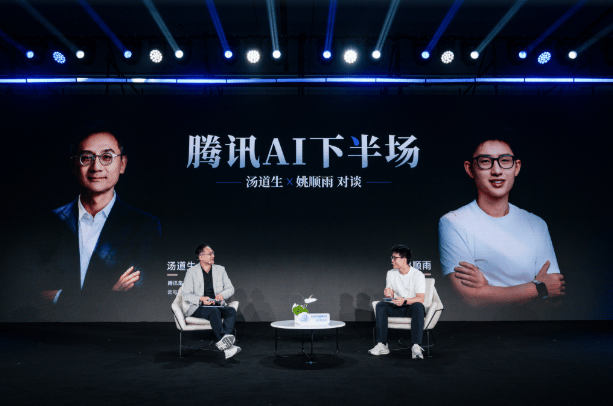
The focus of this dialogue was not simply to explain a talent transfer, but rather how Tencent is redefining organizational capabilities as large models enter the industrial application phase. In the previous round of AI competition, industry attention was heavily concentrated on model parameters, training scale, benchmark scores, inference costs, and single-point capabilities, leading companies to compare primarily around "what the model can achieve." Yao's proposed logic of "good problems" shifts the perspective from model capabilities themselves to real-world application scenarios: as methods like pre-training, post-training, agent frameworks, and tool calling mature, the challenge for technical teams is no longer just finding a stronger algorithm, but determining which user needs, business processes, and product scenarios are truly worth reconstructing with AI. Tencent's uniqueness lies in its rich product line, covering multiple high-frequency scenarios such as social networking, content, gaming, office productivity, cloud services, fintech, and industrial internet. These scenarios involve massive user interactions, complex enterprise processes, and product experiences requiring long-term refinement. For an AI team, such problems are closer to the core of competition in the second half than abstract technical metrics: for model capabilities to enter products, a closed loop of specific tasks, real data, stable feedback, and sustainable iteration must be found.
Yao also mentioned that Tencent is generally a company that operates based on "trust" rather than mere "metrics," a culture that is very important for building a long-term oriented AI organization.
This judgment corresponds to a real contradiction in AI organizational building. Short-term metrics can quickly drive model releases, product launches, and data growth, but cutting-edge AI R&D often requires a longer cycle, allowing for exploration, trial and error, and cross-team collaboration. Especially during the reconstruction phase of agents, foundation models, AI infrastructure, and complex products, many key achievements may not immediately manifest as single metric growth, but rather in the accumulation of underlying capabilities, improvement of product experience, stability of engineering systems, and long-term scenario adaptation. If an organization operates solely around short-term call volumes, benchmark scores, or traffic conversion, the AI team can easily fall into chasing local optima. If higher trust is given to research and product teams under a clear direction, it becomes more likely to refine models, products, data, and user feedback within the same long-term system. Tencent's current push for the Hunyuan large model, agent toolkits, AI Infra, and industrial applications precisely requires this organizational capability of "co-designing models and products," ensuring that technical R&D does not detach from real scenarios and that product teams can understand the boundaries of model capabilities.
Yao's description of the "second half of AI" also indicates that the large model industry is transitioning from a phase of technological explosion to a phase of problem selection. Future competition may not solely depend on who has the single strongest model, but on who can consistently identify high-value problems and embed model capabilities into products that users use daily. For Tencent, this means AI is not just about cloud services, model platforms, or new agent products, but must gradually integrate into social communication, content production, office collaboration, game development, enterprise services, and industrial processes. The more good problems there are, the richer the feedback for model iteration; the more good products there are, the clearer the path for AI capability deployment.
Subsequent observation will focus on whether Tencent can translate the "good problems" Yao mentioned into scalable product outcomes. The competition in the second half of AI will test organizational patience, product understanding, engineering capabilities, and scenario density. Whoever can embed technical capabilities into high-frequency products and complex industrial processes will have a better chance of advancing large models from capability demonstrations to true productivity.
This article is compiled by Wedoany. All AI citations must indicate the source as "Wedoany". If there is any infringement or other issues, please notify us promptly, and we will modify or delete it accordingly. Email: news@wedoany.com