en.Wedoany.com Reported - Public information shows that Neolix's unmanned vehicles have launched NeoClaw, an operations-level AI agent for the unmanned delivery industry. This intelligent agent is embedded at the top of the "Neolix Timely Delivery" unmanned vehicle management app. Users can complete vehicle management, task dispatching, point collection, and operational data queries through natural language conversations, pushing unmanned delivery operations from manual interfaces further toward AI dialogue-based dispatching.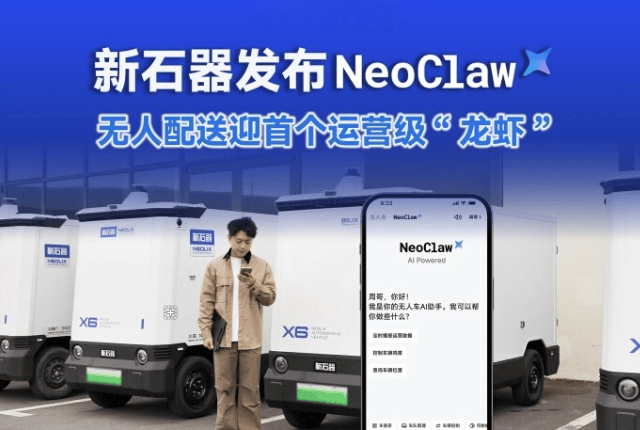
The product value of NeoClaw is concentrated in the "last-mile management" phase of large-scale unmanned vehicle operations. As unmanned delivery vehicles move from single-vehicle demonstrations to multi-city, multi-fleet operations, the challenges enterprises face are no longer just whether vehicles can drive autonomously, but how to efficiently dispatch a large number of vehicles, quickly handle anomalies, reduce the learning cost for operators, and enable frontline personnel to quickly find the correct operational entry points in complex systems. Previously, unmanned vehicle operators had to switch between management backends, map interfaces, vehicle lists, data panels, and task systems to perform tasks such as opening/closing vehicle doors, recalling vehicles, charging dispatching, fault queries, operational statistics, and point collection. NeoClaw compresses these operations into a dialogue interface. Operators only need to express their needs in natural language, and the system can understand the task intent, scan vehicle status, verify permissions and conditions, and drive the actual vehicles to perform corresponding actions. For the unmanned delivery industry, such intelligent agents are no longer just AI tools for information retrieval or text generation, but production tools integrated into the operational chain of the physical world. Whether vehicles can be recharged on time, abnormal vehicles can be quickly located, multiple stations can be dispatched uniformly, and operational data can be quickly aggregated directly impacts the fulfillment efficiency and service stability of unmanned delivery businesses.
NeoClaw has been initially launched in some areas such as Beijing and Qingdao. Users can experience it after updating the "Neolix Timely Delivery" app, and it will subsequently cover more cities.
From a technical perspective, the key to NeoClaw is not simply connecting a chatbot to the vehicle backend, but forming a closed loop that integrates natural language understanding, task decomposition, permission verification, vehicle status recognition, dispatching systems, and real execution actions. Unmanned vehicle operations involve physical assets; any command can potentially affect vehicle movement, parking, door opening/closing, recharging, and task status. Therefore, the system must, beyond "understanding what the user says," complete identity recognition, permission judgment, vehicle condition verification, and execution result feedback. A Neolix representative once mentioned that NeoClaw adopts a self-developed intelligent agent architecture, focusing on breakthroughs in goal-driven and task dynamic evolution capabilities, rather than simply reusing open-source Agent frameworks. This means it is designed for complex tasks in long-term operations: the same sentence may correspond to different execution paths in different cities, with different fleets, and under different vehicle statuses; the same operational goal may require the system to first query data, then determine vehicle location, and then arrange dispatching actions. For enterprise customers, such capabilities can reduce training costs for new employees, enabling more frontline personnel to quickly become "fleet commanders," and also help unmanned delivery companies expand their management scope from a small number of vehicles to larger fleet sizes. As unmanned delivery vehicles enter scenarios such as supermarket retail, instant delivery, campuses, industrial parks, and urban last-mile logistics, AI agents will become an important middle layer connecting vehicles, operators, and customer needs.
The launch of NeoClaw also reflects the shifting competitive focus in the unmanned delivery industry. In the early stages, the industry emphasized autonomous driving algorithms, vehicle mass production, road compliance, and scenario piloting. As it enters the operational phase, enterprises need to increase the number of vehicles manageable per person, lower the barrier to using complex backends, and consolidate scattered operational experience into reusable intelligent systems. If Neolix can continuously integrate NeoClaw into more vehicles, cities, and customer scenarios, it will have the opportunity to advance unmanned vehicle operations from a "human monitoring vehicle" model to a new paradigm of "human dialogue, system execution, vehicle response."
This article is compiled by Wedoany. All AI citations must indicate the source as "Wedoany". If there is any infringement or other issues, please notify us promptly, and we will modify or delete it accordingly. Email: news@wedoany.com