en.Wedoany.com Reported - At the Build 2026 conference, Microsoft unveiled seven internal models under its MAI brand, introduced new server processors optimized for agents, showcased a next-generation quantum chip, and integrated an agent platform spanning Windows, Azure, and GitHub. The company described this positioning as "self-sufficient," emphasizing its ability to provide its own intelligence, its own chips, and its own runtime. However, this move does not signify a break with OpenAI but rather the construction of a controllable alternative, with the partnership continuing.
Mustafa Suleyman, head of Microsoft AI, demonstrated the seven models, covering capabilities such as reasoning, coding, image generation, speech, and transcription. The flagship reasoning model, MAI-Thinking-1, employs a sparse mixture-of-experts design, featuring approximately 35 billion active parameters and a context window of 256,000 tokens. It is currently available in private preview via Microsoft Foundry, rather than a full release. Microsoft stated that blind human evaluators preferred this model over Anthropic's Claude Sonnet 4.6, and it performed comparably to Claude Opus 4.6 on the SWE-bench Pro coding benchmark. Another smaller, more efficient coding model, MAI-Code-1-Flash, will be integrated into the editor for GitHub Copilot users. These models were trained from scratch using licensed data, without knowledge distillation from other labs.
Microsoft stated that these models utilize a training pipeline called "Hill Climber," which continuously cycles and improves as global computing capacity scales. The company co-designed the MAI models with the Maia 200 inference accelerator and reported efficiency gains from pairing the two. Microsoft also introduced Frontier Tuning technology, which allows reinforcement learning to be applied within a customer's own compliance boundaries, adapting models to specific businesses. Microsoft cited an internal case showing task completion rates improving from 13% to 87%, and claimed that a version tailored for Excel tasks matched a frontier OpenAI model at up to 10 times lower cost. However, these figures come from Microsoft and have not been independently verified.
On the infrastructure front, Microsoft released Arm-based Azure Cobalt 200 virtual machines, now in preview, offering up to 50% processor performance improvements depending on the workload, and optimized for Linux-based agent AI. It also added Azure HorizonDB, a Postgres-compatible AI application service with features like vector search, and connectivity to Foundry and Fabric. A GPU-accelerated version of the Fabric data warehouse, in Microsoft's internal testing in May, ran seven times faster than three competing cloud warehouses, though the company did not disclose benchmarks against named competitors.
In the agent domain, Microsoft made the Agent 365 software development kit generally available and reorganized the knowledge layer around Foundry IQ (now generally available), unifying Work IQ, Fabric IQ, Azure SQL, file search, and external data sources, and adding Web IQ for real-time web grounding. A new GitHub Copilot desktop application pushes Copilot beyond chat into management tasks and pull requests, and Visual Studio is migrating onto the GitHub Copilot software foundation. Microsoft also showcased MDASH, a multi-model scanning system in expanded private preview that pairs Defender with GitHub to discover and remediate vulnerabilities, while offering Windows containers to isolate agents under policy.
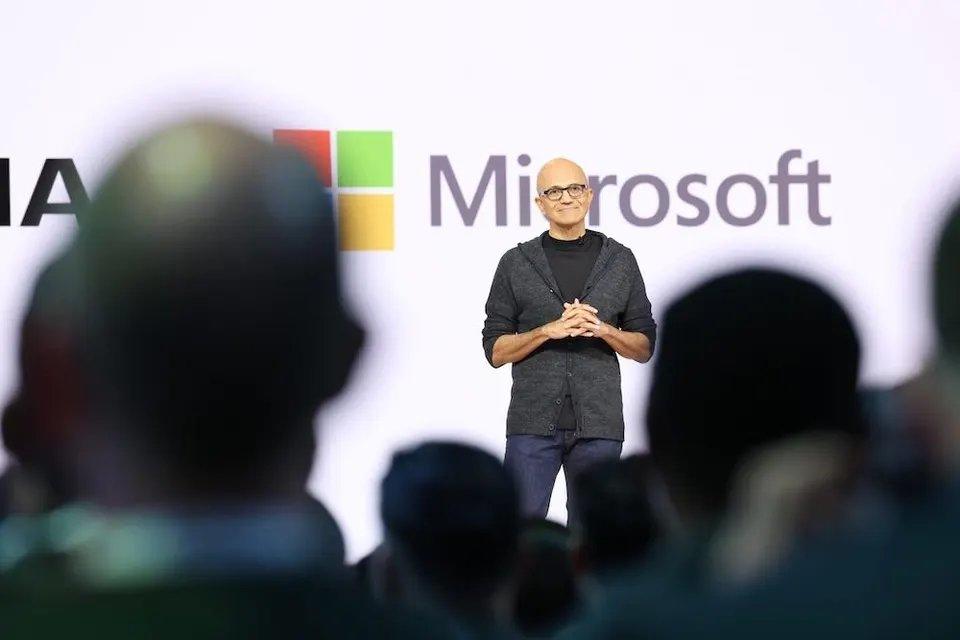
On the hardware side, the Surface RTX Spark Dev Box, built in collaboration with Nvidia, delivers approximately 1 petaflop of local AI compute. A concept device called Project Solara envisions machines running agents that replace applications. Microsoft CEO Satya Nadella appeared alongside Nvidia's Jensen Huang and Qualcomm's Cristiano Amon. In quantum computing, Microsoft unveiled its next-generation quantum chip, Majorana 2, claiming an average qubit lifetime of 20 seconds, a 1,000-fold improvement in reliability over the previous generation, and the potential to achieve one million qubits on a chip the size of a palm, with a target of launching a scalable quantum computer by 2029.
Since 2023, Microsoft's reliance on OpenAI has defined its AI strategy. By owning its own models and co-designing them with Maia and Cobalt chips, Microsoft has gained room to negotiate costs. Currently, MAI still cannot replace OpenAI or Anthropic in Copilot, as those models handle the majority of production traffic. The company still relies on Nvidia for training compute and on chip partners for devices running agents. Every performance metric Microsoft shared comes from its own evaluations. MAI-Thinking-1 is in private preview, Cobalt 200 VMs are in preview, MDASH is in expanded private preview, and Project Solara is a concept device. Buyers currently cannot test most of these claims with their own workloads. Frontier Tuning results are based on an internal case and require independent verification. The quantum timeline is still years away, and quantum roadmaps across the industry have long experienced delays.
This article is compiled by Wedoany. All AI citations must indicate the source as "Wedoany". If there is any infringement or other issues, please notify us promptly, and we will modify or delete it accordingly. Email: news@wedoany.com