en.Wedoany.com Reported - Micro-Epsilon's optoNCDT laser triangulation sensors have been applied to measure metal rim thickness in the flow forming process, helping manufacturers accurately evaluate the thickness distribution of the circular body after each deformation step, ensuring product dimensions meet target requirements while reducing production costs.
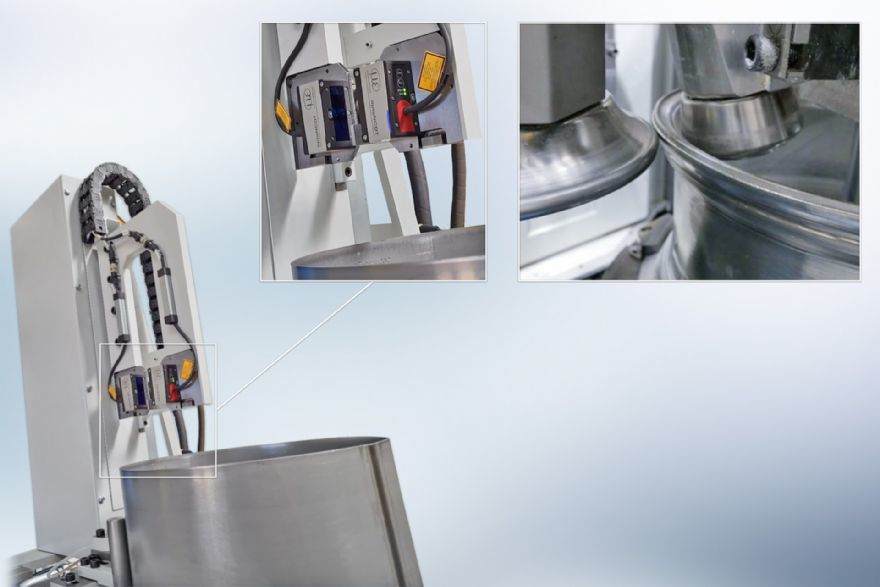
Flow forming is an advanced cold-rolled metal processing technology that uses CNC rollers to press a cylindrical "preform" tightly against a mandrel, causing the material to "flow" and thin during stretching, producing thinner, longer, and stronger components. This process requires high control over material thickness distribution, necessitating precise measurement to ensure final product quality.
The measurement task employs two optoNCDT 1900-10 laser sensors with a 10 mm measuring range. These sensors are designed for dynamic and high-resolution measurement, featuring a compact housing and an innovative mounting sleeve that ensures repeatable alignment of the sensor position with the target. The sensors support high-speed distance, displacement, and position measurement, suitable for automation scenarios such as mechanical engineering, robotics, automotive manufacturing, 3D printing, and coordinate measuring machines.
The optoNCDT 1900 series incorporates an advanced surface compensation (ASC) algorithm that reduces the impact of target material and color variations on measurement results. The sensor dynamically adjusts exposure time or light intensity to match the reflective characteristics of the target surface, enabling reliable measurement of uneven and changing surfaces. The sensor has strong resistance to ambient light interference and can be used in high-illumination environments, including with LED lighting from lasers and vision systems. New software algorithms compensate for ambient light up to 50,000 lux, improving performance under direct sunlight.
The sensor offers 5 μm repeatability and a measurement rate of up to 10 kHz, enabling fast and consistent measurement of rim thickness. With an IP67 protection rating, the sensor provides excellent resistance to shock and vibration, making it suitable for harsh industrial environments. Additionally, the Class 2 laser requires no additional protective measures.
Through an optional industrial Ethernet interface, the optoNCDT 1900-10 sensor supports EtherCAT, EtherNet/IP, or PROFINET protocols, allowing direct integration into a PLC without the need for additional interface modules, thereby obtaining real-time data and reducing installation and wiring efforts. The full optoNCDT 1900 series offers measuring ranges from 2 mm to 500 mm, meeting diverse application requirements.
This article is compiled by Wedoany. All AI citations must indicate the source as "Wedoany". If there is any infringement or other issues, please notify us promptly, and we will modify or delete it accordingly. Email: news@wedoany.com