en.Wedoany.com Reported - Google's Nuvem and Sol submarine cable systems have officially landed in Bermuda, marking a substantial expansion of the island's international digital infrastructure and further solidifying its position as a strategic connectivity hub in the Atlantic. Representatives from the government, the Bermuda Business Development Agency, Google, and project partners attended the commemorative ceremony.

The two cable systems landing this time are designed to enhance international connectivity, improve network resilience, and support the growing demand for secure digital infrastructure. Located in the mid-Atlantic, Bermuda has historically served as an important communications relay point. Local government officials noted that the new cable systems will further strengthen Bermuda's position in the global digital network. This infrastructure is expected to support the financial services, insurance, reinsurance, fintech, digital assets, and other technology-driven industries, contributing to local economic development.
Bermuda's Premier, David Burt, stated that for centuries, Bermuda's location in the Atlantic has been one of its greatest advantages, and this advantage now continues to place the island at the center of the connectivity driving the global economy. Officials emphasized that resilient international connectivity is increasingly important for economic security, disaster preparedness, and business continuity. The Bermuda government believes this project will help attract additional investment, support future technology industries, and lay the foundation for the continued growth of demand for cloud services, AI infrastructure, and international digital connectivity.
Bermuda holds strategic value on transatlantic routes connecting North America, Latin America, the Caribbean, and Europe. The addition of the Nuvem and Sol cables enhances route diversity and provides extra resilience for data flows across the Atlantic. Route diversity has become increasingly critical as stakeholders seek to reduce single points of failure in international communication networks.
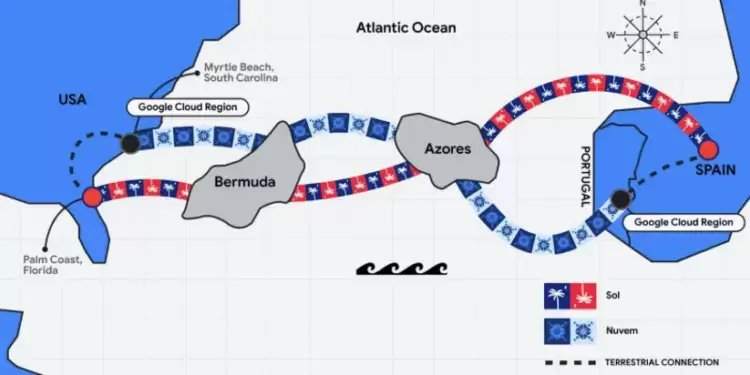
The Nuvem cable system, serving as the eastern corridor, spans approximately 7,194 kilometers (including a 6,900 km trunk, a 170 km Bermuda branch, and a 124 km Azores branch), equipped with 16 fiber pairs, each with a capacity of 24 Tbps, for a total design capacity of about 384 Tbps. Announced in September 2023, the system is scheduled to be operational in the second half of 2026, with landing points including Myrtle Beach, South Carolina, USA; Bermuda; the Azores; and Sines, Portugal.
The Sol cable system, serving as the southeastern corridor, spans approximately 8,153 kilometers and is the only active fiber optic pipeline directly connecting Florida, USA, to mainland Europe. Announced in July 2025, the system is scheduled to be operational in 2028, with landing points including Palm Coast, Florida, USA; Bermuda; the Azores; and Santander, Spain. The system also adopts a 16-fiber pair architecture, with wet equipment provided by US-based SubCom as a turnkey supplier.
The two cable systems feature a dual-corridor transatlantic mesh terrestrial failover interconnection mechanism. If a fiber pair on the Nuvem line is interrupted due to events such as ship anchor dragging or earthquakes, an automatic optical routing engine immediately reroutes the data packet stream to the terrestrial corridor between Florida and South Carolina, transmitting it across the ocean via the Sol system. This dual-path layout helps avoid data flow bottlenecks at traditional northern gateways, such as New Jersey.
This article is compiled by Wedoany. All AI citations must indicate the source as "Wedoany". If there is any infringement or other issues, please notify us promptly, and we will modify or delete it accordingly. Email: news@wedoany.com