en.Wedoany.com Reported - Hewlett Packard Enterprise (HPE) recently announced an expansion of its quantum computing strategy, signing cooperation agreements with eight quantum technology companies to integrate its HPE Cray high-performance computing platform with various quantum technologies, positioning itself as a core system integrator in the hybrid classical-quantum computing space.
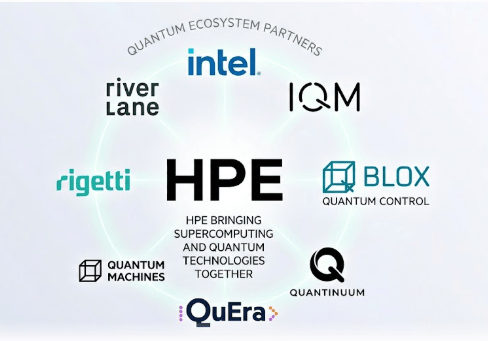
The eight partners cover the major technology stacks in the industry. Hardware technologies include Intel (silicon spin qubits), IQM and Rigetti Computing (superconducting), Quantinuum (ion trap), and QuEra Computing (neutral atoms). Control systems and error correction include Qblox and Quantum Machines (quantum control infrastructure) and Riverlane (quantum error correction).
HPE's collaboration represents an inevitable choice for HPC vendors in the trend of integrating quantum accelerators into supercomputing architectures. Rather than betting on a single internal hardware technology, the company leverages the densely coupled network and classical infrastructure of its Cray supercomputers as a bridge to connect the quantum ecosystem, focusing on co-design, software interoperability, and system-level performance benchmarking—key issues that data centers must address when managing hybrid workflows.
By covering four technology routes—neutral atoms, ion traps, superconducting, and silicon spin—HPE is building a vendor-neutral testbed. This broad strategy allows it to evaluate the pros and cons of different architectures before the industry reaches a consensus on fault-tolerant technology, without committing to a single solution. Including Riverlane in the partnership also indicates that HPE has looked beyond NISQ machines, focusing on how to integrate high-overhead quantum error correction protocols into classical architectures. For the participating quantum hardware and software startups, collaboration with HPE provides critical enterprise channels and validation opportunities, helping their systems meet data center design requirements from the outset. The challenge for HPE lies in advancing these high-level cooperation frameworks and joint testbeds into standardized, commercially viable products, enabling seamless orchestration of workloads among classical CPUs, GPUs, and QPUs.
HPE announced the initiative at HPE Discover 2026 in Las Vegas.
This article is compiled by Wedoany. All AI citations must indicate the source as "Wedoany". If there is any infringement or other issues, please notify us promptly, and we will modify or delete it accordingly. Email: news@wedoany.com