en.Wedoany.com Reported - Israeli startup BaroMar is developing a long-duration renewable energy storage solution based on compressed air and rigid subsea tanks, leveraging the natural pressure of seawater for energy storage. The company has now launched a demonstration project in Cyprus.
As solar and wind power generation scales up, the grid increasingly requires systems capable of storing electricity for hours. Companies and research institutions are seeking alternatives to store excess power during periods of overgeneration and feed it back to the grid when generation is low. The solution developed by BaroMar falls under Compressed Air Energy Storage (CAES) technology, with the key difference being that its tanks are installed on the seabed, using the natural pressure of water to balance the air pressure inside the tanks.
The company has named its first configuration project PROTEAS, which is planned to have a storage capacity of 3 MWh and a continuous discharge duration of 10 hours. An earlier statement from consulting firm Jacobs mentioned a 4 MWh pilot project in Cypriot waters. In December 2024, BaroMar announced a partnership with the Cyprus Institute to install and test the technology at the PROTEAS facility in Cyprus, with the tanks to be submerged at a depth of approximately 100 meters.
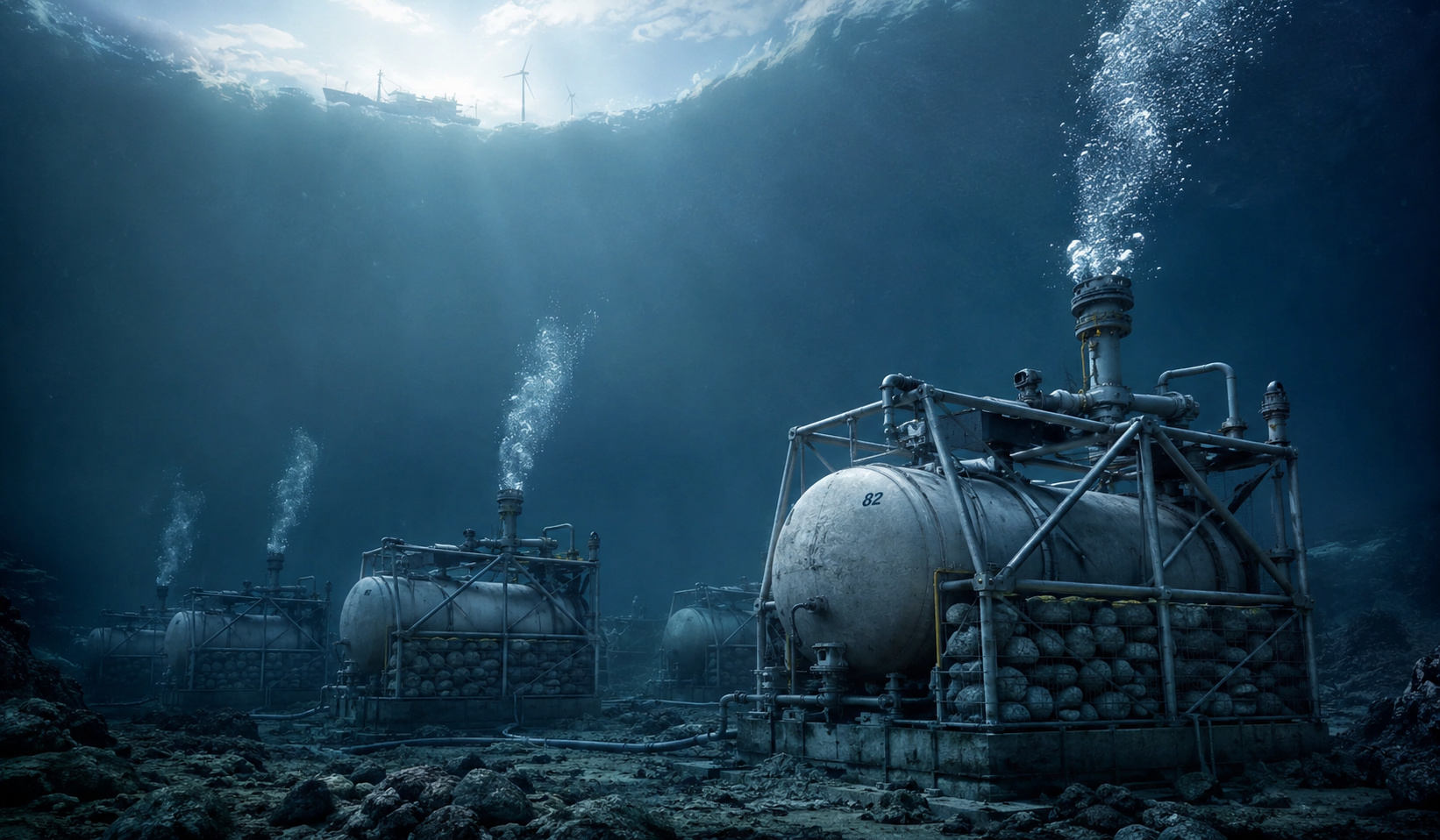
The system works as follows: when there is excess electricity on the grid, the equipment uses this energy to compress air and send it through pipelines into the subsea tanks; when demand increases, the air returns to the surface to drive power generation equipment. In this process, the natural pressure of seawater helps balance the air pressure inside the tanks, thereby reducing the structural requirements of the tanks. During the storage cycle, the tanks are initially filled with seawater; compressed air displaces the water and remains compressed under ambient hydrostatic pressure. When energy is recovered, water re-enters the tanks, pushing the air back through the pipelines, where the airflow passes through a heat recovery system and expansion equipment to drive a generator.
BaroMar's design uses rigid tanks made of concrete and steel, stabilized by ballast cages filled with stones. The technology can operate at depths of 200 to 700 meters below the sea surface; the greater the depth, the higher the hydrostatic pressure. However, the Cyprus project starts with a shallower configuration, with tanks placed at a depth of about 100 meters, connected to onshore infrastructure via flexible air delivery pipelines. According to Jacobs, the pilot project aims to achieve a round-trip efficiency of up to 70% over the complete cycle of compression, storage, and power generation.
The technology is still in the demonstration phase. Development requires studies of seabed conditions, depth, seabed soil behavior, and permitting requirements, as well as assessments of technical risks such as corrosion, salinity, ocean currents, and biofouling. The Cyprus Institute stated that the project will integrate heat recovery and storage systems to improve cycle efficiency. As of publicly verifiable information, no reliable confirmation has been found that the system has entered commercial operation. If testing confirms the parameters announced by the company and its technology partners, subsea compressed air batteries may be evaluated as an alternative among long-duration storage solutions.
This article is compiled by Wedoany. All AI citations must indicate the source as "Wedoany". If there is any infringement or other issues, please notify us promptly, and we will modify or delete it accordingly. Email: news@wedoany.com