en.Wedoany.com Reported - Germany's Infineon Technologies AG has recently launched a new 1300V silicon carbide (SiC) power module in its HybridPACK™ Drive series, targeting traction inverter applications in electric vehicles. This module raises the continuous operating temperature of automotive-grade SiC power modules to a maximum of 205°C. Infineon states that existing designs typically allow operation up to 175°C, and the new module offers a 30°C improvement in temperature capability. This enables automakers and Tier 1 suppliers to unlock higher peak and continuous output power within existing inverter architectures, while also reducing thermal management complexity in next-generation platforms.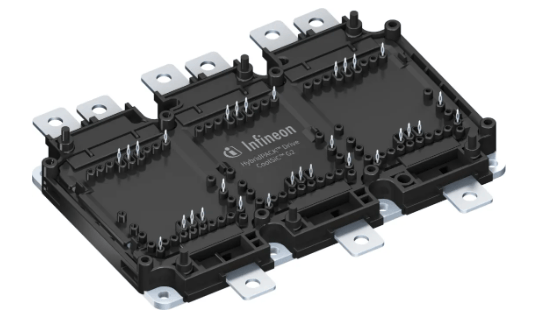
The traction inverter is a core component of an electric vehicle's electric drive system, responsible for converting the battery's direct current (DC) into the alternating current (AC) required to drive the motor. Power modules operate under high voltage, high current, and high-temperature conditions, and their temperature limits directly impact the inverter's continuous power, peak output, cooling design, and the vehicle's overall thermal management strategy. Compared to traditional silicon-based power devices, SiC devices offer higher switching efficiency and lower losses, making them a key technological direction for 800V and higher voltage platforms. Infineon's move to raise the continuous operating temperature to 205°C specifically addresses the demand for higher power density and thermal margin in high-voltage electric drives.
Infineon indicates that the higher operating temperature can increase the output current by up to 15% compared to existing designs, a gain that directly translates into higher inverter power density. For electric vehicle platforms, increased power density means achieving higher output capability within the same space, or reducing system size and weight for the same output target. For already finalized inverter platforms, if the module dimensions, interfaces, and footprint remain consistent, automakers and Tier 1 suppliers can perform performance upgrades without significantly restructuring the architecture.
Another key aspect of this module is its compatibility with existing platforms. Infineon's announcement shows that the new module maintains the same module dimensions, footprint, and interfaces, enabling seamless integration into current platforms. This reduces the pressure of costly redesigns and extended development cycles. For the automotive electronics supply chain, this "compatible upgrade" holds practical value, as automotive-grade product introduction cycles are long, involving verification, reliability testing, functional safety, thermal simulation, vehicle integration, and production qualification. If a power module can leverage mature packaging and interfaces, it helps shorten the time-to-market for next-generation inverter designs.
Thermal management represents another impact of this technological change. Electric vehicle inverters typically rely on liquid cooling plates, cooling circuits, thermal interface materials, and the vehicle's overall thermal management system to maintain device temperature. With the power module capable of withstanding higher junction temperatures, engineers can extract more power under the same cooling conditions or explore smaller or simpler cooling systems in new designs. Simplifying the cooling system not only affects cost but also impacts vehicle weight, packaging space, and energy efficiency. Infineon explicitly states that higher junction temperature tolerance helps reduce system costs, lower vehicle weight, and improve overall energy efficiency.
The 1300V blocking voltage addresses the needs of higher-voltage battery platforms. Infineon states this is the first module in the HybridPACK Drive series with a 1300V blocking voltage, enhancing inverter performance, efficiency, and robustness in scenarios with battery voltages exceeding 900V. As high-end electric vehicles and high-performance platforms explore battery systems above 900V, power devices need to provide higher voltage margins to handle battery voltage fluctuations, regenerative braking, transient conditions, and long-term reliability requirements. The combination of higher blocking voltage and higher temperature capability will provide greater design freedom for next-generation high-voltage electric drive systems.
The HybridPACK™ Drive is Infineon's power module series for traction inverters in hybrid and battery electric vehicles, covering both silicon-based and SiC technology routes. According to Infineon's China website, this series targets traction inverters for electric vehicles and commercial vehicles, with a power range from 100kW to 300kW, emphasizing scalable packaging, ease of design, and automotive qualification capabilities. This product family has previously been extended to 750V and 1200V classes, and the new 1300V SiC module further pushes the product portfolio towards higher voltage platforms.
The first model with 205°C operating capability, the FS01M9R13A7MA2B, has been launched on the market. Infineon also stated that it will extend the 205°C operating temperature capability to the existing 1200V SiC module portfolio within the HybridPACK Drive series. This indicates that 205°C is not an isolated feature for a single model but could become a platform-level upgrade direction for Infineon's automotive SiC modules. For automakers and Tier 1 suppliers, platform-level expansion is more critical than point products, as different vehicle models, power levels, and voltage platforms require reusable module combinations.
Competition in SiC power modules is transitioning from a focus on "efficiency improvement" to a comprehensive stage encompassing "high temperature, high voltage, high power density, and system cost." The next round of upgrades for electric vehicle platforms depends not only on battery capacity and motor efficiency but also on whether the inverter can operate stably under higher voltage, higher temperature, and in more compact spaces. The 205°C continuous operating capability pushes the thermal design boundary outward, providing a new device foundation for automakers to rebalance performance, cost, weight, and reliability.
This article is compiled by Wedoany. All AI citations must indicate the source as "Wedoany". If there is any infringement or other issues, please notify us promptly, and we will modify or delete it accordingly. Email: news@wedoany.com