en.Wedoany.com Reported - Brazil's Rio Grande do Norte is seeking to position itself as a new pole for digital infrastructure for artificial intelligence, cloud computing, and data processing, focusing its strategy on abundant renewable energy, a strategic international connectivity location, land availability, and tax incentives for the data center industry.
This move comes amid discussions between states and the private sector within the framework of the National Fiscal Policy Council (Confaz) regarding tax incentives for data centers. The Brazilian Association of Information Technology and Communication Companies (Brasscom) estimates that Brazil could attract up to USD 92 billion in computer infrastructure investments by 2031, but the association believes the tax burden still reduces the country's competitiveness.
Álvaro Bezerra, Finance Secretary of Rio Grande do Norte, outlined this strategy during a webinar hosted by Brasscom on the attractiveness of investments in computer infrastructure and data centers. According to the secretary, the state government has established a committee to study measures to enhance the state's competitiveness in attracting investments, including attracting submarine cables, structuring public-private partnerships (PPPs) to build data centers, and coordinating tax incentives for the sector. Bezerra stated that the committee is considering what adjustments Rio Grande do Norte needs to make to enable the establishment of large data centers there. However, to date, the state has no signed projects or confirmed investments, and the initiatives remain in the research and modeling phase.
The Finance Department of Rio Grande do Norte (Sefaz-RN) supports the approval of tax incentives for data centers within the Confaz framework. Bezerra believes that competition for investments in this sector is global and that Brazil needs to offer conditions similar to those in other countries. He also emphasized that attracting data centers should be seen as part of a national competitiveness agenda. Sefaz-RN's stance aligns with Brasscom's assessment, which notes that data center construction costs in Brazil are 30% to 35% higher than in competitive markets, with state-level taxes (especially the ICMS tax on goods and services) being a major factor reducing competitiveness. The proposal under discussion at Confaz aims to reduce the tax burden on data center equipment and infrastructure.
Expanding the state's participation in international connectivity infrastructure is another priority. Currently, Brazil's submarine cable systems are largely concentrated in Fortaleza. The Rio Grande do Norte state government assesses that its geographic location helps attract new projects, as the state is situated at the point of the Brazilian territory closest to Europe and Africa, a feature seen as a digital economy asset. The secretary stated that the state government is working with relevant committees to promote the local installation of submarine cables.
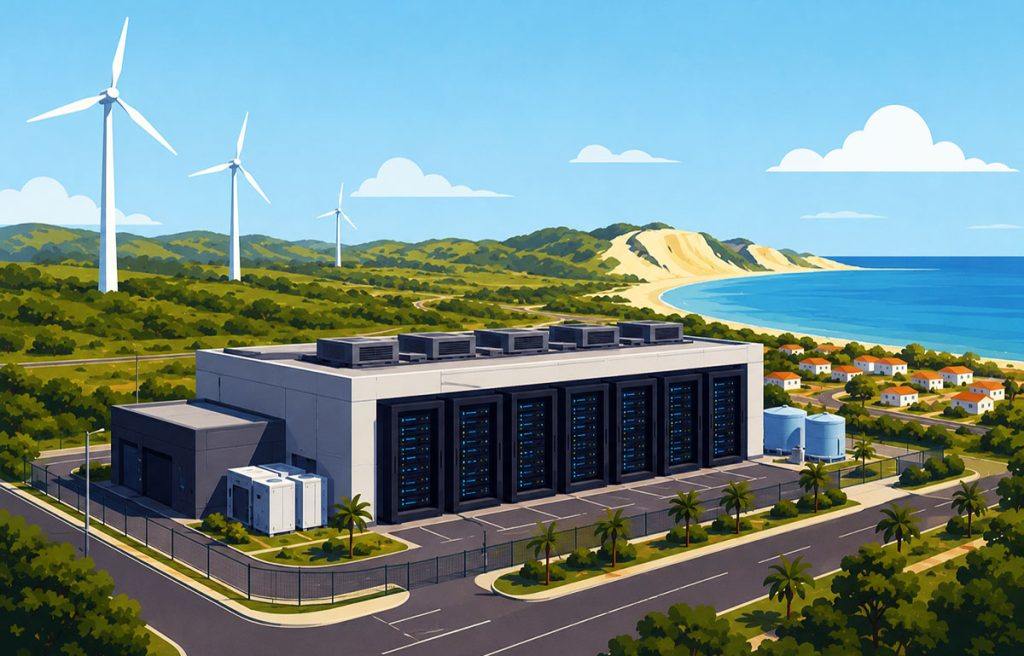
Renewable energy is the state government's main bet. According to Bezerra, Rio Grande do Norte currently generates far more electricity than it consumes, with wind power being particularly prominent. He stated that the state's electricity generation is four times its internal consumption. As the expansion of artificial intelligence drives growth in electricity demand, regions that can combine clean energy, land availability, and connectivity conditions will have an advantage in attracting investments.
One of the options being studied is the use of a PPP model to create conditions for building the first large data center in the state. The proposal envisions that part of the computing capacity would be used by state public agencies to generate initial demand for the project and boost its economic viability. Bezerra stated that the state government is studying how to unlock the attraction of the first large data center through a PPP model, but no timeline or partner has been announced yet.
This move by Rio Grande do Norte occurs against the backdrop of a strong global expansion in digital infrastructure investments driven by the growth of artificial intelligence. The state's strategy combines key factors such as renewable energy, available land, proximity to international connection routes, and institutional support. The challenge lies in converting these potential advantages into concrete projects to integrate into the new geographic landscape of Brazil's digital infrastructure.
This article is compiled by Wedoany. All AI citations must indicate the source as "Wedoany". If there is any infringement or other issues, please notify us promptly, and we will modify or delete it accordingly. Email: news@wedoany.com