en.Wedoany.com Reported - Microsoft is advancing the integration of identity security prevention, detection, and response in the era of artificial intelligence through technologies such as unified identity risk scoring, conditional access optimization agents, and automated attack disruption. As the scale and speed of AI-driven cyberattacks continue to increase, identity security is regarded as the core hub connecting various components of modern defense systems.
In March of this year, Microsoft pointed out that identity security has become a new pressure point for cyberattacks, a trend exacerbated by the evolution of AI. Attackers leverage AI to achieve large-scale personalized social engineering, automated reconnaissance, credential analysis, and real-time strategy adjustments, making attacks that previously required manual operations faster, larger, and more autonomous. However, identity remains the most common entry point, with every unprotected account, administrator, workload, or application potentially serving as a path to sensitive systems. In an AI-accelerated attack environment, the speed and accuracy of detection and response are critical, and identity security can no longer operate in isolation.
Currently, many organizations' Identity and Access Management (IAM) teams and Security Operations Center (SOC) teams use different tools and operational models, leading to significant fragmentation issues. Microsoft is continuously expanding the synergy between Microsoft Entra and Microsoft Defender to provide a more unified identity security experience. The unified identity risk score, introduced at the RSA conference earlier this year, correlates relevant signals from accounts, sessions, workloads, and applications to generate a single identity risk level assessment, which can be directly used in risk-based conditional access policies during the authentication process. The new Microsoft Entra ID Protection experience centralizes visibility into risky users, sign-ins, workloads, and related detections in one place, helping administrators determine whether a risk is an isolated incident or part of a broader pattern.
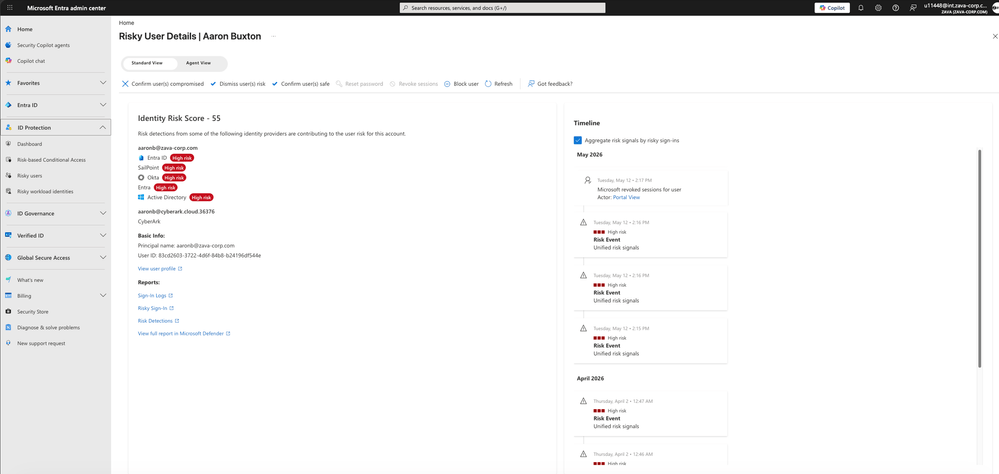
Identity administrators gain enhanced operational capabilities through the new experience: within the new identity risk score, they can view whether risky users, agents, workloads, or sign-ins are isolated incidents or part of a broader pattern spanning sessions, applications, and related accounts.
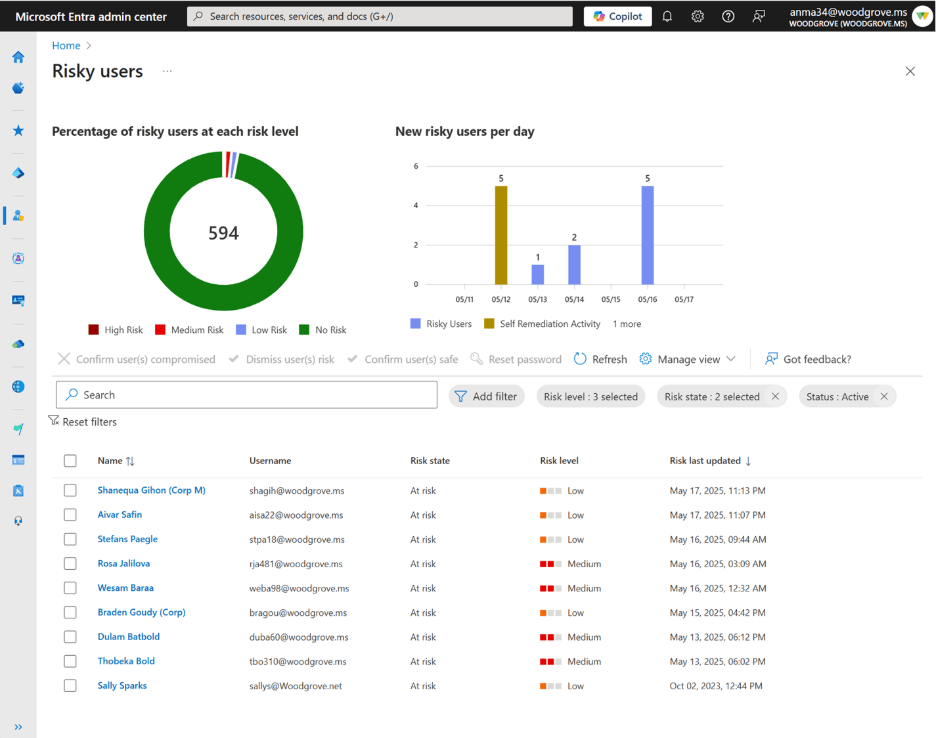
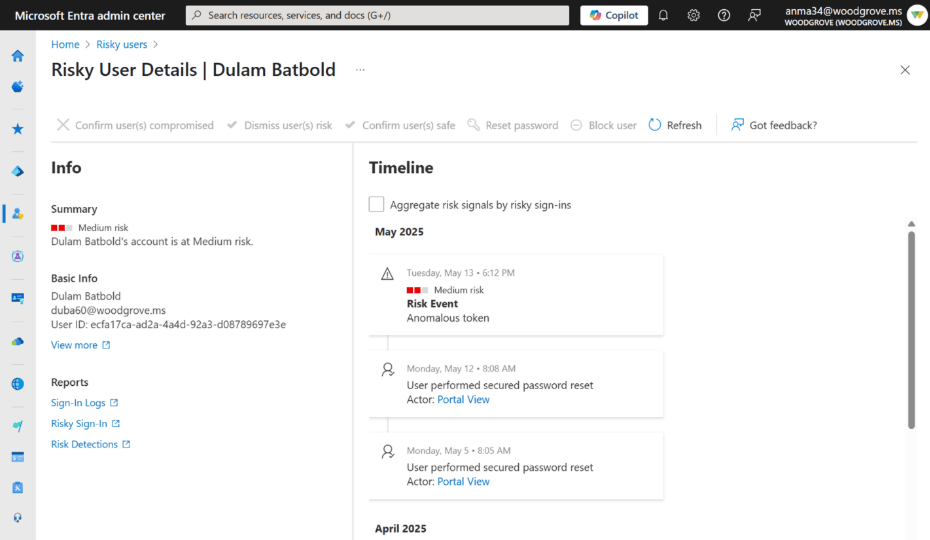
This richer context helps identity teams more comprehensively understand how risks evolve and which related accounts or workloads contribute to the score. Administrators can prioritize the most important identities and make more informed access decisions. For security operations teams, the unified risk score helps prioritize high-risk identities. A new identity-focused RBAC role, coming in public preview, allows SOC teams to access core identity response operations without broad administrative privileges, thereby reducing operational friction between IAM and SOC. Combined with native privileged identity management in Microsoft Entra, organizations can create just-in-time access policies for these roles, further reducing standing permissions.
In terms of proactive prevention, the conditional access optimization agent continuously analyzes identity signals and usage patterns, recommending policy changes to address emerging attack vectors such as agent-based abuse. Microsoft will automatically feed threat detections from Defender directly into conditional access optimization recommendations, supporting more proactive threat mitigation. Additionally, the security alert triage agent has been extended to identity scenarios, combining automated attack disruption with predictive blocking capabilities to form an automated loop from triage and disruption response to continuous posture reinforcement. In the AI era, identity is seen as the central hub connecting prevention, detection, and response into a unified adaptive defense system, and Microsoft is building this system by embedding real-time risk signals directly into the identity infrastructure and policy enforcement layer.
This article is compiled by Wedoany. All AI citations must indicate the source as "Wedoany". If there is any infringement or other issues, please notify us promptly, and we will modify or delete it accordingly. Email: news@wedoany.com