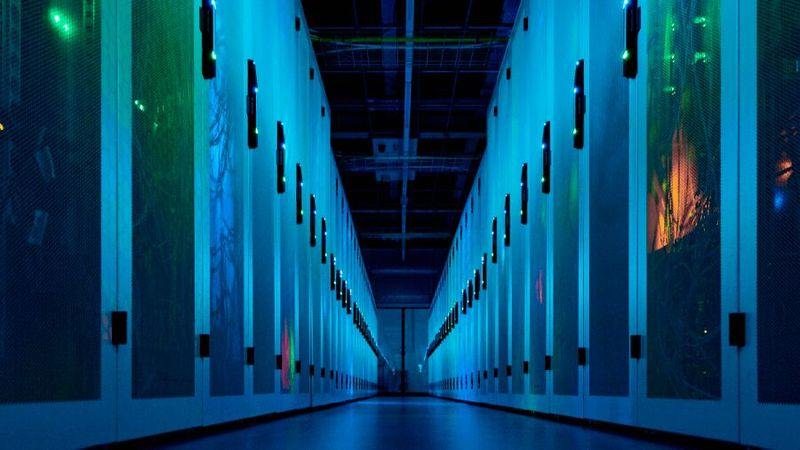
en.Wedoany.com Reported - A report released by Wood Mackenzie on Monday forecasts that India's operational data center capacity will grow from 2.2 GW in 2025 to 12 GW by 2030, an increase of more than fivefold. Key drivers of this growth include the rapid adoption of artificial intelligence, hyperscale cloud investments, and the continued expansion of India's digital economy.
The report shows that data center capacity dedicated to AI is expected to grow from 275 MW in 2025 to 6,546 MW by 2030, a multiple-fold increase. Data center electricity demand is projected to rise from 10 terawatt-hours (TWh) in 2025 to 191 TWh by 2040, reaching roughly 20 times the 2025 level and accounting for 7% of total electricity demand.
Souhardya Pal, Research Associate at Wood Mackenzie, noted that India's data center market is emerging as a structural investment theme. Hyperscale capital spending, growing AI workloads, and a decade-long policy support framework position India to compete with any market in the Asia-Pacific region. For developers and investors, the key question is no longer whether to enter India, but where to locate and how to enter.
According to the report, India's digital economy reached INR 32 trillion in 2025, accounting for approximately 12% of GDP. Over 1.03 billion active internet users and roughly 22 billion monthly UPI transactions are also continuously driving demand for data center infrastructure. India's domestic AI market is expected to reach INR 11.7 trillion by 2032.
By regional distribution, Maharashtra and Tamil Nadu currently account for approximately 65% of installed IT load combined. Future investment is expected to expand into Andhra Pradesh, Telangana, Uttar Pradesh, and Karnataka. Global hyperscale operators such as Amazon Web Services (AWS) and Google, as well as Indian domestic player AdaniConnex, have already made significant commitments in these emerging markets, with AdaniConnex announcing a development pipeline of 2.6 GW.
The report's analysis suggests that access to reliable, cost-competitive power has replaced land and capital as the primary constraint on the industry. Captive power generation and long-term renewable energy power purchase agreements are becoming the preferred strategies for developers. Rashika Gupta, Research Vice President at Wood Mackenzie, stated that land and capital are no longer limiting factors for data center developers in India; the ability to secure reliable 24/7 power at the node level now directly determines site selection and delivery timelines. Developers who secure their power strategy early through captive generation or long-term renewable PPAs will lock in structural cost and sustainability advantages for the lifecycle of their assets.
Water availability is identified in the report as one of the most underestimated investment risks for the industry. AI workloads have increased rack density and cooling requirements, making water access an increasingly important site selection criterion, particularly in water-stressed markets such as Tamil Nadu and Karnataka. The report notes that developers adopting closed-loop cooling systems and zero-liquid-discharge technologies are already reducing freshwater consumption and gaining a first-mover advantage in preparing for potential future regulatory requirements.
The report concludes that India's robust digital demand, supportive policies, expanding renewable energy market, and accelerating AI adoption are collectively creating one of the fastest-growing data center markets globally. Long-term success will increasingly depend on developers' combined ability to secure reliable power, manage water resources, and select locations that offer both growth potential and infrastructure resilience.