en.Wedoany.com Reported - Nvidia has demonstrated a embodied intelligence robotics technology called ENPIRE (Agentic Robot Policy Self-Improvement), which enables robots to autonomously learn and execute high-precision tasks, including installing GPUs onto motherboards.
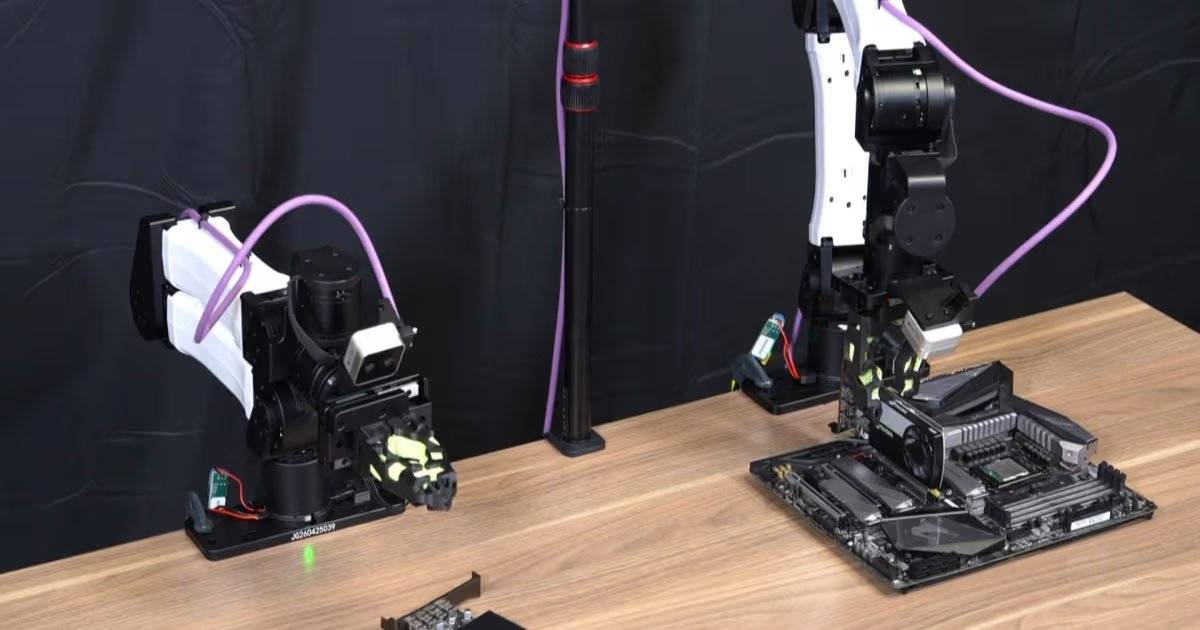
In the released demonstration video, eight robots collaborate autonomously to complete complex tasks without human intervention. One robotic arm picks up a graphics card and places it into the PCIe slot on a motherboard, while another robot demonstrates sorting metal pins in a container and precisely cutting zip ties. Jim Fan, Director of Artificial Intelligence and Distinguished Scientist at Nvidia, stated that this demonstration proves researchers can "activate AutoResearch in the physical world for the first time."
Fan explained that the ENPIRE project provides eight Codex agents with a set of robots, GPU allocation, and a substantial token budget; these agents are assigned tasks requiring completion as quickly as possible without errors. The entire robot fleet begins operating, learning to find visual cues, reset scenes, practice new skills, adjust control stacks, read papers online, debate, reflect, and retry directly on the hardware. He noted that the team simply handed the Codex API to the atomic world, and the rest was emergence.
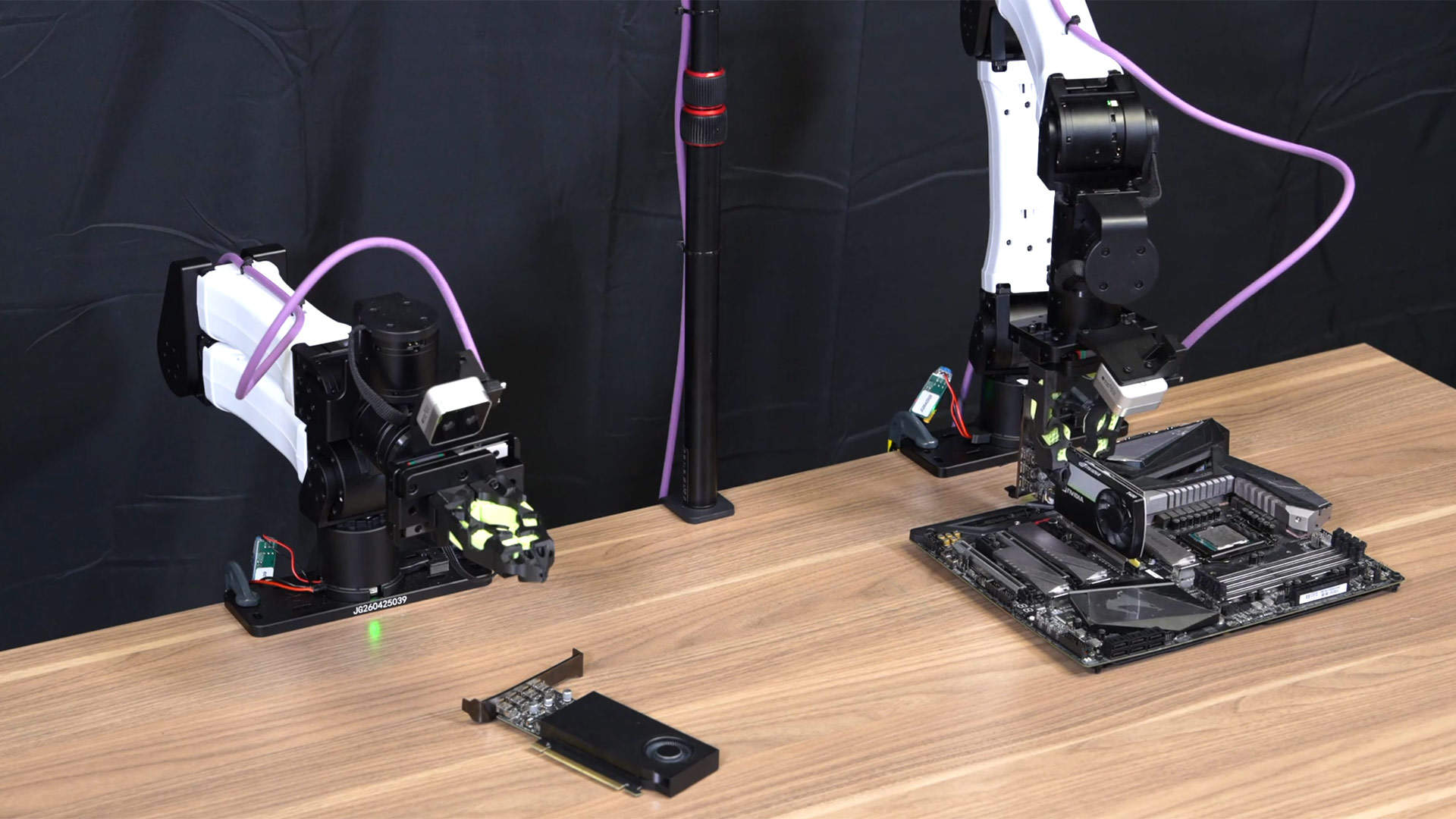
ENPIRE is a framework for coding agents that instantiates a physical feedback loop through four core modules: the Environment module (EN) for automatic reset and verification; the Policy Improvement module (PI) for initiating policy optimization; the Rollout module (R) for evaluating policies using single or multiple parallel-running robots; and the Evolution module (E), where coding agents analyze logs, consult literature, and improve training infrastructure and algorithm code to resolve failure modes.
The robot "fully autonomously installing a GPU" is the most striking part of the demonstration. In this PC DIY task recording, one robotic arm selects and passes a graphics card to another arm positioned in front of a motherboard; the second arm then carefully aligns the graphics card's PCIe slot with the motherboard slot, slowly lowers it, and pushes it into place. Other AutoResearch projects assigned to the robots included sorting fine pins and tying and cutting zip ties.
In the related research paper "ENPIRE: Agentic Robot Policy Self-Improvement in the Real World," results are shown comparing different coding agents, including Codex with GPT-5.5, Claude Code with Opus 4.7, and Kimi Code with Kimi K2.6. Researchers also tested the scale of the robot fleet, concluding that "eight robots exploring in parallel completed tasks significantly faster than smaller fleets."
The ability of robots to learn to perform physical tasks on their own without explicit programming opens the door to more advanced automation. This technology enables robots not only to repeat programmed actions but also to experiment autonomously, learn from mistakes, and improve performance. The ENPIRE approach demonstrates that AI agents can manipulate real hardware with a precision previously achievable only by humans. This research is also relevant to the development of increasingly powerful laptop chips in 2026, as more advanced GPUs allow AI agents like Codex to conduct more complex simulations and training, accelerating the robot learning process in the real world.
This article is compiled by Wedoany. All AI citations must indicate the source as "Wedoany". If there is any infringement or other issues, please notify us promptly, and we will modify or delete it accordingly. Email: news@wedoany.com