South Korea's AhnLab CloudMate Launches SecureBridge to Prevent AI Data Leakage
en.Wedoany.com Reported - AhnLab CloudMate unveiled the generative AI security solution SecureBridge at the "2026 AI Cloud Conference" held in Seoul. The solution adopts an agentless architecture designed to control data leakage risks arising from AI.
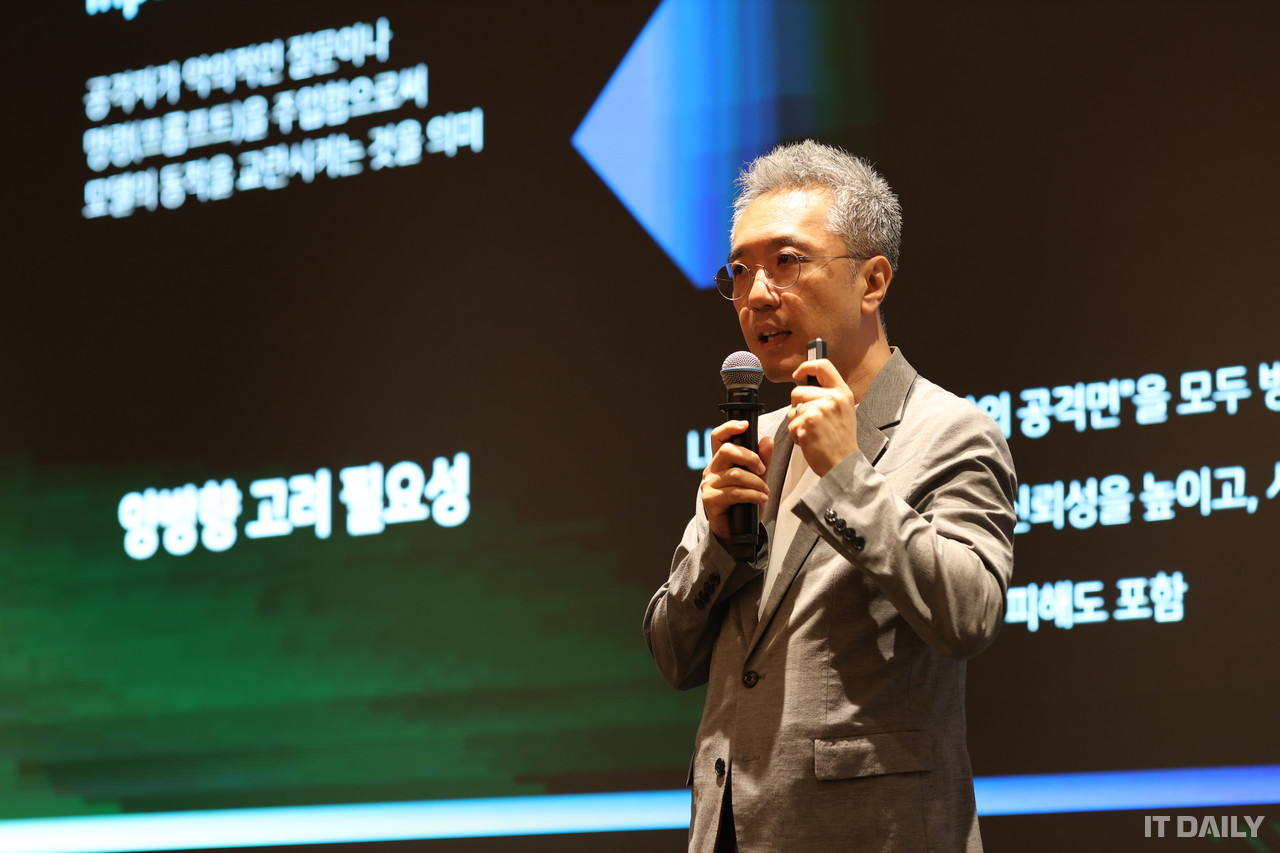
Choi Gwang-ho (최광호), Chief Technology Officer (CTO) of AhnLab CloudMate, stated at the conference held on the 24th at EL Tower in Yangjae-dong, Seoul, that AI has become a new channel for data circulation, and the key to security lies in controlling data leakage through AI. Citing statistical data, he noted that 30% of office workers have entered sensitive information into AI, while internal company analysis shows that data leakage incidents related to generative AI have increased 2.5 times year-over-year.
CTO Choi Gwang-ho believes that traditional security practices block internal threats and control external data outflow through multi-layered defense systems, whereas data leakage from large language models (LLMs) requires unified control from both input and output dimensions. To address this, AhnLab CloudMate proposed the "Guardian Architecture," which defines the process from input to final response as a single workflow, centering on the LLM to control the overall input and output areas. Drawing on the Policy Enforcement Point (PEP) and Policy Decision Point (PDP) concepts from zero-trust architecture, it decides to allow or block in an independent area before passing this decision to the input and output zones.
The SecureBridge solution based on the Guardian Architecture features an "Agentless" characteristic. CTO Choi Gwang-ho explained that agent programs typically need to be installed and intervene in the operating system (OS) to control other programs. However, since the main structure of generative AI involves communicating with external servers—unless it is on-device AI—it does not affect endpoints, so an agentless structure can still enhance security.
SecureBridge adopts an agentless structure that does not affect the user interface, reducing the hassle of accessing specific websites or installing applications for AI security. It can control the leakage of personal, sensitive, and confidential information transmitted through generative AI, and block prompt injection attacks caused by malicious instructions. Administrators can monitor and collect prompt history through this solution, check internal AI usage within the company, and confirm whether unauthorized "Shadow AI" is being used. SecureBridge has information on 1,200 AI services, enabling control and blocking of unauthorized AI, and is expected to support information on approximately 100 additional AI services by the end of 2026.
CTO Choi Gwang-ho stated that the generative AI used by enterprises is nearly in a security vacuum, requiring layered and refined solutions for AI to reduce risks. He expressed hope that SecureBridge could become the first step in preventing data leakage caused by generative AI.
This article is compiled by Wedoany. All AI citations must indicate the source as "Wedoany". If there is any infringement or other issues, please notify us promptly, and we will modify or delete it accordingly. Email: news@wedoany.com
Related Products


Industrial and Commercial Point-Type Gas Detector
Jinan Benan Technology Development Co., Ltd.

Multi-function Marine Monitoring Low-altitude Detection Radar Sea-air Boundary Ocean Dynamic Environment Measurement
Chengdu Dixin Technology Co., Ltd.
Hot Selling 10 Inch Intel N5100 I5 I7 FHD 8 +128GB 16+256GB Win10 Pro Win11 Pro 4G 5G Rugged Tablet PC Pad with NFC Barcode
Highton Electronics Co., Ltd.

Mine Explosion-proof and Intrinsically Safe Industrial Ethernet Ring Network (10 Gigabit/Gigabit)
Chongqing Mas Sci&Tech Co., Ltd.
GYTA Type Non-Self-Supporting Aerial/Duct Optical Cable
TONGDING INTERCONNECTION INFORMATION CO., LTD.


G.652.D Wavelength-extended Non-dispersion Shifted Single-mode Optical Fiber
HONGAN GROUP CO., LTD.
One-Stop Steward Service for the Entire Logistics System Integration Chain
Zhongding Intelligent (Wuxi) Technology Co., Ltd.
MUX Series Communication Interface Device for Security and Stability Control System
Nanjing NR Electric Co., Ltd.