en.Wedoany.com Reported - Wang Chenglu, CEO of Shenzhen Kaihong Digital Industry Development Co., Ltd., recently announced that after two years of development, its self-developed robot operating system, M-Robots OS, has been fully donated to the OpenAtom Foundation, with its dedicated first-level root community now operational.
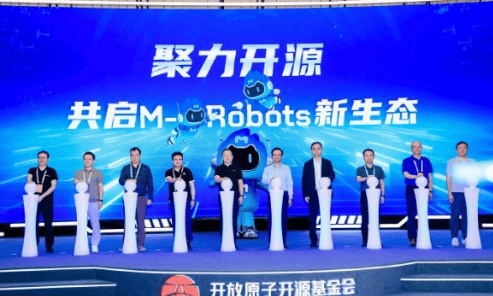
M-Robots OS is the first open-source HarmonyOS-based robot operating system in China. Version 1.0 was released in April 2025, and version 2.0, launched in May this year, features four core capabilities: multi-machine real-time collaboration, multi-hardware form factor compatibility, AI-native integration, and rich APIs with development toolchains. It is a full-stack system platform offering "unified underlying architecture with diverse scenarios."
The upgraded M-Robots OS 2.0 boasts six core capabilities. Its modular framework supports decoupling of software and hardware, allowing on-demand customization and flexible deployment for robots ranging from 20 KB to X GB, covering various forms from lightweight service robots to large-scale industrial robots. Hybrid deployment capabilities balance human-machine interaction with hard real-time response, with interrupt response latency and task switching latency both under 1 microsecond. Based on the self-developed distributed communication technology M-DDS, derived from the open-source HarmonyOS distributed soft bus, it enables full interconnection between robots and physical world devices, with microsecond-level ultra-low latency within a robot's body and audio-video latency between robots as low as 4 milliseconds, a 42% reduction compared to Fast-DDS. Leveraging a super-device architecture, the system breaks single-device limitations, enabling cross-device sharing of algorithms, perception, and execution capabilities, seamless cross-end coordination of task commands and data information, and supporting integrated collaborative operations of robot clusters. Built-in native AI capabilities support multimodal human-machine interaction, driven by AI agents for autonomous multi-agent collaboration, dynamically generating optimal group collaborative decision-making solutions. The system is compatible with mainstream middleware such as ROS1/ROS2 and Dora-rs, reducing application migration costs by 80%.
This article is compiled by Wedoany. All AI citations must indicate the source as "Wedoany". If there is any infringement or other issues, please notify us promptly, and we will modify or delete it accordingly. Email: news@wedoany.com