en.Wedoany.com Reported - June 30 news – SK Hynix is accelerating the bidding process for inspection equipment orders at its Cheongju HBM back-end process plant P&T7, with the total order value potentially reaching up to 400 billion KRW. As lead times for related inspection equipment components have extended to over a year, SK Hynix and equipment suppliers have already begun verbal allocation discussions for approximately 200 units of equipment a year in advance, securing equipment capacity for the 2027 production line construction and HBM4 mass production preparation.
P&T7 is not an ordinary memory production line expansion project but a critical back-end base built by SK Hynix to meet AI memory demand. 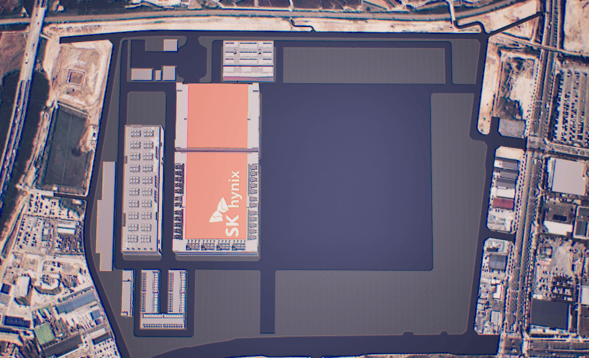 This facility is primarily used for the manufacturing, post-packaging testing, and wafer testing support of high-bandwidth memory products such as HBM4, with the wafer testing line expected to be completed by October 2027. HBM products are formed by stacking multiple layers of DRAM, requiring higher bandwidth, lower power consumption, better thermal management, higher yield, and greater packaging stability. The inspection process must perform screening and verification under more complex electrical conditions. Any delay in the delivery of inspection equipment would compress subsequent equipment installation, debugging, mass production qualification, and capacity ramp-up. Therefore, equipment suppliers are vying for orders a year before the production line is completed, reflecting that HBM4 capacity construction has entered a more specific equipment scheduling phase.
The competition among inspection equipment companies is not for a single machine order but for a comprehensive capacity entry point centered on the HBM back-end process. If all approximately 200 units are allocated to the P&T7 project, they will cover multiple stages including wafer-level testing, post-packaging testing, burn-in screening, automated loading/unloading, data collection, and quality analysis.
HBM4 targets AI servers, GPU accelerator cards, and high-performance computing platforms, where customers demand high product consistency and delivery rhythm. The value of high-bandwidth memory comes not only from wafer manufacturing but also from stacking, interconnection, packaging, and testing capabilities in the back-end process. As AI chips continue to demand higher HBM capacity and speed, testing equipment must handle higher parallelism, more pins, more complex signal integrity issues, and meet customer requirements for yield, reliability, and batch traceability. SK Hynix's early coordination of supply volumes with equipment suppliers is primarily to avoid scheduling conflicts during the concentrated delivery of key testing equipment in 2027. Equipment companies hope to enter SK Hynix's next-generation HBM supply chain through P&T7 orders, with potential opportunities for subsequent maintenance, spare parts, upgrades, and capacity expansion.
The extension of equipment component lead times to over a year is the direct cause of this early order competition. Semiconductor inspection equipment consists of test heads, probe-related components, high-speed circuit modules, precision motion systems, temperature control systems, and automation mechanisms. The supply cycle for some core components has always been long. After the expansion of AI memory production, memory manufacturers, testing equipment suppliers, and component makers are simultaneously competing for upstream capacity, further extending delivery cycles.
SK Group Chairman Chey Tae-won recently stated that an additional 100 trillion KRW investment will be made in Cheongju to strengthen NAND flash and advanced packaging capabilities. The Cheongju base is transforming from a traditional memory manufacturing hub into an AI memory manufacturing cluster that coordinates NAND, HBM, advanced packaging, and testing capabilities. The early initiation of P&T7 inspection equipment orders is a signal that this investment is materializing into manufacturing equipment. For the semiconductor equipment supply chain, the demand generated by HBM expansion will continue to propagate to testers, handlers, probe stations, automated material handling, test fixtures, cleanroom support, and equipment maintenance services. If SK Hynix proceeds with the construction of the P&T7 wafer testing line as planned, the pace of equipment introduction will directly impact the formation speed of HBM4 back-end process capabilities and affect its delivery flexibility in the AI memory supply competition.