en.Wedoany.com Reported - Researchers at the University of Birmingham (www.birmingham.ac.uk) have demonstrated a new method for producing ultrathin catalysts, offering a novel approach to the catalytic breakdown of persistent water pollutants. The process uses layered materials as precursors, dispersing them in sustainable solvents (water and ethanol), and applying high strain rates to both the liquid and solid phases within the dispersion. The mechanical strain overcomes the van der Waals forces binding the materials together, separating the layers into micron- and nanometer-scale sheets that can reach thicknesses of just a few atoms or molecules. In addition to fabricating ultrathin materials with high quantum efficiency, the new process readily supports the combination of different materials, enabling the team to experiment with "unique artificial materials, such as graphitic carbon nitride and molybdenum disulfide, two promising organic and inorganic layered semiconductors that can support photocatalytic activity in the ultraviolet (UV) and visible light spectrum," said Jason Stafford, Associate Professor of Mechanical Engineering at the University of Birmingham. Driven by mechanical force rather than thermal energy, the process has a smaller environmental footprint compared to some other catalyst manufacturing methods, and the solvents and precursors can be recovered and reused during the process.
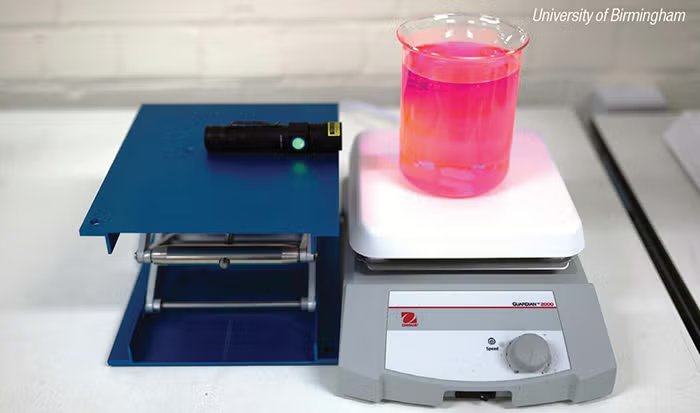
The focus on photocatalysis has led to the application of these new materials in degrading harmful pollutants in water. Such applications typically use photocatalysts for Advanced Oxidation Processes (AOPs). University of Birmingham researcher Irwing Ramirez noted: "By enabling photocatalysis in both the UV and visible light regions, these catalyst materials can utilize a higher proportion of incident sunlight than traditional photocatalysts like titanium dioxide, and avoid some of the drawbacks of other AOPs. This could open the door to passive solar wastewater treatment, which typically requires high-intensity lighting. Furthermore, two-dimensional nanostructured materials offer a larger surface area per gram of material, helping to improve reaction rates and more efficient light utilization."
In the laboratory, the team has produced scaled-up quantities of the new photocatalytic materials, equivalent to approximately 100 grams of catalyst. Jacob Brown, a graduate student in Stafford's team, added: "While the overall quantity seems small, for wastewater applications, it can treat hundreds or even thousands of liters of water. This work also demonstrates that the synthesized nanomaterials can be supported on substrates like glass, thereby avoiding costly downstream catalyst separation and enabling the treatment of large volumes of wastewater. This is particularly important for scaling up to continuous flow treatment systems." To demonstrate the catalyst itself in a wastewater treatment environment, the team has scaled up from a small semi-batch process to a 5-liter pilot-scale system, which can be illuminated using UV light or sunlight in an outdoor setting.