Osaka Metropolitan University Develops Battery-Free Solar Fuel Electrolyzer
en.Wedoany.com Reported - Researchers at Osaka Metropolitan University have developed a solar fuel electrolyzer that can self-regulate fluctuations in sunlight without the need for external batteries or electronic devices, achieving stable formic acid production from water and carbon dioxide under outdoor conditions.
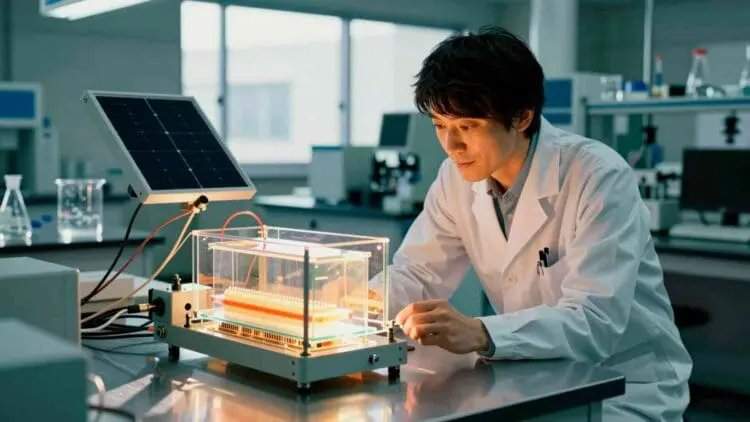
Solar fuel production has long been plagued by fluctuations in sunlight, as the energy reaching the panels continuously changes with cloud cover, seasons, and the sun's angle. Traditional approaches require adding batteries, converters, and control electronics, along with Maximum Power Point Tracking (MPPT) technology to continuously adjust voltage and current to compensate for fluctuations, thereby maintaining stable output—adding cost and complexity. To address this, the team at Osaka Metropolitan University, led by Associate Professor Yasuo Matsubara and Professor Yutaka Amao, redesigned the electrolyzer structure by integrating a custom solid electrolyte directly into the system. This material gives the device self-correcting behavior without the need for external converters. When sunlight intensifies, the electrolyzer naturally heats up, causing a drop in resistance and allowing current to flow more freely, with the regulation process automatically embedded in the material.
The team tested the device under real outdoor conditions, where sunlight intensified and diminished over time, and the electrolyzer continuously produced formic acid from water and carbon dioxide throughout the process. This self-regulating design makes fuel output more consistent than systems that rely on external electronics to track peak power, which must react to changes, whereas the new system adjusts as part of its normal operation. Professor Yutaka Amao described the effect as the system "automating" production while reducing reliance on batteries and expensive external components. Here, automation does not depend on software or sensors, but rather on the physical properties of the material at work.
The technology is still in the research phase, but outdoor performance data indicates that the concept has moved from controlled laboratory results to validation under real weather and full-day variations. By eliminating batteries and auxiliary electronics, the economics of artificial photosynthesis improve, with lower initial costs helping the system be adopted in large-scale energy projects as well as small-scale applications in cities, businesses, and homes. Fewer components also reduce material requirements, removing the burden of additional equipment when converting variable sunlight into storable fuel. More steps are still needed from proof of concept to practical deployment, but the direction is clear: a solar fuel system that manages its own electricity like a plant manages its own chemistry is no longer a theoretical goal.