IAEA Commends Uzbekistan's Nuclear Infrastructure Progress
en.Wedoany.com Reported - The International Atomic Energy Agency (IAEA) Integrated Nuclear Infrastructure Review (INIR) follow-up mission recently concluded its visit to Uzbekistan, commending the country's progress in nuclear energy development and recognizing that it has established a solid infrastructure foundation for the implementation phase of its nuclear power plant project.
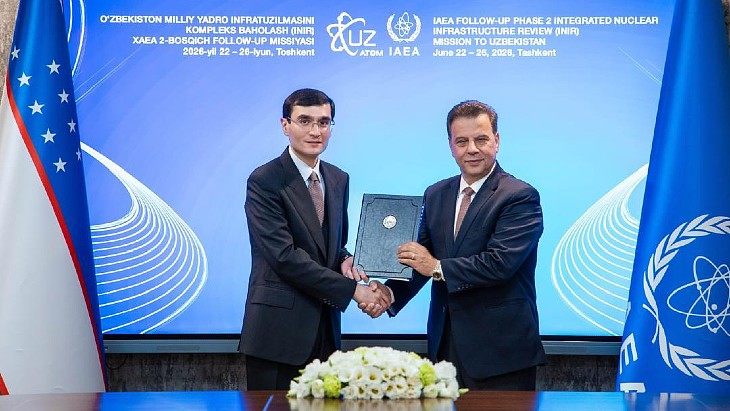
The mission, comprising experts from Brazil and Turkey along with two IAEA staff members, conducted its work from June 22 to 26, assessing Uzbekistan's progress since the previous review in 2021. John Haddad, the mission leader from the IAEA's Nuclear Infrastructure Development Section, stated that Uzbekistan has demonstrated its commitment to developing a safe, secure, and sustainable nuclear energy program, actively implementing recommendations from the 2021 review and building a solid infrastructure foundation for the project implementation phase. He added that the world is eager to learn from Uzbekistan's experience in constructing nuclear power plants, as the country is one of the few building small modular reactors outside the reactor's country of origin, making these experiences highly valuable. He advised Uzbekistan: "Be prepared to play an important role in the global nuclear energy sector."
Uzbekistan has launched its first nuclear power plant project in cooperation with Russia, which will feature two RITM-200N small modular reactors (SMRs) and two VVER-1000 large reactors. The first concrete pour for the foundation of the first SMR was completed in April this year, marking the official start of the project. The RITM-200N is a water-cooled small modular reactor derived from nuclear-powered icebreaker technology, with a thermal power of 190 MW, an electrical output of 55 MWe, and a design life of 60 years. The first land-based version of the RITM-200N is currently under construction in Yakutia, Russia, with the first unit scheduled to begin operation in 2027. Uzbekistan's project represents the first export order for a Russian SMR.
The IAEA stated that the mission expressed appreciation for Uzbekistan's progress, noting that the country has acceded to relevant international legal instruments, amended its national nuclear legislation, developed regulations for licensing, regulatory oversight, and management systems, and completed necessary grid studies and upgrade plans. The IAEA also noted that further efforts are needed to complete ongoing actions to strengthen the nuclear regulatory body and finalize the feasibility study. The mission conducted its review based on the IAEA's "Milestones Approach," which covers 19 infrastructure issues, three phases (consideration, preparation, and construction), and three milestones (decision, contracting, and operation). The mission has submitted a preliminary report to Uzbekistan, which will be reviewed, and the IAEA will release the final report in due course.
Azim Akhmedkhadjaev, Director of the Atomic Energy Agency (Uzatom), stated that this review is "an important tool for open professional dialogue, enabling us to objectively assess the existing work on national nuclear infrastructure development, compare results with international standards and IAEA recommendations, and identify practical next steps."
Uzbekistan, the world's fifth-largest uranium supplier, has a long nuclear-related history. The country once had two research reactors: a 10 MW pool-type reactor (WWR-SM) that has been operating since 1959 at the Institute of Nuclear Physics of the Academy of Sciences of Uzbekistan near Tashkent, and a 20 kW small research reactor operated by Tashkent JSC Foton, which was decommissioned between 2015 and 2019. Uzbekistan has long planned to develop nuclear energy, and a contract was signed during Russian President Vladimir Putin's visit in May 2024. Initially, a 330 MW nuclear power plant with six RITM-200N SMRs was planned, with the first unit expected to reach criticality by the end of 2029, followed by sequential commissioning. In 2025, a contract addendum for the new nuclear power plant in the Jizzakh region adjusted the scope to include two gigawatt-class VVER-1000 units and two SMRs, increasing the planned installed capacity from the original 330 MWe to over 2100 MWe. In October last year, excavation work for the first SMR's foundation pit began, reaching a depth of 13 meters and removing approximately 1.5 million cubic meters of earth. In March this year, Rosatom stated that the concrete pour for the reactor building foundation amounted to about 900 cubic meters, completed in April, followed by leveling and waterproofing of the foundation, with the first concrete pour for the reactor building base slab completed in June.
Related Products


Hydraulic Turbine Genset
Dongfang Electric Corporation Dongfang Electric Machinery Co., Ltd.

CITIC Heavy Industries Offshore Wind Power Equipment Hydraulic Pile Hammer
CITIC Heavy Industries Co., Ltd.
Oil-immersed Amorphous Alloy Core Distribution Transformer
Pinggao Group Smart Electric Co., Ltd.


Electromagnetic Fluid Seawater Floating Oil Separation and Recover Equipment
Huate Magnet Group Co., Ltd.