China's AutoNavi AI Premium Ride Service Upgraded: Users Can Now Book a Ride Directly via Voice Commands
en.Wedoany.com Reported - On July 6, China's AutoNavi (Gaode) Maps announced an upgrade to its AI premium ride service, allowing users to fully express their travel needs through natural language. The "AI Premium Ride Concierge" automatically identifies key information and matches personalized ride options. After the upgrade, users no longer need to navigate through menus, check tags, or contact drivers individually. They simply describe their travel scenario, physical condition, and service preferences, and the system completes demand analysis and service configuration.
The focus of this upgrade is shifting the premium ride service from "user self-configuration" to "system understanding of user status." Previously, if users wanted a quieter in-car environment, smooth driving, pre-cooled air conditioning, help with luggage, or drop-off inside a residential area, they typically had to manually fill in remarks or communicate with the driver after the ride was accepted. While the process seemed simple, when users had multiple requirements, it often led to incomplete expressions, inconsistent driver understanding, and the platform's inability to standardize records. With the integration of the AI Premium Ride Concierge, users can express their needs as naturally as in daily conversation. For example, saying "A family of three going to Beijing Capital Airport, with an elderly person who gets carsick" allows the system to identify multiple layers of information—such as elderly travel, need for smooth driving, passenger prone to motion sickness, and preference for ventilation—and convert these requirements into vehicle matching and driver service prompts.
In terms of functionality, users open China's AutoNavi Maps, long-press the microphone, and state their status and destination. Users in cities like Beijing, Shanghai, Hangzhou, and Chengdu can update the app to the latest version to use natural language matching for premium ride services. Compared to traditional ride-hailing interfaces, the AI Premium Ride Concierge reduces the steps users need to switch between vehicle types, remarks, tags, and phone calls, consolidating personalized needs that were previously scattered across different interaction points into a single natural expression.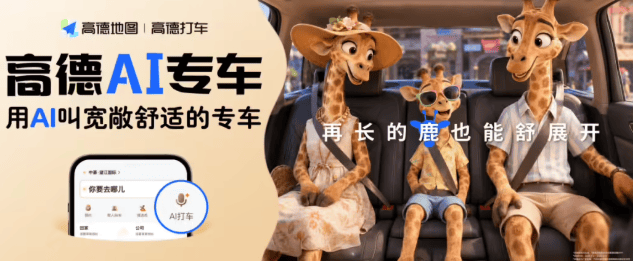
Behind this upgrade lies the shift of ride-hailing services from "standardized supply" to "scenario-based matching." Premium ride services already have basic standards for vehicle quality, driver conduct, and in-car environment, but different passengers have different needs in different scenarios. A user just off a flight may need the driver to help with luggage and maintain a quiet car; a user who dislikes heat may want the air conditioning pre-set to a comfortable temperature; passengers with elderly, children, or those prone to motion sickness care more about smooth driving, vehicle type, and ventilation. The AI Premium Ride Concierge identifies this information in advance and passes it to the service chain's vehicle matching, driver prompts, and trip execution stages. Thus, the premium ride service is not just about "getting passengers to their destination" but preparing around the passenger's status before pickup.
AutoNavi's embedding of AI capabilities into ride-hailing services also indicates that competition among mobility platforms is shifting from traffic entry points and price subsidies to service understanding capabilities, dispatch precision, and fulfillment quality. Natural language interaction lowers the barrier for user expression, while the platform must accurately decompose colloquial demands into executable actions: which demands affect vehicle selection, which require driver prompts, which are in-car services, and which need to be completed before pickup. This requires the system to simultaneously possess capabilities in semantic understanding, location services, vehicle supply, driver coordination, and service rule management.
For China's AutoNavi Maps, the value of the AI Premium Ride Concierge lies not only in simplifying the ride-hailing entry point but also in enabling the platform to convert a large number of non-standard demands into identifiable, transmittable, and reviewable service information. Passengers no longer need to think "which tag should I choose" but directly state "what my current status is, where I want to go, and how I want to ride." Drivers no longer receive scattered remarks but clearer service prompts. As similar capabilities expand to more cities and travel scenarios, the product experience of ride-hailing platforms will increasingly rely on AI's understanding of real-life language, rather than simply adding buttons and options.
Related Products

KJD127(A) Mining Explosion-Proof and Intrinsically Safe Computer
Taiyuan Xiangming Intelligent Control Technology Co., Ltd.


Multi-function Marine Monitoring Low-altitude Detection Radar Sea-air Boundary Ocean Dynamic Environment Measurement
Chengdu Dixin Technology Co., Ltd.
20 Inch 1600*900 Full HD 60Hz TFT LED Monitor with VGA and DP Interfaces for Desktop Computers-Business Use
Guangzhou Zanying Optoelectronics Technology Co., Ltd.
Automatic Aiming Laser Remote Obstacle Removal Robot
Pinggao Group Weihai High-Voltage Apparatus Co., Ltd.


Industrial and Commercial Point-Type Gas Detector
Jinan Benan Technology Development Co., Ltd.
MUX Series Communication Interface Device for Security and Stability Control System
Nanjing NR Electric Co., Ltd.