en.Wedoany.com Reported - In the race for "Physical AI," which integrates humanoid robots, robotics, and autonomous vehicles, success hinges on two core elements: building a sufficiently reliable "body" and implanting a sufficiently intelligent "brain" into the robot.
NVIDIA is actively laying out the entire Physical AI ecosystem, spearheaded by platforms such as Omniverse and Cosmos. Competitors in the hardware sector, including Tesla, Boston Enamix, Gongzi, and Unitree, are each focused on accumulating empirical data. This means the success or failure of a robotics venture depends on who can first secure the "infrastructure for learning and validation."
For a robot's body and brain to operate flawlessly in the real physical world, an invisible preparatory phase is essential. This includes calibration work to align errors from different sensors like LiDAR and cameras into a single coordinate system, as well as digital twin and simulation environments that allow robots to safely test and make mistakes before deployment.
In the domain where a robot's body and brain converge, South Korean companies can find business opportunities. In particular, the demand for core components such as precision sensors, data, and simulation is expected to grow exponentially. Like the semiconductor industry, the larger the robot market becomes, the more likely new revenue models will emerge in related infrastructure areas.
For example, most of the 3D data and learning data used in NVIDIA's virtual training platform are based on roads and buildings in the United States and Europe. Therefore, a separate "localization" effort is now needed for South Korea's unique road, building, and signage environments.
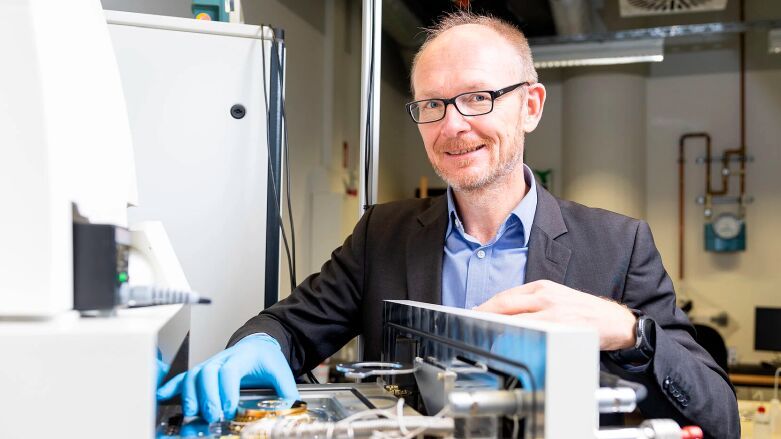
![Mobil Tech founder and CEO Kim Jae-seung is being interviewed by Maeil Business Newspaper. [Mobil Tech]](https://img.wedoany.com/2026/0709/20260709094526187.png)
Founded in 2017, Mobil Tech is a South Korean Physical AI infrastructure company targeting precisely this niche. The company provides and exports the infrastructure necessary for Physical AI systems, such as autonomous vehicles and robots, to perceive the real world and operate safely. Notably, Mobil Tech collaborates with NVIDIA, directly supplying Korean-style spatial data infrastructure within the Omniverse ecosystem. The company also conducted a joint demonstration with NVIDIA at CES 2025.
Mobil Tech has secured Naver and Hyundai Motor as its initial investors and is expanding its business. The company's strategy is to build the "invisible infrastructure" that allows AI algorithms to learn and validate within the "perception-judgment-control" process of autonomous vehicles and robots.
Kim Jae-seung, founder and CEO of Mobil Tech, born in 1988, jumped straight into entrepreneurship from graduate school. He states that in the robotics industry, China's strength lies in the body (hardware), while America's strength lies in the brain (AI models). He believes South Korea should focus on providing core components like precision sensors, data, and simulation, similar to its role in the semiconductor industry. Regarding the commercialization timeline for humanoid robots, Kim predicts that industrial robots will come first, while humanoid robots may see a "breakthrough" in AI models within the next two to three years.
Kim explains that Mobil Tech's business is primarily divided into two pillars: sensors and simulation. In terms of sales, the sensor business is larger and serves as the company's short-term "cash cow," which is related to the ongoing heavy investment in hardware within the autonomous driving sector. However, he predicts that the simulation and digital twin business will ultimately drive the company's long-term growth, as its applications can span multiple industries, including real estate and content production.
![A factory simulation scene realized by Mobil Tech's proprietary digital twin technology. [Mobil Tech]](https://img.wedoany.com/2026/0709/20260709094526256.png)
The company's products include the "Sensor Suite" and "Calibration Sweet," with clients such as Hyundai Motor and Strad Vision. Another core product, "Replica City," is a simulation environment that scans real spaces with LiDAR and overlays game engine visualization technology to create a virtual environment matching real-world size and coordinates, used for autonomous driving and robot learning. The company has completed automated simulation for container unloading at the Port of Dubai and participated in Naver's project in Saudi Arabia. Recently, the company has been responding to demand from humanoid robot developers, creating 3D environments for them to learn various actions.
Kim revealed that the connection with NVIDIA began with a meeting at CES several years ago. Currently, Mobil Tech supplies Korean-style 3D assets to NVIDIA and assists in the local deployment of NVIDIA solutions in South Korea. He views NVIDIA's Physical AI ecosystem pragmatically, believing that in the short term, the market will center around NVIDIA, but in the long term, as the ecosystem matures, new competitors may emerge to challenge its pricing structure.