en.Wedoany.com Reported - On July 9, the open-source robotics collaboration between NVIDIA and Hugging Face entered a new phase. The two parties will introduce open-source foundation models, data collection frameworks, and training deployment workflows for robotics development, combining NVIDIA's GPU ecosystem, CUDA software stack, and Isaac robot platform with Hugging Face's model library and developer community to lower the barriers for robot AI training, fine-tuning, and deployment.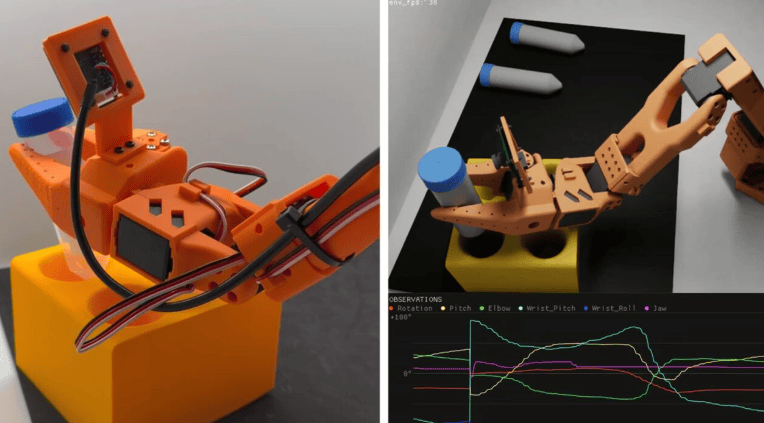
The core entry point of this collaboration is Hugging Face's open-source robotics library, LeRobot. LeRobot is used for training, running, and sharing robot datasets, models, policies, and workflows. NVIDIA integrates capabilities such as Isaac GR00T 1.7 and Isaac Teleop into it, enabling developers to complete data collection, data standardization, model post-training, performance evaluation, and deployment in a unified process. For robotics development, the difficulty lies not only in the model itself but also in data sources, simulation environments, real robot adaptation, task evaluation, and edge deployment. In the past, developers often had to handle hardware control, training frameworks, simulation tools, data formats, and deployment platforms separately, and the fragmented process increased costs. By placing robot models, data, simulation, and deployment tools into an open workflow, NVIDIA and Hugging Face are essentially opening the chain of large model development for robotics to the open-source community.
Isaac GR00T 1.7 is a key model in this collaboration. It is an open visual-language-action model designed for humanoid robots, helping developers adapt the model to new robot forms and task scenarios.
Robot foundation models differ from AI models that only process text or images. They need to understand the relationships between visual input, language instructions, robot body states, and action outputs, and convert the results into executable motion strategies. Actions such as grasping, moving, turning, obstacle avoidance, placing, opening doors, and organizing objects require the model to form a closed loop between perception, reasoning, and control. NVIDIA's GPU, CUDA, Isaac Sim, Isaac Lab, and Jetson platforms provide training, simulation, accelerated computing, and edge deployment capabilities; Hugging Face offers model hosting, dataset sharing, open-source collaboration, and developer distribution channels. When combined, robot companies, research institutions, and developers can more quickly access models, data, and training tools, rather than starting from scratch by building underlying frameworks.
Isaac Teleop handles the robot data collection phase. This framework helps developers collect high-quality human demonstration data through external devices and integrate it into LeRobot in a standardized, interoperable format. Robot training heavily relies on action data, especially human demonstration trajectories, grasping actions, operation processes, and failure samples; the more standardized this data is, the higher the efficiency of model reuse and community collaboration.
NVIDIA also plans to introduce Cosmos 3 into LeRobot. Cosmos 3 is a world foundation model for physical AI, used to generate and augment robot data, simulate scenarios, and support policy development when real-world data is insufficient or collection costs are too high. Robot training is often limited by the cost of real data collection, especially in dangerous scenarios, complex working conditions, and low-frequency tasks. Simulation and synthetic data can supplement training samples, helping the model complete more validation before being deployed on physical robots.
This collaboration will advance open-source robot model training from "single-point model release" to an integrated process of "model, data, simulation, post-training, evaluation, and deployment." Subsequent focus will be on the adaptation effectiveness of GR00T 1.7 on different robot bodies, the data collection quality of Isaac Teleop, the data generation capability of Cosmos 3 after being integrated into LeRobot, and the deployment performance of visual-language-action models on edge platforms such as Jetson.