China's Micro LED Optical Interconnect Company Nexilumen Completes Tens of Millions of Yuan in Seed Funding
en.Wedoany.com Reported - Nexilumen (Shanghai) Technology Co., Ltd. recently announced the completion of tens of millions of yuan in seed funding, jointly invested by Fudan Sci-Tech Innovation and Furong Investment. The company's global brand is Nexilumen, co-founded by a team led by Professor Tian Pengfei from Fudan University and a team led by Professor Shen Bo from Peking University.
The core technical team previously published a research result in *Nature Communications*, focusing on a long-wavelength InGaN Micro LED optical interconnect platform based on diamond substrates. This platform integrates long-wavelength InGaN Micro LEDs, diamond heterogeneous integration, transfer printing, and optical communication into a unified technical system. Nexilumen's core competitiveness lies in the deep integration of Micro LED display technology with optical communication technology. Micro LEDs, characterized by threshold-free operation, extremely small device capacitance, excellent CMOS compatibility, and inherent two-dimensional scalability, are considered ideal light sources for building high-density optical interconnect architectures.
Previously, high-speed optical interconnect research has largely focused on blue and green short-wavelength devices. Long-wavelength yellow and red Micro LEDs, due to lattice mismatch and polarization effects caused by high indium content, have long had modulation bandwidths limited to the hundreds of MHz level, making it difficult to meet high-speed communication demands. Nexilumen's technical team, through the epitaxial design of superlattice strain-relief layers and triple quantum wells, grew high-quality long-wavelength InGaN epitaxial layers on silicon substrates. Subsequently, using transfer printing processes, the chips were integrated onto high-thermal-conductivity diamond substrates, and two-photon microlens manufacturing technology was employed to narrow the divergence angle and improve fiber coupling efficiency.
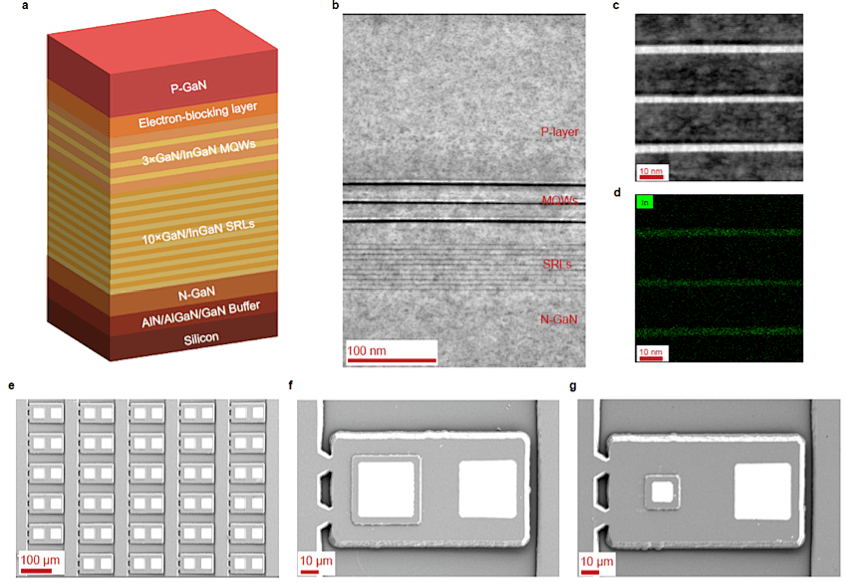
Measured data shows that at a current density of only 6.25 A/cm², a 20μm yellow Micro LED achieves an electro-optical modulation bandwidth of 2850.4 MHz, the highest reported globally for Micro LEDs under the same current density conditions. At a communication rate of 1.5 Gbps, the transmitter energy efficiency is as low as 0.056 pJ/bit, setting a new world record for the lowest power consumption in Micro LED optical interconnects. The introduction of the diamond substrate limits the device temperature rise to 2% to 8% of that on traditional glass substrates, effectively addressing the thermal management challenges under high-speed operation.
The team is currently advancing the monolithic and heterogeneous integration of CMOS driver circuits with Micro LED arrays. It is expected that a prototype optical interconnect system with a capacity of 1.6 Tbps will soon be constructed, providing an independently controllable solution for CPO co-packaged optics and chip-to-chip optical I/O in next-generation AI computing clusters.
Related Products


Industrial and Commercial Point-Type Gas Detector
Jinan Benan Technology Development Co., Ltd.
Automatic Aiming Laser Remote Obstacle Removal Robot
Pinggao Group Weihai High-Voltage Apparatus Co., Ltd.



TWP16 P-Band Tropospheric Wind Profile Radar
China Huayun Meteorological Technology Group Co., Ltd.