US-Swiss Universities Collaborate to Develop a Flapping-Wing Robot Capable of Swimming and Flying
en.Wedoany.com Reported - Engineers from the Massachusetts Institute of Technology (MIT) and the Swiss Federal Institute of Technology Lausanne (EPFL) have designed a robot capable of swimming underwater and flapping its wings to leap out of the water and fly, mimicking the behavior of diving birds. Named the "Flapping-Wing Aerial-Aquatic Vehicle" (FAAV), the robot weighs less than 300 grams and aims to help scientists study the flight mechanics of diving birds in both air and water. The robot consists of a central fuselage, two flexible flapping wings, and a steerable tail, with wings and tail that can be replaced with different sizes as needed.
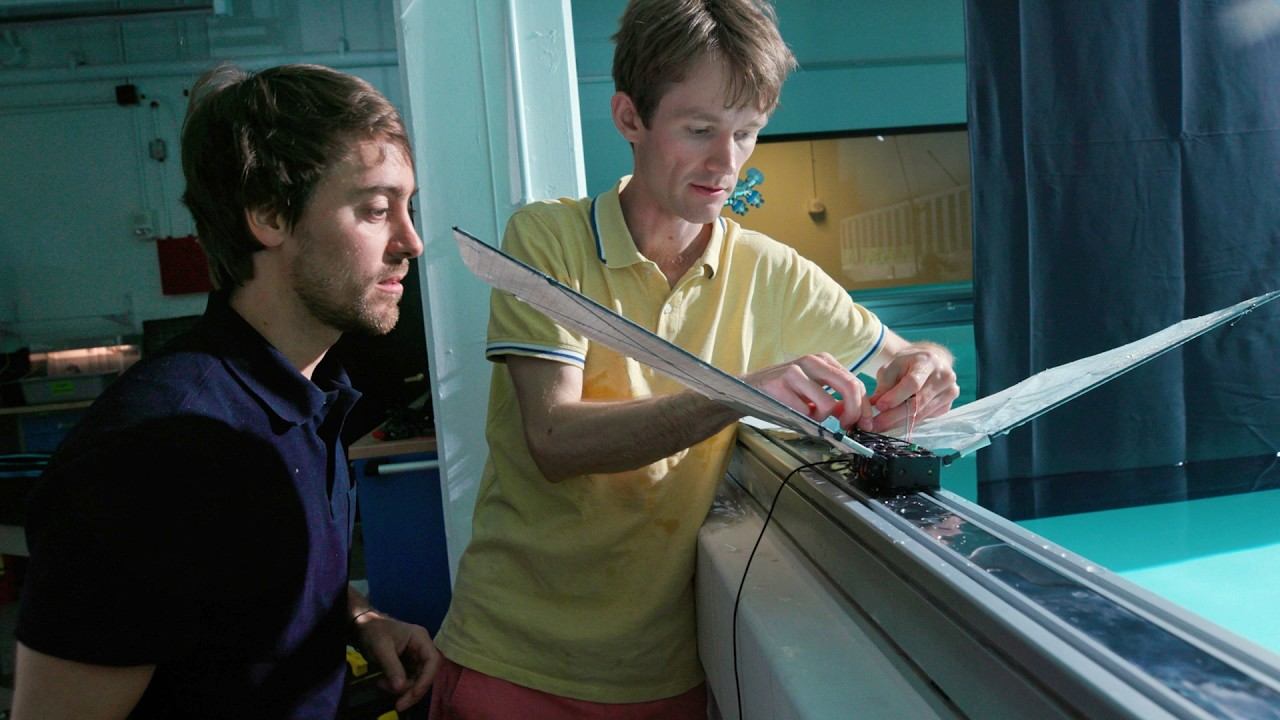
In experiments conducted in a small pool and Switzerland's Lake Geneva, engineers determined the combination of wingspan size, flapping frequency, and tail angle that enables the robot to smoothly transition from swimming underwater to breaking through the water surface and flying into the air. The research findings were published in the journal Science. Raphael Zufferey, an assistant professor of mechanical engineering at MIT, stated that this design may help understand how diving birds adjust their flight mechanics to adapt to both air and water, and could also lead to new types of aerial-aquatic drones and vehicles. Zufferey is the lead author of this new study, with co-authors from EPFL and the Northwest Indian College in Bellingham, Washington. Researchers envision that oceanographers, marine biologists, and coastal community members could launch this winged robot from a ship or shore, fly it near hazardous waters such as icebergs or whale pods, dive in to collect samples, and then fly back to transmit data, at a cost far lower than traditional methods.
The research team reviewed scientific literature to compile data on diving birds such as puffins, petrels, and kingfishers, finding that smaller birds flap their wings at about 10 times per second in the air and about 4 times per second in water. Based on this, the team developed a robot with a flapping frequency similar to that of real diving birds. The robot's fuselage houses a battery and a waterproof motor that drives a crankshaft to push the film wings, coated with hydrophobic nanoparticles, up and down at a preset frequency, while the tail can change angle to assist flight. The researchers created and tested three sets of wings: small (60 cm wide), medium (80 cm wide), and large (100 cm wide). During tests, the robot was placed about half a meter underwater, with wings flapping at a specific frequency and the tail tilted at a specific angle. Results showed that when flying with medium-sized wings, the robot could reliably fly, swim, and transition between water and air, requiring the wings to be both flexible and sturdy.
When flapping at a frequency of about 5 Hz, the robot reached a speed of nearly 1 meter per second in water and about 6 meters per second in air, similar to real diving birds. To achieve the water-to-air transition, the robot needed to pitch at a 70-degree angle to prevent the wingtips from touching the water surface. The study also found that this size combination allowed the robot to exit the water and fly without needing to paddle with its feet, as birds like puffins do. In the future, the team will improve the wing design to add steering capabilities and test performance under turbulent conditions, ultimately aiming to deploy the vehicle to aid marine science research. This work was partially supported by a Marie Skłodowska-Curie Actions fellowship.
Related Products


High-Speed Flexible Fully Automatic Stamping Production Line
JIER Machine-Tool Group Co., Ltd.

Excavator Bucket Teeth Heat Treatment Production Line
Suzhou Hezhongju Intelligent Equipment Co., Ltd.



Pneumatic high-pressure wear-resistant ball valve
Zhejiang Deca Control Valve Meter Co., Ltd.
QLZNGJ Intelligent Steel Reinforcement Trolley
Luoyang China Railway Qiangli Machinery Co., Ltd.